Fabric Width Conversion Calculator
Convert original yardage to a new fabric width, then account for usable selvedge loss, piece count, repeat matching, nap direction, seam allowance, waste, and bolt rounding.
Load a common fabric swap, then tune the inputs for your exact fabric label width and usable cut width.
Conversion breakdown
Formula used
Equivalent length = original length x original usable width / new usable width.
Allowances are added after the width conversion so the base area stays clear.
Usable width
Usable width subtracts both selvedges.
A 54 in bolt with 0.75 in lost per side gives 52.5 in of planning width.
Repeat matching
Each piece can round up to the next full repeat.
Large repeats add length fastest when the project has many separate pieces.
Bolt conversion
The final result rounds to common store cuts.
Use 1/4 yard for most fabric counters or full yard for roll ordering.
| Width swap | Starting length | Width-only conversion | Common use |
|---|---|---|---|
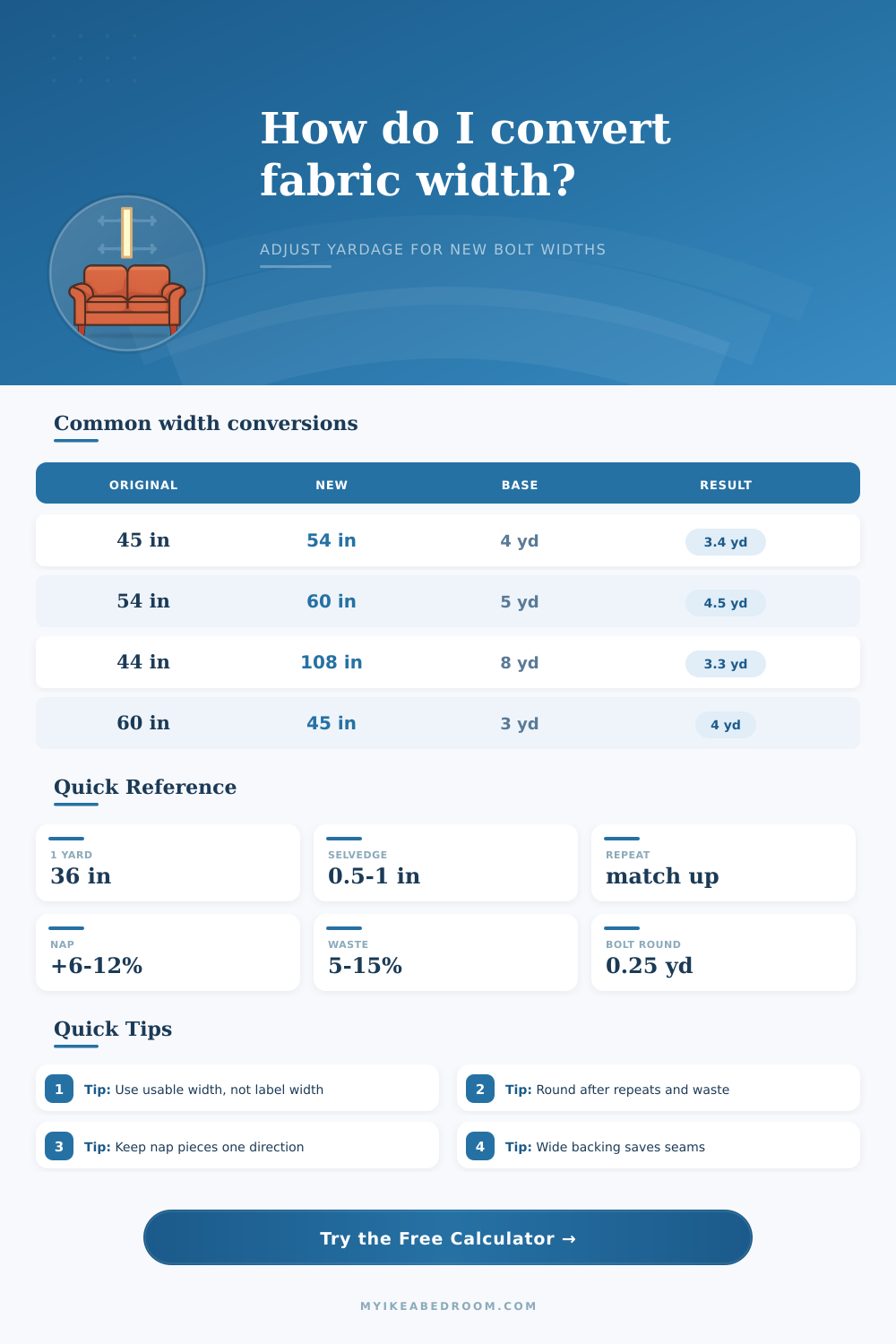
| 45 in to 54 in | 4 yd | 3.33 yd | Upholstery, pillows, slip seats |
| 54 in to 45 in | 4 yd | 4.80 yd | Decor fabric swapped to narrower cotton |
| 54 in to 60 in | 5 yd | 4.50 yd | Drapery and wide sheers |
| 44 in to 108 in | 8 yd | 3.26 yd | Quilting cotton to wide backing |
| 60 in to 45 in | 3 yd | 4.00 yd | Canvas or apparel to narrower goods |
| Fabric family | Label width | Typical usable width | Selvedge note |
|---|---|---|---|
| Quilting cotton | 44 to 45 in | 42 to 43.5 in | Trim both printed edges before piecing |
| Home decor cotton | 54 in | 52 to 53 in | Check woven edge thickness |
| Drapery fabric | 54 to 60 in | 52.5 to 58.5 in | Directional prints may need one-way cuts |
| Fashion fabric | 55 to 60 in | 53 to 58.5 in | Knits can curl at the edge |
| Wide quilt backing | 104 to 118 in | 102 to 116 in | Square the cut ends before loading |
| Pattern repeat | Added per piece | Best used for | Planning note |
|---|---|---|---|
| 0 in | 0 in | Solids, small textures | No repeat matching needed |
| 4 to 8 in | Up to one repeat | Small prints, ticking stripes | Usually modest extra length |
| 12 to 18 in | Up to one repeat | Florals, medallions, checks | Match visible panels first |
| 24 in or more | Up to one repeat | Large drapery motifs | Piece count strongly affects yardage |
| Order unit | Increment | Equivalent | When to use |
|---|---|---|---|
| Fine cut | 1/8 yd | 4.5 in | Small projects and trim pieces |
| Standard cut | 1/4 yd | 9 in | Most fabric counter purchases |
| Generous cut | 1/2 yd | 18 in | Directional prints and home textiles |
| Roll planning | 1 yd | 36 in | Large bolts, drapery, upholstery runs |
When buying fabric for a sewing project, one has to calculate the amount of fabric that is needed for a project. Many people may believe that using the mathematical equation to calculate the amount of yardage for a project is the best way to calculate the amount of fabric to purchase. However, using the total area of a fabric project to calculate the amount of yardage of fabric to purchase is an incorrect method for purchasing fabric.
If people use this equation to calculate the amount of yardage of fabric to purchase, it is possible that the fabric purchased will be to short for the sewing project. Thus, people must understand that the width of the fabric can play a role in the yardage of fabric that is purchased for they sewing project. One factor that a person has to consider when purchasing fabric is the usable width of the fabric.
How to Figure Out How Much Fabric to Buy
The width of the fabric that is listed on the label of the fabric may not be the usable width of that fabric. For example, the fabric may be labeled as being 54 inches in width. However, that width may be the width of the selvedges of the fabric.
Selvedges are the edges of the fabric that is created during the manufacturing process of the fabric. Those selvedges contain pin holes and other elements that make the selvedge portion of the fabric unusable for the sewing project. Thus, the width of the selvedges have to be subtracted from the total width of the fabric to determine the usable width of the fabric.
Additionally, another factor to consider is the pattern repeats of the fabric. If the fabric contains a printed motif, such as a floral motif or a geometric motif, then the pattern pieces that a person is to create for the sewing project cannot be placed anywhere on the fabric. The motif has to be aligned correct with the other pieces of the same pattern so that when the project is complete, the pattern looks even.
To even this out, people have to sacrifice some inches of fabric to ensure that the patterns align correct. Thus, the number of fabric pieces that is to be cut will impact the total amount of fabric required for the sewing project. Another factor to consider is the nap of the fabric.
The nap of the fabric is the direction in which the fibers of the fabric lie. For fabrics like velvet and corduroy, if you rotate the pieces of a pattern with respect to each other, the nap of the fabric may make it so that the velvet or corduroy fabric pieces appear to be of different color. The direction of the nap has to be considered when purchasing the amount of fabric needed.
Thus, people will have to purchase more fabric to ensure that the pattern pieces are laid in the same direction as each other. Furthermore, another consideration is for wasted fabric due to mistake in the sewing process. During the sewing process, one may make a mistake with the fabric pieces.
For instance, when cutting the fabric, it is possible to make a stray cut that ruin the fabric. Any such mistake can ruin the sewing project. Thus, people have to purchase additional fabric to allow for mistakes in the sewing process.
The fabric calculator helps people take into account the usable width, pattern repeats, and the nap of the fabric to ensure that they have the necessary amount of fabric for the project. Finally, one has to round the amount of fabric calculated for a project to the nearest increment in which the fabric stores sell the fabric. For instance, fabric stores may sell fabric in increments of 0.25 yards or 0.125 yards.
Thus, if the calculations of the amount of fabric required for a sewing project comes to 1.225 yard, it would not be possible for the individuals to purchase that amount of fabric. Therefore, the amount would have to be rounded up to the nearest increment to which the fabric store sells the fabric. Thus, by considering each of these factors, people will be able to purchase the most correct amount of fabric for there sewing project.