Fabric Shrinkage Calculator
Compare original fabric dimensions with washed measurements or known shrink percentages, then size raw cuts for curtains, bedding, cushion covers, slipcovers, muslin tests, and washable home textiles.
Load a common sewing or home textile scenario, then adjust the measurements, fabric type, grain direction, seam allowance, and buffer to match your project.
Fabric shrinkage breakdown
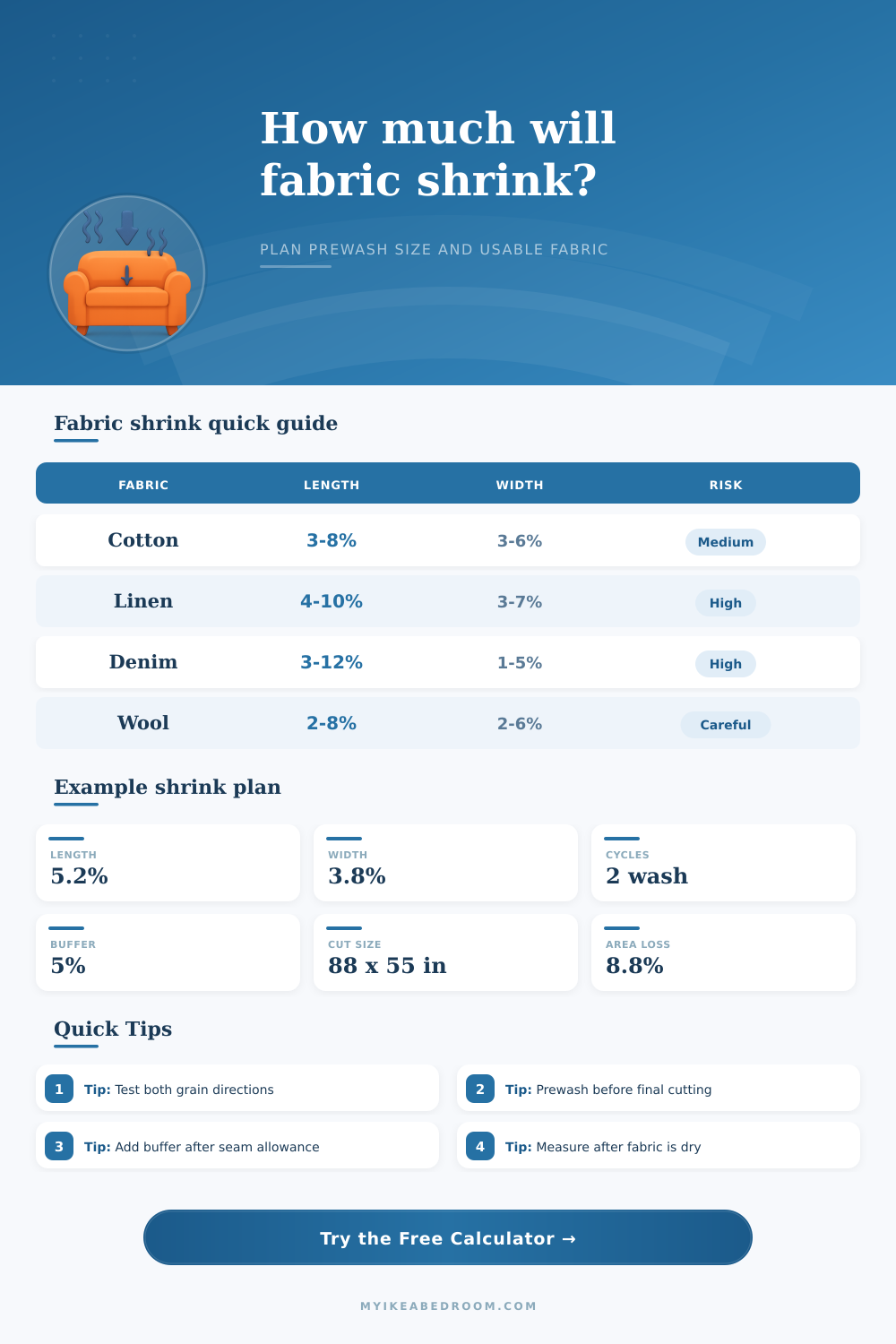
| Fabric type | Typical length shrink | Typical width shrink | Planning note |
|---|---|---|---|
| Cotton curtain panel | 3% to 8% | 3% to 6% | Warm wash and full drying usually reveal most shrink. |
| Linen bedding | 4% to 10% | 3% to 7% | Expect more change in loose weaves and tumble drying. |
| Denim slipcover | 3% to 12% | 1% to 5% | Twill may shrink more along length than width. |
| Wool blend cushion | 2% to 8% | 2% to 6% | Use gentle care; agitation can change shrink behavior. |
| Muslin prewash | 5% to 12% | 4% to 9% | Good test cloth for checking pattern and seam allowances. |
| Prewash cycles | Expected result | Calculator factor | Best used for |
|---|---|---|---|
| No prewash yet | Plan for full potential shrink | 1.00x | Estimating raw yardage before cutting or washing. |
| 1 wash cycle | Most first-shrink appears | 1.00x | Everyday cotton, curtains, bedding, and covers. |
| 2 wash cycles | Small extra settling | 1.08x | Linen, flannel, muslin, denim, and washable covers. |
| 3 wash cycles | More stable sizing | 1.12x | Projects where fit tolerance is tight after laundering. |
| Grain direction | Length adjustment | Width adjustment | Use case |
|---|---|---|---|
| Balanced warp and weft | 1.00x | 1.00x | General home fabric panels and square sample testing. |
| Lengthwise priority | 1.08x | 0.96x | Curtains, duvet length, bed skirt drops, long covers. |
| Crosswise priority | 0.96x | 1.08x | Wide cushions, headboards, valances, bench panels. |
| Bias or diagonal pieces | 1.12x | 1.12x | Diagonal seams, shaped covers, curved textile panels. |
| Project piece | Common tolerance | Buffer range | Measurement note |
|---|---|---|---|
| Curtain panel | Length is critical | 3% to 7% | Measure after hemming allowance is included. |
| Bedding panel | Width and length both matter | 5% to 10% | Account for duvet loft, pillow depth, or mattress wrap. |
| Cushion cover | Small fit changes show quickly | 4% to 8% | Keep grain consistent across front, back, and boxing. |
| Slipcover section | Fit depends on joined panels | 7% to 12% | Test a sample before cutting multiple matching pieces. |
Low movement
0% to 3%
Typical for polyester, outdoor synthetic cloth, stabilized blends, and already laundered fabric.
Moderate movement
3% to 6%
Common for cotton curtains, washable pillow covers, quilting cotton, and standard home textiles.
High movement
6% to 10%
Plan extra raw size for linen bedding, flannel sheets, muslin tests, and many rayon fabrics.
Test first
10%+
Use a larger wash sample before cutting denim, loose weaves, bias pieces, or fitted slipcovers.
Shrinkage occur with fabric because the fabric are comprised of fibers that is under tension. The fibers of the fabric will relax when the fabric is exposed to water and heat. The relaxing of the fibers of the fabric can cause the dimension of the fabric to change.
The changes in the dimensions of the fabric is referred to as shrinkage. When sewn project are washed, it is common for those projects to shrink in size. In order to avoid having a sewing project become too small after it is completed and washed, it is important to account for fabric shrinkage prior to cutting the fabric.
How to Deal with Fabric Shrinkage
Fabric is not a monolith; rather, it is an architectural grid made up of warp thread and weft threads. Each of these types of threads can shrink at a different rate than the other type of thread. For instance, denim tend to shrink in one dimension more then in the others.
Because warp and weft threads can shrink at different rates, it is important to measure the length and the width of the fabric prior to cutting. One way to determine the exact shrinkage percentage of a fabric is to perform a sample test. Cutting a small square of the fabric, you can wash the sample square using the same settings as the sewing project.
Once you wash the fabric, you can measure the dimensions of the square again to compare to the original measurement. Percentage shrinkage can then be calculated from these measurements. Fabrics has different types of fibers.
Cotton and linen fabrics tend to shrink and linen continues to shrink over several washings of the fabric. Synthetics are stable and dont shrink much when washed. It is important to determine which dimension of the project is the most important.
For projects that are long in one dimension, such as a curtains, that most important dimension will be the length of the curtain. For projects like cushion, the width may be the most important dimension. Providing extra fabric to the most important dimension prior to sewing can protect the project from shrinkage after the project is sewn.
In addition to accounting for fabric shrinkage, it is also helpful to incorporate a safety buffer into the calculations for the project. A safety buffer is an additional amount of the fabric that is provide beyond the amount that is required for the project. Additional fabric can account for unexpected changes to the fabric, such as heat in the dryer or differences within batch of fabric.
It is also possible to prewash all of the fabric prior to cutting it. However, it isnt easy to prewash all of the fabric. Additionally, prewashing the fabric can skew the grain line of the fabric.
An alternative to prewashing the fabric is to calculate the shrinkage percentage of the fabric and cut the fabric pieces to be more larger than the pattern requires. In order to ensure that the sewing project will turn out correctly once the fabric is washed, it is important to follow a few step prior to sewing the project. First, determine the shrinkage percentage of the fabric.
Second, add the seam allowances to the measurement on the pattern. Third, add a safety buffer to the measurements. Finally, add the shrinkage percentage to the total measurement of the project.
Following these steps will ensure that the dimensions of the sewing project will be correct after the project is washed and the fabric shrink.