Fabric Repeat Calculator
Plan patterned fabric cuts by rounding each panel to the vertical repeat, checking horizontal motif width, adding half-drop offsets, lining yardage, and waste allowance.
Load a patterned fabric scenario, then adjust panel size, repeat spacing, lining, and matching style to fit your project.
Cutting breakdown
| Vertical repeat | Typical fabric | Cutting effect | Best use |
|---|---|---|---|
| 0 to 3 in | Plain, small texture | Little repeat waste | Panels, cushions, shades |
| 4 to 12 in | Stripe, small geometric | Moderate rounding per drop | Roman shades, cushions |
| 13 to 24 in | Botanical or damask | Visible extra yardage | Drapery pairs, valances |
| 25 in and up | Large scenic print | Plan motif placement first | Feature panels, half-drop |
| Matching style | What gets aligned | Waste tendency | Use when |
|---|---|---|---|
| No match | Length plus hems only | Lowest | Texture, solids, random print |
| Vertical repeat | Panel bottoms and motif height | Low to medium | Single panels or shades |
| Side-by-side | Motifs across adjacent panels | Medium | Curtain pairs, wide windows |
| Plaid or stripe | Vertical and horizontal repeat | Highest | Checks, grids, strong stripes |
| Lining choice | Layer multiplier | Repeat matched? | Calculator treatment |
|---|---|---|---|
| No lining | 0 | No | Face fabric only |
| Plain lining | 1 | No | Base cut length by drops |
| Blackout lining | 1.05 | No | Adds a handling allowance |
| Interlining plus lining | 2 | No | Two plain layers estimated |
| Preset | Panel length | Repeat | Planning note |
|---|---|---|---|
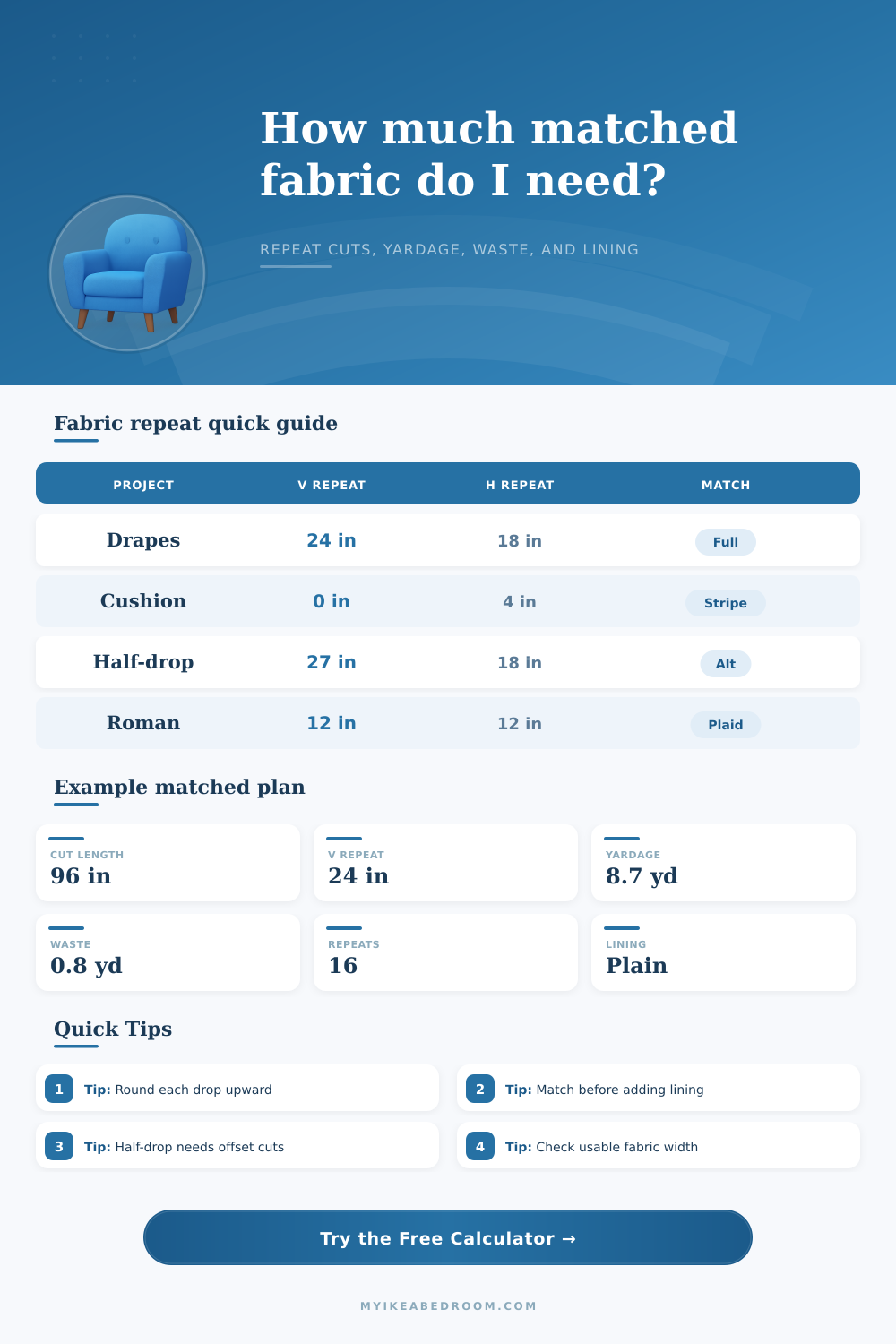
| Large floral drapery | 96 in | 27 in | Round every drop upward |
| Striped cushions | 18 in | 0 in | Horizontal repeat matters most |
| Half-drop print | 90 in | 25.5 in | Alternate drops need offset |
| Plaid roman shade | 62 in | 12 in | Check both repeat directions |
No match
Uses the raw panel length plus hems. Best for solids, textures, and random prints.
Lowest yardage, but motifs may land differently from panel to panel.
Vertical repeat
Rounds the cut length up to the next full repeat. Best for roman shades and single panels.
Creates even motif height without forcing horizontal alignment.
Side match
Rounds length and panel width to repeat units. Best for paired drapes and joined widths.
Adds width planning so motifs can continue across panels.
Half-drop
Adds a half-repeat offset for alternate panels. Best for wallpaper-like fabric repeats.
Useful when motifs stagger instead of stacking in straight columns.
When sewing curtains with pattern fabric, account for the vertical repeat of the fabric pattern. The vertical repeat is a measurement between two identical point within the fabric design. Patterned fabric dont continue in a straight line; instead, it features repeating design cycles.
If you dont account for these vertical repeats, your curtain panel may feature misaligned design elements. For example, one curtain panel may feature a flower motif at the beginning of the curtain panel while the next curtain panel feature a stem at the beginning of the curtain panel. Many individuals will measure the width of the window in which the curtains will go and add inches for the hems of the curtains.
How to Measure and Cut Patterned Fabric for Curtains
This is only necessary for solid fabric. For patterned fabric, you must calculate the vertical repeat of the pattern to determine the length of the fabric that you will need to purchase. If you would like your curtains to be ninety inches in length and the vertical repeat of the fabric is twenty-four inch, you wont be able to cut the fabric to ninety inches.
You will have to round down to the nearest even twenty-four inch measurement, meaning that you will have to purchase more fabric than the width of the window. To determine the length of fabric that you will need to purchase, calculate the length of the curtains that you would like to make and the length of the hems of the curtains. Once you have the length of the curtains and the hems in inches, use the vertical repeat of the fabric pattern to determine to which length you will have to cut the fabric.
Round the length to which you will cut the fabric to the nearest inch upward to allow for the pattern of the fabric to be continuous from one curtain panel to the next. Do not truncate the pattern. Another element to consider when using patterned fabric is the way in which the pattern elements align horizontal with the curtain panels.
Some fabrics has stripes while others have complex botanical designs that must align from one curtain panel to the next. If you choose the side by side curtain panel option, you will have to round the horizontal measurements of the curtains to the nearest horizontal repeat of the fabric pattern. Rounding to the nearest horizontal repeat may produce more fabric trim waste.
For fabrics with plaid or check patterns, you will have to round both the horizontal and vertical measurements to the nearest repeat of the design. A misalignment of the plaid pattern will be more noticeable than a misalignment of a random floral pattern. Some patterned fabrics use a half-drop layout.
With a half-drop layout, the design elements of the fabric are not aligned in straight columns but are offset from one another to create the appearances of an organic fabric design. This half-drop layout means that the alternate panels for the curtains will start half of the design element repeat lower than the first panel. You will have to account for this offset in the total yardage of the fabric that you will purchase.
You must be disciplined in the starting marks of the panels of fabric. The lining of the curtains does not require the same consideration of the pattern as the curtain panels. For the lining panels, use plain cotton fabric or blackout lining fabric.
Plain cotton and blackout fabric will be duplicated in length to the curtain panels. However, if you select blackout fabric, a small percentage of the lining will need to be purchased in excess to the length of the curtain panels because blackout fabric can be slippery and difficultly to sew. It is normal for fabric to waste during the sewing process.
Fabric waste can result from the need to round curtain measurements to the nearest fabric pattern repeat and as a direct result of cutting the fabric to the required panels. Eight to ten percent of the total yardage of the curtains can be wasted. If the curtains will feature a large scenic print in the fabric panels, more fabric waste may be required.
It is better to have excess fabric than to be short of the amount of fabric that are required for the curtains. The most important measurement in the sewing of curtains from patterned fabric is the repeat adjusted cut length of the curtain panels. This measurement will allow you to calculate the number of repeats of the pattern that you will purchase and the amount of the curtain panels that will be wasted in the cutting process.
You must round the measurements of the curtains upward to account for the pattern of the fabric panels. By rounding the measurements of the curtain panels to the nearest inch, you create a plan for the curtains that will ensure that each element of the pattern remains in the proper position.