Eye Level Calculator
Set wall-mounted art, mirrors, TVs, and grouped pieces by standing eye height, seated eye height, viewer distance, furniture height, object size, room use, and preferred vertical offset.
Load a common room situation, then adjust the eye heights, distance, furniture height, object size, arrangement, and offset before marking the wall.
Placement breakdown
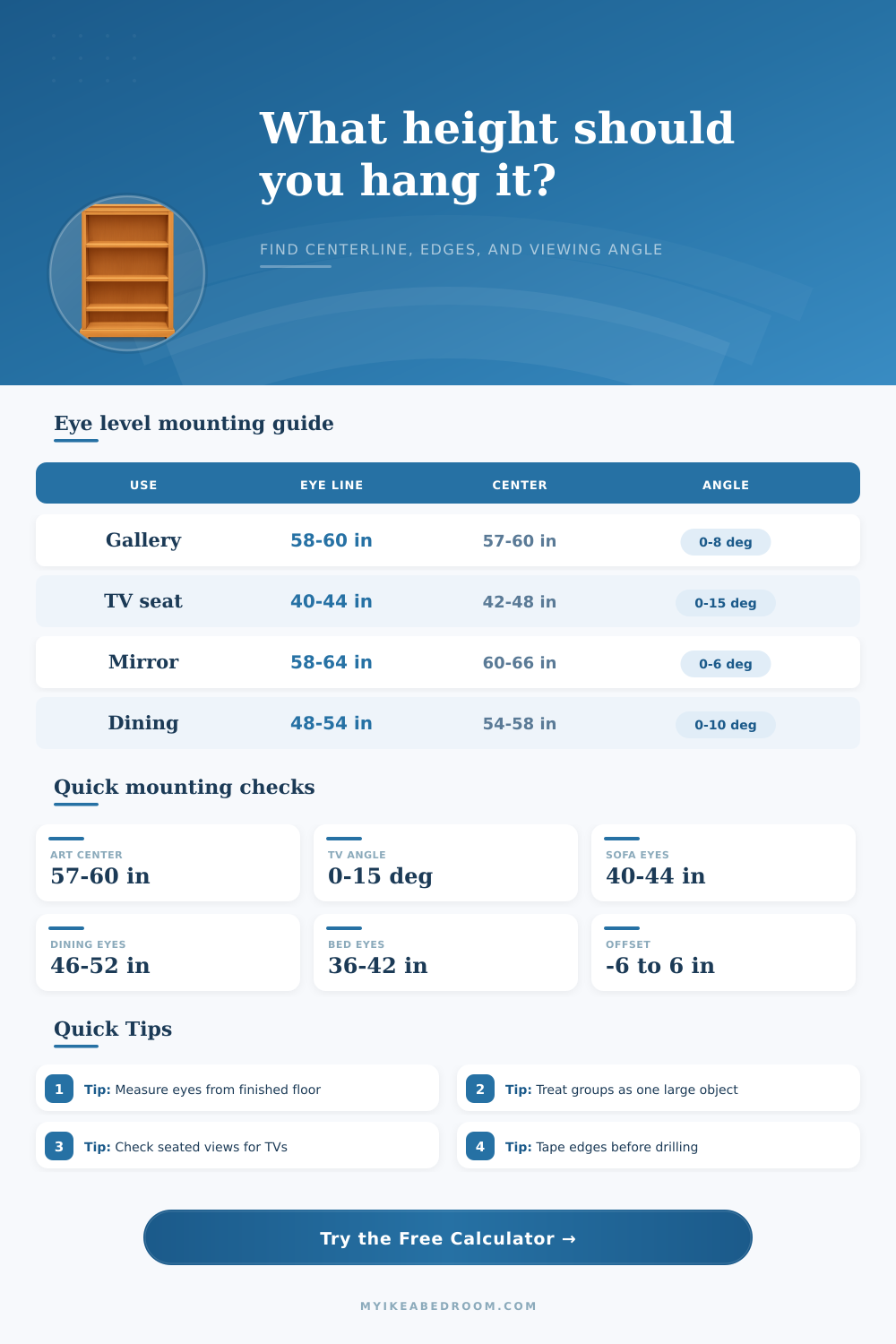
| Object type | Starting centerline | Best viewer | Adjustment note |
|---|---|---|---|
| Framed art or print | 57 to 60 in | Standing or mixed rooms | Use the center of the full frame or mat opening as the visual center. |
| Gallery wall group | 57 to 60 in | Standing circulation | Treat the whole grouping as one large rectangle before hanging pieces. |
| TV or media screen | 42 to 48 in | Seated viewers | Prioritize low viewing angle over a traditional gallery centerline. |
| Mirror | 60 to 66 in | Standing check point | Keep the face zone near eye height while clearing furniture below. |
| Nursery or kids art | 48 to 56 in | Adult plus child view | Stay above furniture reach and lower than a full adult gallery line. |
| Seat or posture | Typical eye line | Furniture height | Use case |
|---|---|---|---|
| Deep sofa lounge | 38 to 42 in | 30 to 36 in back | TVs, low art, and media wall placement. |
| Upright sofa or accent chair | 40 to 45 in | 30 to 38 in back | Living room art and conversation seating. |
| Dining chair | 46 to 52 in | 18 in seat | Dining room art viewed seated and standing. |
| Bed reading posture | 36 to 44 in | 36 to 54 in headboard | Art over beds, shelves, and bedroom TVs. |
| Desk posture | 44 to 50 in | 29 to 31 in desk | Office art, pin boards, and wall shelves. |
| Anchor below | Usual bottom gap | Centerline behavior | Placement watch |
|---|---|---|---|
| Sofa or sectional | 6 to 10 in | Often lower than pure standing eye level | Avoid raising art so high it detaches from the sofa. |
| Console or dresser | 4 to 8 in | Mirror or art may sit above a taller anchor | Check lamps, TVs, and objects on top. |
| Headboard | 6 to 12 in | Centerline depends on headboard height | Use a shorter object if the top nears the ceiling. |
| Crib or kids bed | 10 to 18 in | Mount higher than reach, lower than gallery art | Use secure hardware and avoid reachable cords. |
| No furniture | 18 in or more | Pure eye-level centerline | Keep bottom edge clear of baseboard and traffic. |
| Angle from eye | Feels like | Best for | Adjustment |
|---|---|---|---|
| 0 to 5 deg | Natural eye-level view | Art, mirrors, and frequent TV viewing | Ideal for long viewing sessions. |
| 6 to 10 deg | Slight upward look | Dining art, console art, and bedroom TVs | Usually comfortable at normal room distances. |
| 11 to 15 deg | Noticeable lift | TV above console or tall furniture | Use tilt hardware or lower the centerline if possible. |
| 16 to 20 deg | High wall position | Occasional viewing only | Increase distance, lower the piece, or reduce height. |
| Over 20 deg | Strained view | Decorative display rather than viewing | Choose a different wall or make the object smaller. |
Standing gallery line
Best for: Hallways, entries, and blank walls.
Priority: Center the full object near average standing eye height.
Watch: Furniture below can force the bottom edge upward.
Seated viewing line
Best for: TVs, media rooms, and sofa-facing art.
Priority: Keep the center close to seated eye height.
Watch: Tall consoles can create a steep viewing angle.
Furniture anchored
Best for: Dressers, sofas, beds, desks, and consoles.
Priority: Maintain a clean gap above the anchor below.
Watch: Keep the top edge from crowding the ceiling.
Grouped layout
Best for: Gallery walls, triptychs, and stacked pairs.
Priority: Use the combined group center, not each piece center.
Watch: Vertical groups get tall quickly and may need a lower start.
When you hang art on a wall, you must determine the correct height for the art piece so that the art look balanced in the room. Many peoples will attempt to hang art by guessing where the center of the art should be. Using this guess may cause the art to be hung either too high or too low on the wall.
If you hang the art too high, there may be empty spaces between the art and the furnishings in the room. Alternatively, if you hang the art too low, the art may appear as if it is slipping off the wall. Thus, you should use mathematical measurement to determine the proper height to allow the art to look balanced.
How to Hang Art at the Right Height
One common error is to use a single height measurement for all type of rooms in a house. Instead, you need to consider the eye level of the individual who will be in that specific room. For instance, using the standard of sixty inches for art galleries is only suitable for individuals who is standing.
In living areas, however, the individual is likely to be sitting in a chair. If you hang art to accommodate an individual’s standing eye level, the individual may need to tilt their head when they is sitting. Thus, you should hang the art according to the need of individuals who are either standing or sitting in the room.
The particular use of the room will dictate the height of the art. For instance, hallway will require that you hang the art to allow for individuals to stand in the hallway and view the art. However, bedrooms may require art to be hung to accommodate both standing and seated individuals in the same room.
An easy way to account for both of these need is to use a calculator that weigh each of these individual needs for eye level. Using such a calculator will ensure that the art does not end up too high above a couch or too low when hung beside a hallway. Another factor to consider when hanging art is the type of furnitures that will be located beneath the art.
Art should appear to be connect to the furnishings in the room. Most people hang art pieces to appear above a piece of furnishing in the room. Thus, simply using the guideline of the individual’s eye level may cause the art to appear detached from the furnishings.
To avoid this issue, you should ensure that there is a consistent gap between the bottom of the art and the top of the furnishings. This gap should be between six and ten inch high. To ensure the art is hung correctly relative to the furnishings, use the calculator to input the height of the furnishings and the desired gap.
Finally, if you are hanging a group of frames (often referred to as a gallery wall), you must consider the viewing angle of the individual who will view the art. Many individuals will hang each individual frame so that the center of each frame is even with the viewer’s eye line. This is incorrect, however, because the group of frame should be viewed as one large rectangle.
Determine the center of this large rectangle and arrange the frames within that large rectangle. Make certain to account for gap between each frame when calculating where the frames should be hung on the wall. Another viewing consideration is the viewing angle relative to the type of art that is to be hung on the wall.
For instance, you should hang mirrors so that an individual can view their own face when standing in the room. For televisions, however, you should hang the screen so that an individual does not strain their neck excessive when viewing the screen. An excessively steep viewing angle relative to the screen size indicates the screen is hung at the incorrect height within the room.
Adjustments to the television hanging may be required to fix this issue. Before driving a nail into the wall to hang the art, it is important to physically check where to hang the art using painter’s tape. Use the calculator to determine the top, bottom, and centerline of the art.
Place painter’s tape along the wall according to the calculations. Step back to the distance where you will be standing or sitting to view the art. If you need to tilt your head to view the art correctly, adjust the hanging of the art.
Trust the math for the first ten inches of hanging of the art, but trust your eyes for the last inch. By considering each of these factors, your art and any mirrors will be hung in the correct position.