Extending Table Leaf Storage Calculator
Measure drop-in, butterfly, gateleg, and self-storing dining table leaves, then check storage clearance, stacked thickness, extended seating, and room circulation before the next dinner setup.
Load a real dining table scenario, then fine-tune the leaf count, storage cubby, protective padding, and room clearance.
| Table Type | Typical Closed Size | Leaf Setup | Storage Note |
|---|---|---|---|
| Round pedestal | 42 to 48 in diameter | One 16 to 20 in butterfly leaf | Often self-stores below the top; verify hinge clearance. |
| Apartment rectangle | 48 to 60 in long | One 12 to 18 in loose leaf | Fits many wardrobe shelves if padded on all sides. |
| Family rectangle | 64 to 78 in long | Two 16 to 20 in leaves | Store flat or vertical with dividers to protect finish. |
| Console extension | 16 to 22 in deep | Three to five panels | Needs more stacked height than a standard leaf pair. |
| Gateleg table | 10 to 18 in closed width | Attached folding sides | No loose cubby, but check folded wall clearance. |
| Leaf Count | Minimum Stack Height | Practical Cubby Height | Best Storage Orientation |
|---|---|---|---|
| 1 leaf | Leaf thickness plus top pad | 4 to 5 in for most leaves | Flat shelf, table frame, or padded sleeve |
| 2 leaves | Two leaves plus separator pad | 6 to 8 in for 1.5 in leaves | Flat under-bed tray or divided cabinet shelf |
| 3 panels | Three panels plus two separators | 8 to 10 in for console panels | Stacked box with fabric between panels |
| 4 leaves | Four leaves plus three separators | 10 to 13 in for thicker tops | Vertical rack or deep cabinet with dividers |
| Extended Length | Comfortable Side Seats | With Both Ends | Room Length Target |
|---|---|---|---|
| 60 in | 4 side seats | 6 total seats | 132 in with 36 in ends |
| 72 in | 6 side seats | 8 total seats | 144 in with 36 in ends |
| 84 in | 6 side seats | 8 total seats | 156 in with 36 in ends |
| 96 in | 8 side seats | 10 total seats | 168 in with 36 in ends |
| 108 in | 8 side seats | 10 total seats | 180 in with 36 in ends |
| Location | Strength | Watch Point | Best For |
|---|---|---|---|
| Inside table frame | Leaves stay with the table | Measure rails, aprons, and hardware first | Butterfly and self-storing leaves |
| Closet shelf | Easy access and stable temperature | Door opening may be smaller than shelf width | One or two loose leaves |
| Under-bed tray | Good for long, flat leaves | Needs dust cover and enough pull-out length | Wide rectangular leaves |
| Vertical wall rack | Saves shelf area | Requires dividers and anti-tip support | Large multi-leaf sets |
| Dining cabinet | Close to the table | Check shelf sag and hinge intrusion | Finished leaves with sleeves |
Flat Shelf
Best finish protection when the shelf is deep enough and the leaf can slide without scraping side edges.
Vertical Rack
Good for tall cabinets and large sets, but every leaf needs a divider so panels do not rub together.
Under-Bed Tray
Works well for long leaves if the tray clears bed supports and leaves can be pulled out straight.
Inside Table
Most convenient for butterfly leaves, but the table frame must still close cleanly around the folded leaf.
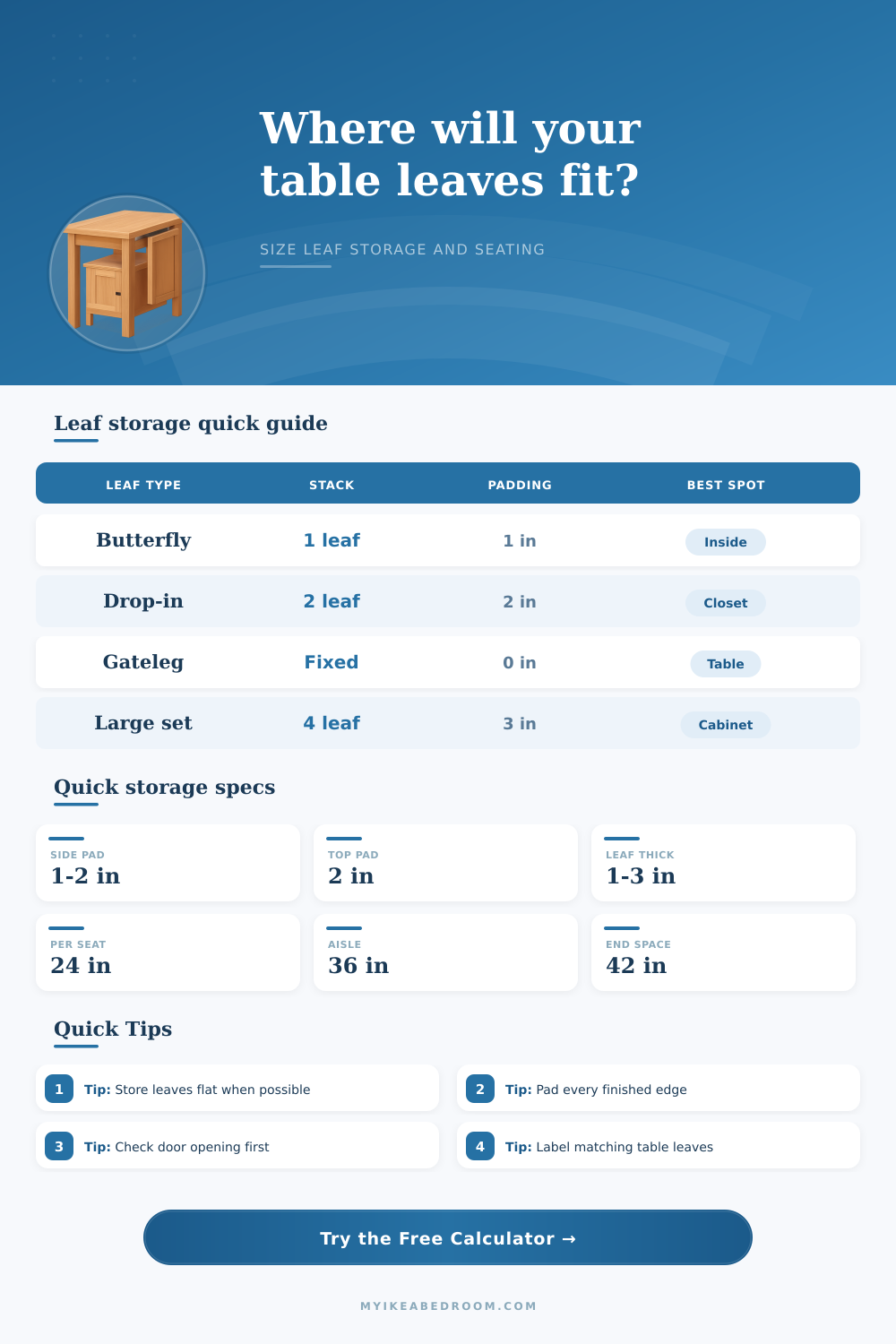
Measure the real opening, not the cabinet label. Hinges, face frames, closet tracks, and shelf lips often reduce the usable slot by an inch or more.
Keep finished faces separated. A thin felt layer or cotton sleeve between leaves prevents pressure marks when the stack sits for months.
So many times you get invited to a friend’s home for dinner and it is clear there are far more guests than seats available at their table. Food has been prepared and wine breathes while you stare at a tiny table that will only accommodate 4 chairs max. Then comes that usual problem; where did we store those leaves? Oh yes, they are in some back corner of the house. Now we hope the table will expand without damaging the finish or risking injury. It seems like such an easy fix until it don’t work out.
Stretching a table is less of a carpenter issue and more of a logistical one. Can you confirm your room will accept the extended size of the tables once expanded? How do you store these additional pieces so as not to take up valuable space in your home when not in use? There are plenty of people who purchases leaves before considering storage options (that is not the way to go).
Tips for Storing and Using Your Table Leaves
Here’s what I mean: a table leaf isn’t flat, it has depth (volume), edges, and a thickness. What if you’re using two at once for a dinner? You need to pad for the space between them otherwise, you’ll end up with pressure marks on your finish from the wood grain. The calculator I referred to above accounts for all this when you plug in how many leaves you’ll store, plus how much cushioning you want between them. Instead of guessing whether your closet shelf is thick enough, you punch in the bare measurements of each leaf plus the clearance you require around them. The tool then spits out whether youve got enough room to store them or if it’s simply too tight.
It’s not so much how many, but rather how thick they are. You can take a normal dining leaf, which is maybe an inch and a half thick. Add some felt separators for protection and side padding to keep the edges from chipping. Before you know it, the stack has grown! So now you’re not simply storing wood, you’re storing a protected piece of something that require space to breathe.
Jamming a set of four leaves in a shallow cabinet with no thought to dividers will result in pressure marks on your finish. And these aren’t apparent until months down the road when it comes time to use the leaves once more. It’s one of those little things that matter for keeping your furnitures looking good for years to come.
When the leaves come off and the table goes out, what’s next? Circulation. More floor space will be needed with a bigger table. This includes clearance between the chairs so they can be pulled back from the table without colliding with the wall (or someone coming through with a tray of appetizers). The most comfortable size is 24 inches per chair seat. But that’s based off assuming there’s sufficient aisle space behind each chair.
So if your dining nook is narrow, making it longer may mean narrowing the width of the area where people will sit, and that feels crowded. When considering required walkways and end clearances, the tool estimates how many people will fit comfortabley.
With gateleg tables, the leaves is attached and create a different feel. There are no loose panels to put away in another place. But you must still think about the wall clearance on either side when the sides fold down. Sometimes a dropped leaf will prevent the table from fitting through a door or bump into a radiator if space is tight. Check these things before you commit to the extension.
The convenience of butterfly leaves that are stored within the table frame is that they remain with the furniture. This can be particularly helpful if you don’t want extra pieces to hide. The downside is that interior measurements must be exact so that hinges do not bind when the table is closed.
And then there’s the big picture: Making the transition seamless. Who wants their table ruined? Who wants their living room turned into an obstacle course? Adding seating should of been no more difficult than that. If you think ahead about the extra space needed and where storage will go, you’ll have peace of mind. It becomes second nature instead of a frantic last-minute process.
The chairs fit (without cramping); the leaves slide out effortlessly; and everybody eats better.