Epoxy grout planning for wet rooms and dense tile
Epoxy Grout Coverage Calculator
Estimate epoxy grout coverage using tile module ratio, real fill depth, edge and texture adjustments, waste, kit size, and room temperature so unit staging feels closer to the jobsite.
Each preset loads a real epoxy grout scenario with tile size, joint width, texture factor, kit size, and temperature so you can compare backsplash, shower, floor, pool, and commercial layouts fast.
Epoxy is not the only grout on the shelf, but its stain resistance and dense fill behave differently enough that coverage, pot life, and cleanup planning deserve their own comparison.
Epoxy grout is a material that are used to fill the spaces between tiles. Furthermore, epoxy grout is a material that hardens very quick once you mix the epoxy grout. Consequently, the placement of the epoxy grout must be plan in a way that ensures that the epoxy grout does not harden prior to the placement of the epoxy grout into the spaces between the tiles.
Because epoxy grout is very dense and highly resistant to stains, it is an apropriate material to use in areas that are likely to become wet, such as wet room and kitchens. However, because epoxy grout is so dense, any plan to use the epoxy grout in these areas must also take into consideration the potential waste of the epoxy grout if it is not careful planned; the dense nature of the epoxy grout will require excessive scrubbing of the tiles if any epoxy grout is wasted. The amount of epoxy grout that is required to cover a floor based off the layout of the tiles is dependent upon the open joint ratio of the area to be tiled.
How Much Epoxy Grout Do You Need
The open joint ratio is the percentage of the area of a floor that will require epoxy grout to fill the joints between the tiles. For instance, floors that utilize small mosaic tiles will require more epoxy grout than floors filled with large porcelain slab due to the fact that there are more joints created by small tiles relative to large tiles. In addition to the size of the tiles, the width of the joints created between the tiles will also impact the amount of epoxy grout that is required to place into those joints.
Areas that utilize irregularly shaped tiles, such as hexagons or even pebbles will have a higher open joint ratio than areas with more regular shape. Similarly, areas that utilize long planks of tile will have a higher open joint ratio than areas that use other type of tiles because the long planks will create more ends that is to be cut in the placement of the tiles, and each end that is cut will create a joint. Beyond the joint ratios, the edge of the tiles also impact the amount of epoxy grout that must be purchased for a project.
Rectified porcelain tiles have straight edges, and will require less epoxy grout to adhere to those edges than tiles with irregular edges, such as those that have been pressed or handmade. Additionally, the texture of the floor will impact the amount of epoxy grout that must be purchased. For instance, textured porcelain floors will trap the epoxy grout within the groove of its texture, while polished glass tiles will allow the epoxy grout to easily be released from the tiles.
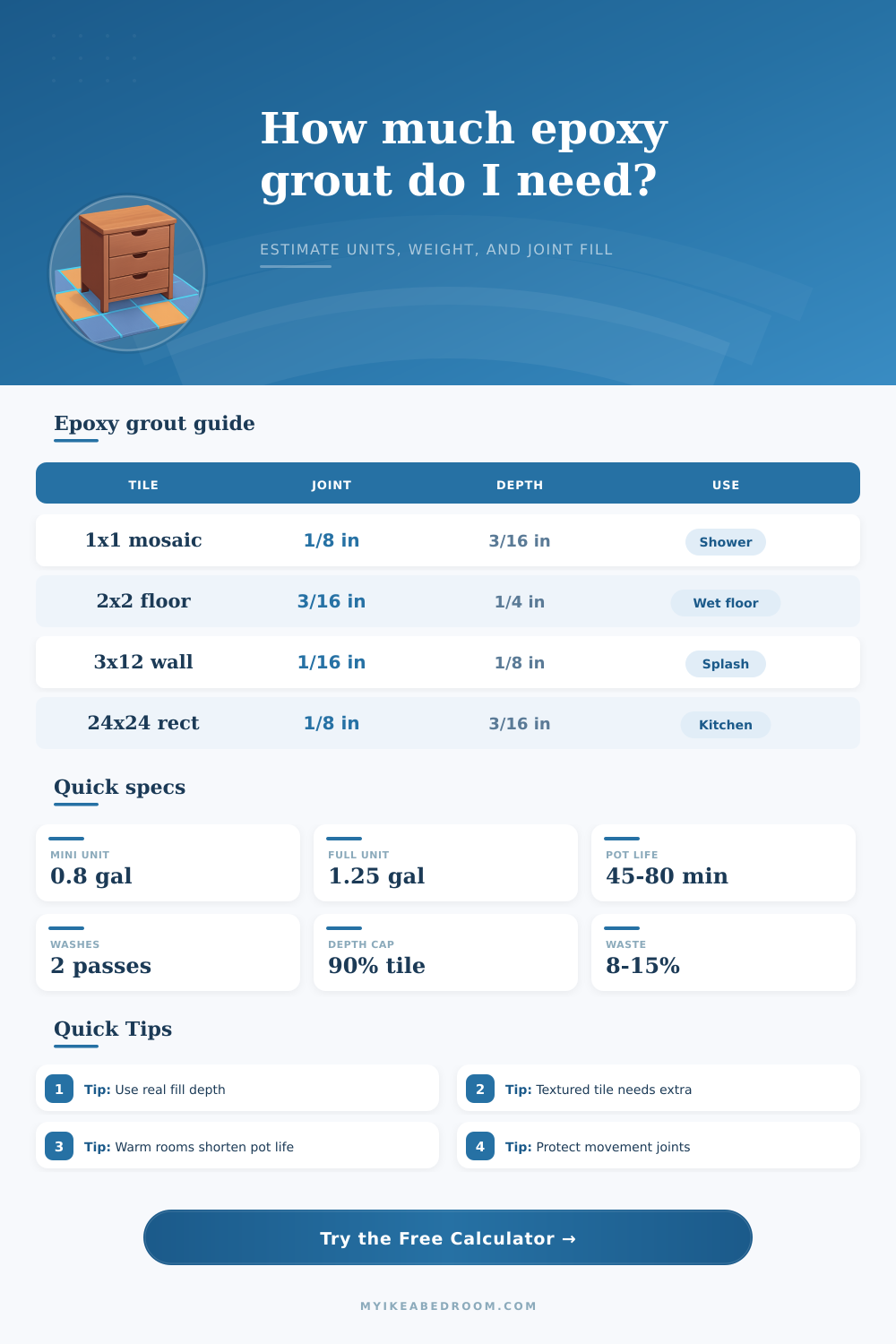
Grip tiles, however, will also trap epoxy grout. Finally, the temperature at which the epoxy grout is used will impact the amount of epoxy grout that is available; epoxy grout loses its “pot life” at higher temperature. For example, at room temperatures of 70 degrees F., the pot life of epoxy grout is approximately 80 minutes, but if the temperature is 90 degrees F., the life of the epoxy grout may decrease to 45 minutes.
Thus, it is necessary to account for the temperature of the area in which the epoxy grout will be used. Consequently, an 8 to 15 percent waste factor must be included in the calculation for the amount of epoxy grout that will be purchased; some of the epoxy grout may spill during the project, and some will be used to clean the tiles. It is also necessary to create batches of the epoxy grout so that they can be used at a rate that is consistent with the epoxy grout’s working time.
Each unit of epoxy grout weighs approximately 18 pounds. However, if the area that is to be tiled is particularly hot, or if the porcelain tiles to be tiled are of a heavier texture, the worker should batch the epoxy grout into smaller batches. Any movement joints in the tiled area must remain open and uncoated with epoxy grout because epoxy grout does not flex.
The amount of epoxy grout that is needed for any project can be adjusted according to the specific environment of the job site. For instance, mudrooms that have 8-by-48 inch planks will have many joints along the perimeter of those planks, and the textured nature of those planks will cause the epoxy grout to be absorbed into the texture of those planks. Another example of a job that may require adjustments to the amount of epoxy grout that is purchased is a pool waterline that consist of 1-inch glass tiles; the narrowness of the joints between the tiles will require more epoxy grout to be placed into those joints, especially given that the high levels of humidity and the sunlight that falls upon the pool will shorten the “pot life” of the epoxy grout.
Furthermore, it is also necessary to ensure that the joints are filled with epoxy grout to 90 percent of the thickness of the tiles; such a percentage will allow for the removal of haze caused by the epoxy grout, and will allow the epoxy grout to be easy polished. Many mistake can be made in the placement of epoxy grout. For example, individuals may overlook the texture of the tiles in a planned project; the texture of the tiles will require either more or less epoxy grout to adhere to the edges of those tiles.
Homeowners may measure the gross area to be tiled but fail to account for niches or benches that are to be tiled in the same project. Consequently, homeowners may underestimate the amount of epoxy grout that is needed for the entire area. Finally, many individuals may underestimate the impact that temperature can have on epoxy grout.
For instance, the epoxy grout may be allowed to set in the bucket of the homeowner due to the change in the temperature of the tile or the room in which the epoxy grout is prepared. Consequently, the epoxy grout should not be washed more than two times prior to the epoxy grout begins to harden. Epoxy grout is different than cement grout in that epoxy grout is heavier per unit of measurement, and epoxy grout will last the floor longer in areas that are exposed to harsh environment.
While cement grout is easier to spread on dry floors, cement grout does not have the same resistance against staining as epoxy grout. Thus, the epoxy grout that is selected will have to be chosen according to the level of exposure that the area will have, and according to the needs of the project itself. Epoxy grout is a durable material that is often used in wet room and kitchens due to the material’s resistance to staining.
However, care must be taken to calculate the necessary amount of epoxy grout to be used in an area; the coverage area of epoxy grout is dependent upon the layout of the area to be tiled, the texture of the tiles, the impact that the temperature will have upon the epoxy grout, and the waste factor that must be accounted for in the purchasing of the epoxy grout.