Entryway Hook Quantity Calculator
Estimate the hook count, spacing, usable rail length, rows, reach height, and coat or bag capacity for apartment entries, family drop zones, mudrooms, and child-friendly entry walls.
Load a real entryway scenario, then adjust the people, wall span, blocked trim space, hook spacing, and row plan to match your room.
Best for: family coats, bags, and daily loads.
Lets hooks share load across multiple fasteners and keeps spacing flexible.
Best for: light jackets, keys, and scarves.
Keep reserve hooks lower and avoid concentrated backpack loads.
Best for: mudrooms and heavy winter gear.
Works well with wide spacing and double rows for mixed users.
Best for: overflow items and renters.
Plan fewer hooks per row so swinging doors stay comfortable.
| Item type | Suggested centers | Typical row | Planning note |
|---|---|---|---|
| Keys, caps, scarves | 3 to 4.5 in | Low or side row | Useful as accessory hooks, not primary coat capacity. |
| Light jackets | 5 to 6 in | Adult row | Good for apartments and warm-weather entries. |
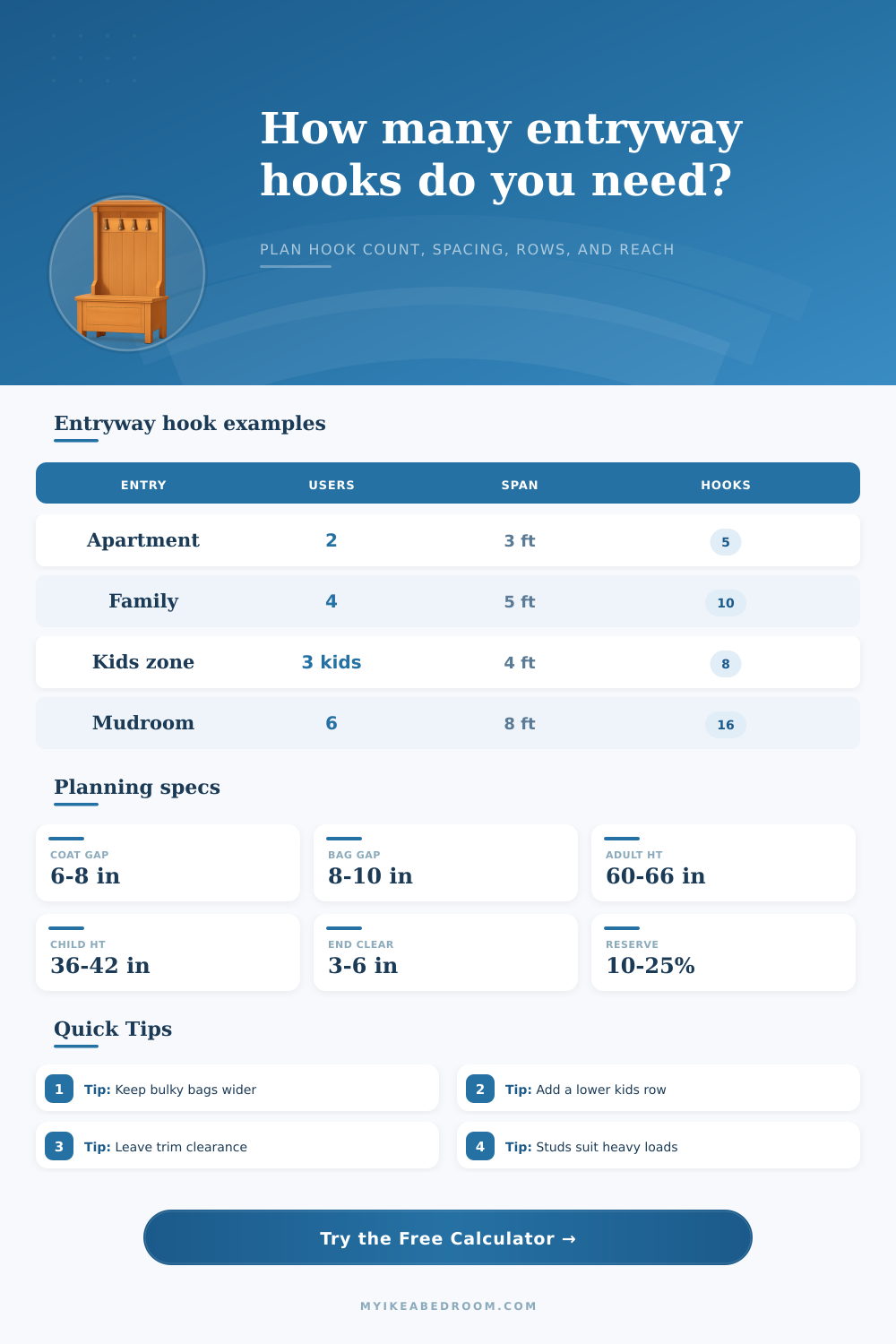
| Daily coats | 6 to 8 in | Adult row | Use this as the normal entryway default. |
| Bulky coats | 8 to 10 in | Adult row | Best for winter gear and hooks near benches. |
| Backpacks and totes | 9 to 12 in | Lower row | Give bags extra shoulder room so straps do not tangle. |
| User or item | Common height | Metric height | Use case |
|---|---|---|---|
| Adult coat row | 60 to 66 in | 152 to 168 cm | General coats, jackets, and hats. |
| Accessible reach row | 44 to 48 in | 112 to 122 cm | Comfortable forward reach for many users. |
| Child hook row | 36 to 42 in | 91 to 107 cm | Backpacks, coats, lunch bags, and school gear. |
| Bag or leash row | 42 to 48 in | 107 to 122 cm | Keeps bulky items below shoulder-height coats. |
| Usable rail length | 6 in centers | 8 in centers | Best fit |
|---|---|---|---|
| 24 in | 4 hooks | 3 hooks | Small entry or closet overflow. |
| 36 in | 6 hooks | 4 hooks | Apartment pair or guest rail. |
| 48 in | 8 hooks | 6 hooks | Family four daily coats. |
| 60 in | 10 hooks | 7 hooks | Bench wall with bags. |
| 72 in | 12 hooks | 9 hooks | Mudroom or shared hallway. |
| Entryway type | People and items | Typical hook count | Preferred row plan |
|---|---|---|---|
| Apartment entry | 2 adults plus bags | 5 to 7 hooks | One compact row with accessory hooks. |
| Family entry | 4 users plus guests | 9 to 12 hooks | Adult row plus lower bag or child row. |
| Kids school zone | 3 children | 6 to 9 hooks | Low row, wider bag spacing, clear names or zones. |
| Mudroom wall | 5 to 6 users | 14 to 18 hooks | Two rows with bulky spacing and strong backing. |
| Guest nook | Occasional coats | 4 to 8 hooks | Adult-height row near the entry path. |
Count the bulky items first. Coats, backpacks, totes, and sports bags drive spacing more than small accessories. If the calculator says the wall is width-limited, switch to two rows instead of squeezing centers tighter.
Match reach height to the user. A lower child row usually works better than extra adult-height hooks because kids can hang backpacks without piling them on the floor or bench.
The entryway is the area where the interior of the house meet the exterior of the house. Many people use hook in the entryway to help keep the entryway organized. If there are not enough hooks in the entryway, the entryway may become a pile of items that is left in the entryway.
The items that can be hung on a hook may be a coat or a backpack, but a hook can also hold several bag. The spacing of the hooks and the height of the hooks needs to be planned according to the items that will be hung on the hooks and the individual that will be using the hooks in the entryway. The calculator above will help you to determine the number of hooks that are needed in your entryway.
How to Plan Hooks for Your Entryway
To use the calculator, you will need to enter the length of the wall into your entryway, the number of adults and children that live in your home, and the type of items that you will be hanging on the hooks in your entryway. The calculator takes into account your total wall space, the clearance needed for individuals of all ages and size, and the number of items such as seasonal coat and guest coat that may be hung on the hooks. These items is accounted for in the calculation the calculator makes because bulky items such as winter coats will take up more space than light jackets and will compete for space with other bulky item.
The spacing between the hooks is another critical piece of information that you will enter into the calculator. Spacing between hooks is often underestimate. Six inch spacing may work well for individuals with light winter jackets but may not provide enough space for individuals with backpacks.
Backpacks are wider than light jackets and require more room on the shoulders where the strap of the backpack will rest. The calculator allows individuals to enter different spacing profiles for different type of items. The profiles range from compact spacing for items such as scarf to wide spacing for items such as backpacks.
The number of rows that you plan to install in your entryway will change the capacity of your entryway. If you only plan to install one row at an adult height, then children will have to place their item on the floor. If you include rows for children at a lower height, the entryway will be able to handle more item without taking up additional length in the hallway.
Another factor in the calculation of the number of hooks that will be needed in your entryway is the mounting surface of the wall in which the hooks will be installed. If you will install the hooks into the stud of the wall, then they can hold heavy load. If you will install the hooks into the drywall of the entryway, they will be limited to items that are relatively light in weight.
While the calculator will not change the number of hooks that is calculated for your entryway based on the mounting surface of the wall, the suggested plan will provide a note that describes the hardware that you will use in installing the hooks to account for the strength of the hardware and the item that will be hung on the hooks. A common mistake in calculating the number of hooks for an entryway is to calculate the number of individuals in the entryway but to forget the number of item that each of these individuals will have that must be hung on the hooks. Beyond coats, adults will also have their bags and children will have their bag that will need hooks placed at a lower height.
Children will not necessarily need hook at an adult height. Items such as winter coats will change throughout the year. The calculator includes a percentage that will be applied to the number of calculated hooks to provide a reserve in case item in the entryway need to be changed.
The height of the individual that will use the entryways hook will determine the reach height for the hooks. Hooks for adults will be placed between 60 and 66 inches from the floor. Childrens hooks will be placed between 36 and 42 inches from the floor.
When the calculator suggest a mixed plan for the installation of the hooks, the height of each row will be matched to the height of the individuals that will use the entryway. The number that is provided by the calculator is not a single number, but instead a range of numbers. The range will account for the changes in the number of item that live in the entryway.
Based on the range of hooks that are calculated for the entryway, you will purchase the hardware for the hooks that account for the weight of the item that will be hanging from the hooks and the strength of the wall that will support those hooks. Using this plan will ensure that the entryway is organized and that no item are placed on the floor where individuals may become tripped up by those items. You should of used this plan to make sure your entryway looks moddern and isnt messy.
It’s going to look great once you’re done with the installation.