Embroidery Floss Length Calculator
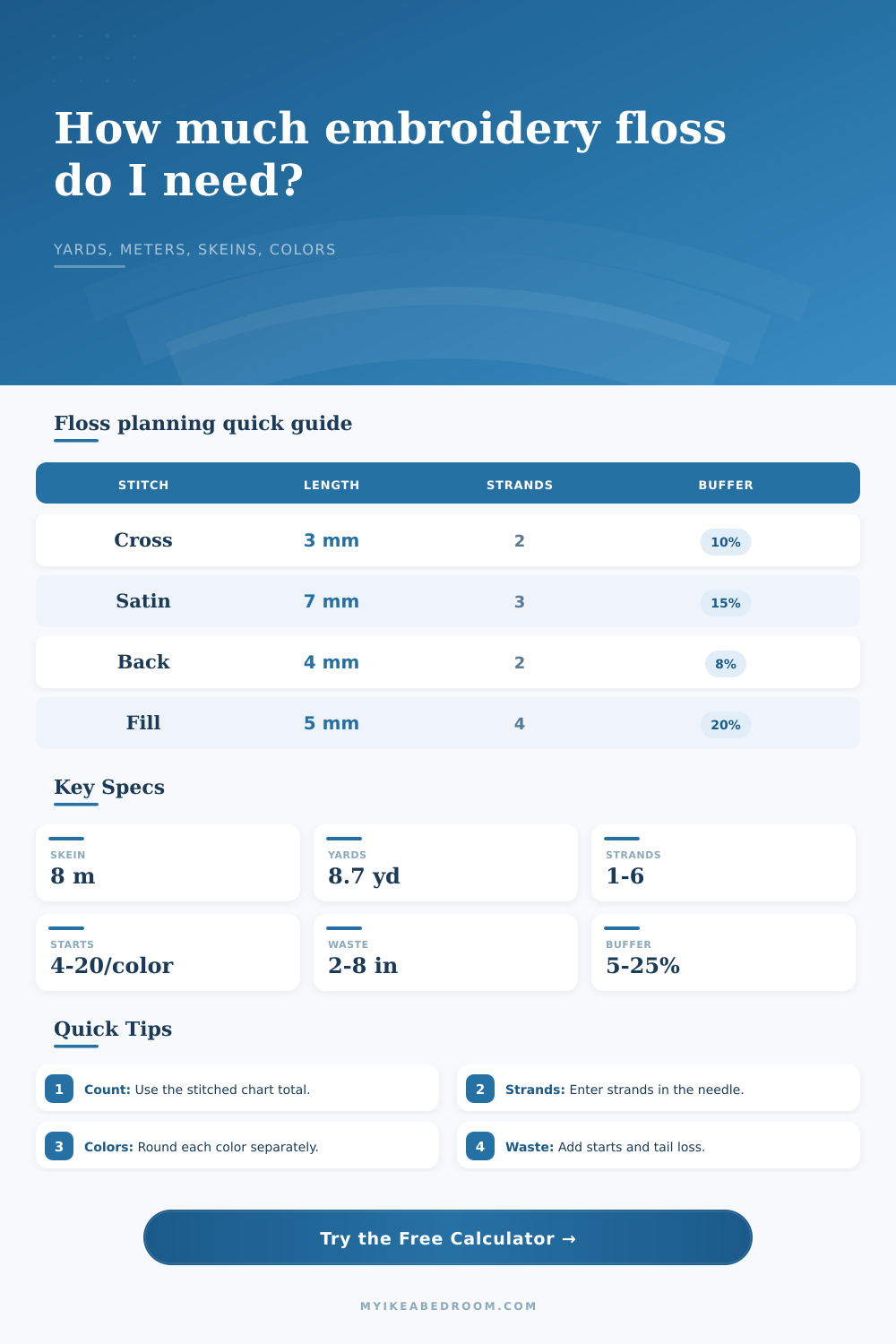
Estimate embroidery floss from stitch count, average stitch length, strands in the needle, standard 8 m / 8.7 yd skeins, starts, color count, back travel, and working buffer.
📌Stitch presets
⚙Floss inputs
Floss Length Results
| Color group | Share | Length | Rounded skeins |
|---|---|---|---|
| Main color | 0% | 0 yd | 0 |
🧵Floss reference cards
📊Reference tables
| Stitch preset | Typical average length | Path multiplier | Planning note |
|---|---|---|---|
| Cross stitch | 2.0 to 3.6 mm per fabric square | 1.80x | Represents two diagonal passes plus small path variation across fabric count. |
| Half cross stitch | 2.0 to 3.6 mm | 1.00x | Useful for tent stitch, light backgrounds, and single diagonal coverage. |
| Backstitch or running stitch | 3 to 5 mm | 1.10x | Small overlap and anchoring make outlines use slightly more than visible line length. |
| Stem stitch | 3 to 5 mm | 1.35x | Overlapping slant and direction changes increase thread path. |
| Chain stitch | 4 to 6 mm | 1.55x | Looped structure uses more floss than a straight running line. |
| Satin stitch fill | 5 to 12 mm | 1.18x | Average visible stitch is long, with extra thread on entry and exit turns. |
| Long-short shading | 4 to 9 mm | 1.30x | Layered overlaps and color blending need extra length per visible stitch. |
| French knots | 3 to 6 mm | 2.40x | Wraps around the needle create a high thread path for each counted knot. |
| Blackwork repeat | 2 to 4 mm | 1.20x | Small repeated paths and reversals add a modest allowance beyond visible lines. |
| Blanket stitch edge | 4 to 8 mm | 1.65x | Vertical leg plus edge loop makes each stitch use more floss than the edge spacing. |
| Strands in needle | Six-strand skein equivalent | Working strand length from one skein | Best use |
|---|---|---|---|
| 1 strand | 1/6 of skein per meter stitched | 48 m / 52.5 yd | Fine backstitch, blackwork, tiny text, and delicate line detail. |
| 2 strands | 2/6 of skein per meter stitched | 24 m / 26.2 yd | Common cross stitch coverage on many evenweave and Aida counts. |
| 3 strands | 3/6 of skein per meter stitched | 16 m / 17.5 yd | Fuller coverage, bolder outlines, small satin motifs, and texture stitches. |
| 4 strands | 4/6 of skein per meter stitched | 12 m / 13.1 yd | Chain stitch borders, thick fills, cushion details, and decorative edging. |
| 5 strands | 5/6 of skein per meter stitched | 9.6 m / 10.5 yd | Raised texture, bold monograms, and heavy decorative stitches. |
| 6 strands | 1 full skein per meter stitched | 8 m / 8.7 yd | Full bundle stitching, blanket edging, chunky accents, and fast visible coverage. |
| Project layout | Starts per color | Waste per start | Suggested allowance |
|---|---|---|---|
| Continuous border or lettering | 2 to 6 | 2 to 4 in | Use 5% back travel and 5% to 10% final buffer. |
| Simple cross stitch block | 4 to 10 | 3 to 5 in | Use 10% back travel and a normal 10% buffer. |
| Scattered color motifs | 10 to 25 | 4 to 6 in | Use 15% back travel because many short threads are trimmed. |
| Confetti-heavy chart | 20 to 50 | 5 to 8 in | Use 20% to 25% for jumps, parking, and restarts. |
| Dense satin or long-short fill | 8 to 20 | 4 to 6 in | Use 15% to 20% buffer for blending and reworked stitches. |
| Project | Stitches or marks | Common setup | Floss planning note |
|---|---|---|---|
| Small hoop sampler | 800 to 1800 stitches | 2 strands, 6 to 10 colors | Color rounding usually matters more than total skein equivalent. |
| Quote hoop with flowers | 1200 to 3500 stitches | 1 to 3 strands, mixed stitches | Letters use little floss, but floral fills and knots can dominate one color. |
| Medium cross stitch chart | 5000 to 12000 stitches | 2 strands, 12 to 30 colors | Use the color split setting to catch main background colors. |
| Filled patch or badge | 2000 to 8000 stitches | 3 to 6 strands, satin or long-short | Heavier strand count can move one color above a single skein. |
| Table linen border | 3000 to 15000 stitches | 2 to 4 strands, repeated motifs | Long repeats are efficient, but matching corners adds starts and tails. |
💡Floss calculation tips
The hundredth time you pull needle through fabric, the thread slips free with a faint snap. Out of floss.
Been there? Done that? Then you know how frustrating it can be to try completing a counted chart without planning ahead. It’s not so much that stitch is frustrating, it’s the secret math that few patterns address: how much thread does it take?
How to Calculate Your Thread Needs
The skein looks like plenty. Six strands means all length are used up on each single pass. Use two strands and the same skein covers an even bigger swath of fabric.
Once you know how many stitches there is (the input) and how much strand you want to use (another input), you plug those into calculator at the top. And it figures out the rest for you. You still save yourself because you understand whys behind those numbers.
That’s where most people go wrong with their projects: they think “stitch count = thread length”. They don’t. A cross stitch isn’t just a line of thread! It has two diagonals through it, each going over one and then under another fiber as it cross the fabric. The total distance the thread travels is far greater than width of the stitch on the canvas itself.
That’s where folks mess up: They purchase thread based off the visual image, not realizing they also need thread for all the hidden back-and-forth weaving that creates the image.
The other variable that makes an even bigger difference are strand count. As you split up a skein you’re dividing the total length by how many strands you leave on needle. If you use two you are now only using one third of the skeins length per stitch path. Six strands means you’re using the full length. The impact is huge. It is enough to do a little sampler, but not enough to do a big design in a single hoop at all.
You see most patterns calls for two or three strands for normal coverage. That’s a happy medium where it doesn’t burn through your yarn fast while still being durable. Heavier for texture looks awesome, but goes quickly.
Budgets can also depend on how the colors are distributed. For instance, while your overall amount of floss needed may be small, you can’t combine colors. Twenty different shades means twenty different skeins, regardless of how little of any one shade show up in the final design. To account for this, the tool will round up separately per color instead of averaging them together.
Maybe you realy just want 10 meters of a particular shade of blue. That’s not a whole skein (which would be eight), so now you have to buy an entire package anyway. And those tiny scraps accumulate quickly.
Additionally, the overall length of your thread depend on the amount of waste you have. Any time you begin a new color or re-begin an old one, you will trim away a few inches from the end of your thread and anchor in the tail. That’s no big deal when you’re stitching in a long, uninterrupted block of work. But it can add up quickly (easily more than the stitch length itself) when you are working a scattered design with isolated motifs.
The calculator let you account for the waste of those starts and stops. It’s essential if you’re working a chart like this that has more of a confetti feel. You will learn not just how to stitch, but also how to manage your thread.
Embroidery becomes seamless when you plan for it. Instead of fighting it reactively, you pull out your colors, your hoop and you sit down to stitch. You would of known you won’t have to interrupt yourself for a run to the supply closet. It’s not glamorous math, but it’s what makes a finished piece.
Once the colors go in just as intended and thread stays put, the pain of the broken thread dissapears. All you can think about is the feel of needle going back and forth. You can appreciate the rhythm instead than the work of the spool.