Economy Quilt Block Calculator
Plan square-in-a-square economy blocks with center squares, two triangle rounds, trim targets, block layout, fabric width, buffer, and cutting method allowances.
Choose a block plan, then refine the center size, triangle rounds, rows, columns, and cutting style for your quilt project.
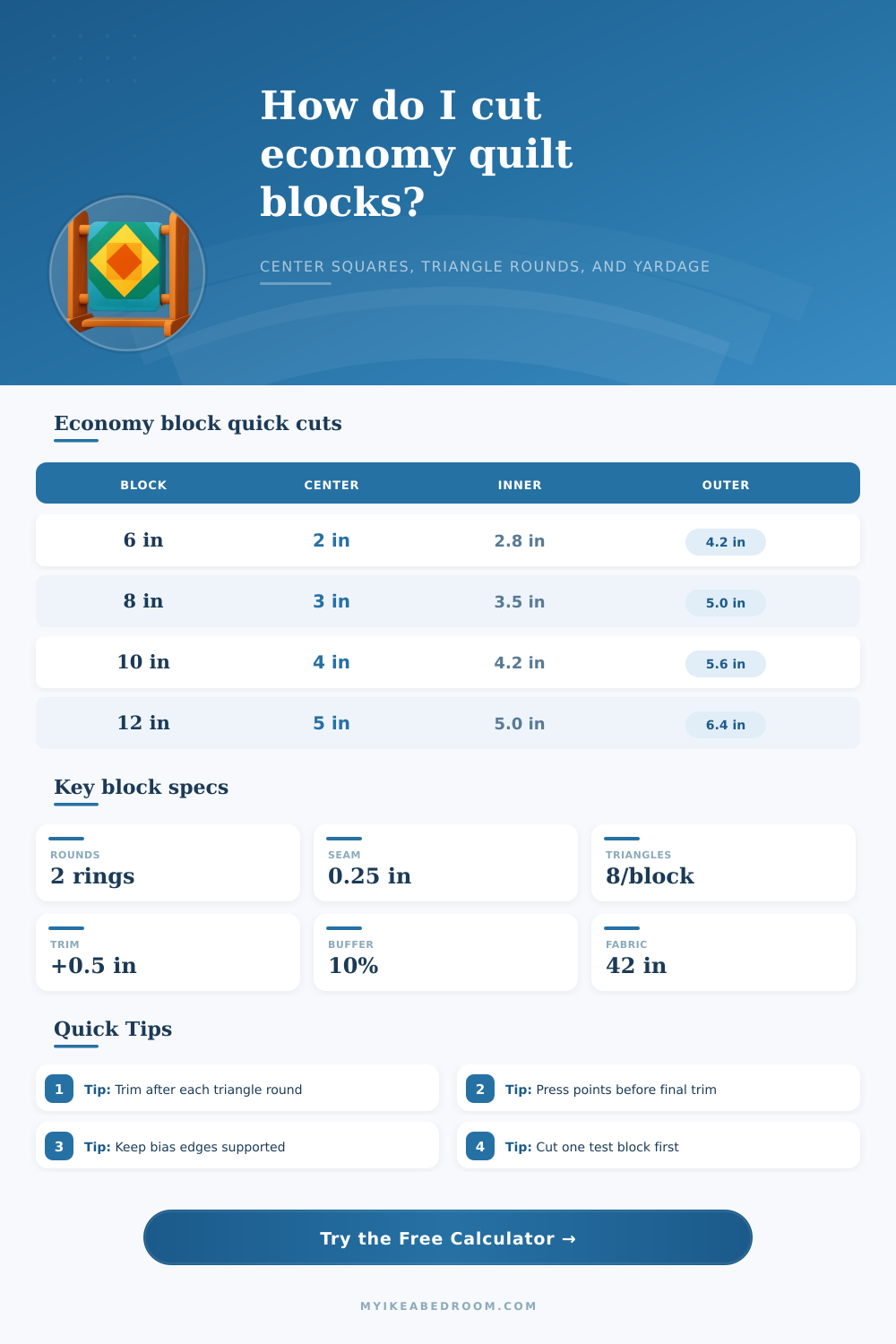
| Finished block | Center finished | Center cut | Inner QST square | Outer QST square | Final trim |
|---|---|---|---|---|---|
| 6 in | 2 in | 2 1/2 in | 2 7/8 in | 4 1/4 in | 6 1/2 in |
| 8 in | 3 in | 3 1/2 in | 3 1/2 in | 5 in | 8 1/2 in |
| 10 in | 4 in | 4 1/2 in | 4 1/4 in | 5 5/8 in | 10 1/2 in |
| 12 in | 5 in | 5 1/2 in | 5 in | 6 1/2 in | 12 1/2 in |
| Method | QST allowance | Best use | Trim expectation | Center handling |
|---|---|---|---|---|
| Exact QST formula | 1 1/8 in | Repeating blocks | Light trimming | Standard cut |
| Oversized triangles | 1 3/8 in | Beginner friendly | Trim each round | Standard cut |
| Foundation piecing | 1 5/8 in | Sharp points | Trim on lines | Standard cut |
| Fussy-cut center | 1 3/8 in | Motif centers | Trim carefully | Extra 1/4 in |
| Project | Block grid | Block size | Quilt center | With 3 in border |
|---|---|---|---|---|
| Baby quilt | 5 by 6 | 6 in | 30 by 36 in | 36 by 42 in |
| Throw quilt | 6 by 8 | 8 in | 48 by 64 in | 54 by 70 in |
| Twin quilt | 6 by 9 | 10 in | 60 by 90 in | 66 by 96 in |
| Queen quilt | 8 by 9 | 10 in | 80 by 90 in | 86 by 96 in |
Look: centered square framed by two point rounds.
Use: simple two-color or three-color blocks.
Look: feature print framed like a tiny picture.
Use: novelty fabric, album quilts, memory blocks.
Look: repeated centers with mixed triangle fabrics.
Use: small cuts, leftovers, controlled color families.
Look: large feature blocks balanced by quieter blocks.
Use: statement quilts and coordinated bedroom sets.
Trim sequence: Square the block after the first triangle round before adding the outer round. A small early wobble grows quickly in economy blocks.
Bias control: Quarter-square triangles place bias edges near the outside of the patch. Handle them flat, press gently, and avoid stretching the points.
The economy quilt blocks consists of a center square and two rounds of triangles. The center square is placed within the first ring of triangles, and a second ring of triangles is placed around the first ring of triangles. The second ring of triangles push the points of the design towards the edges of the quilt block.
Such a quilt block may appear to be a simple quilt from a distance, but there are certain mathematical and cutting considerations that must be made prior to sew an economy quilt block. Before cutting any fabric for an economy quilt block, there are several decision that must be made regarding the size of the quilt block and the components of the block. Decisions must be made about the finished size of the quilt block, the size of the center square, and the width of each of the triangle rounds.
How to Plan, Cut, and Sew an Economy Quilt Block
The size of the finished quilt block will impact the size of the quarter-square triangles that will be needed to create the quilt block. Each of these decisions will impact the total amount of fabric that will be required for the quilt block. A calculator can assist with the math behind the quilt block.
While a calculator can determine the amount of fabric necessary for a given size of the quilt block, it cannot make suggestions as to whether a particular size will be apropiate for the bed upon which the quilt will be placed, or how the fabric will look when the quilt is complete. Many people begin to determine the size of their economy quilt block prior to calculating the amount of fabric that will be required. Six-inch quilt blocks are often selected for use as baby quilts.
Eight-inch and ten-inch blocks contain fewer seams that may be difficult for young children to sew, and are also visually calmer then blocks of other sizes. Twelve-inch blocks provide more room for the center fabrics within each block to be visually prominent. A calculator can be used to determine how many economy quilt blocks of a certain size will fit into the area of a quilt.
Additionally, the calculator can help to account for the amount of sashing or borders that will be incorporated into the quilt. Each different size of quilt block will require a different amount of fabric for the project, so monitoring the amount of fabric as different sizes are entered into the calculator will help to plan for fabric purchases. The size of the center square of an economy quilt block is important.
A small center square will leave more room for the triangles rounds to fill the block, as well as create a more prominent star-shape image of the block. A large center square will place the points of the triangles into the quilt in a way that may appear heavily to the viewer. If using a fussy-cut motif within the center square, it is necessary to add an extra margin of the size of the cut fabric to the design to allow it to remain centered within the quilt block once the triangles are added.
A calculator can help determine whether every economy quilt block within a quilt will use the same center fabric, or if different fabrics will be used for each block. The use of different center fabrics will require more fabric than if the same fabric is to be used for every block. For those sewing an economy quilt block, another decision must be made regarding the cutting method of the triangles of the block.
Some individuals may choose to cut exact quarter-square triangles to the size calculated by a mathematical formula to the size of the blocks, but any error in cutting will be immediately visible within the quilt block. Other individuals may choose to first cut oversized triangles of the size of the block plus the allowance for the triangles that will be added in the second round, allowing for more forgiveness in the cutting process, though at the cost of increased fabric waste. Another cutting method is known as foundation piecing, wherein the pieces of fabric are held in place with paper prior to sewing the blocks, and is a very stable method of sewing the triangles.
Each of these cutting methods will be accounted for in the fabric calculations that the calculator makes. The calculator will provide measurements of the entire quilt that will be created once all of the size parameters of the individual block are sized. The calculator can calculate the amount of fabric that will be needed for each of the sashings of the quilt, the amount of fabric needed for any borders for the quilt, and the amount of fabric needed for the binding of the quilt.
Additional calculations will be necessary for the amount of fabric that will be needed for the backing for the quilt, as well as for the overhang of that backing. It is important to order sufficient amount of binding and backing for the quilt, as many individuals tend to under-order these amounts. The calculator also permits the selection of a buffer percentage to account for possible fabric flaws or sewing errors in the creation of the economy quilt block.
In addition to the use of the calculator, there are some sewing habits that will make sewing economy quilt blocks easier. Trimming the block after each round of triangles are added will allow for easier sewing of the outer triangles. Cutting the block prior to adding the outer triangles will allow for any issues within the inner blocks to be rectified before sewing the outer triangles.
The inner square must be ensured to be perfectly square prior to sewing the first round of triangles, as the second round of triangles will not correctly fit into the block if the inner square and first round of triangles is not both perfectly square. Each of the points of the quilt block should be pressed carefully. The bias edges of the fabrics should be supported on an ironing board when pressed to avoid stretching the edges.
Creating a test block can help individuals to practice each of the steps in the quilting process. Finally, economy quilt block layouts will impact the appearance of the finished quilt. A classic two-color economy quilt will exhibit a different appearance to the viewer than a scrappy quilt that uses different fabrics within the points of the triangles.
Additionally, an album or medallion layout may use each of the economy quilt blocks to support a larger design of interest in the center of the quilt. Each of these layout options will have an impact upon the amount of fabric that is required for the project, as well as the precision with which the blocks need to be cut. By planning the size of the center square, the size and number of each round of triangles, and the size of the entire block, the individual will ensure that each of the points of the blocks are within their correct position and placement.