Dust Collector Duct Size Calculator
Size shop dust-collection ducts from target CFM, conveying velocity, branch and main duct diameter, tool port restriction, elbows, flex hose, and available static pressure.
1Shop Presets
Choose a common machine or trunk line, then adjust the run length, flex hose, and elbows to match your layout.
2Airflow Inputs
3Duct And Port Sizes
4Run Length And Fittings
5Results
6Quick Duct Targets
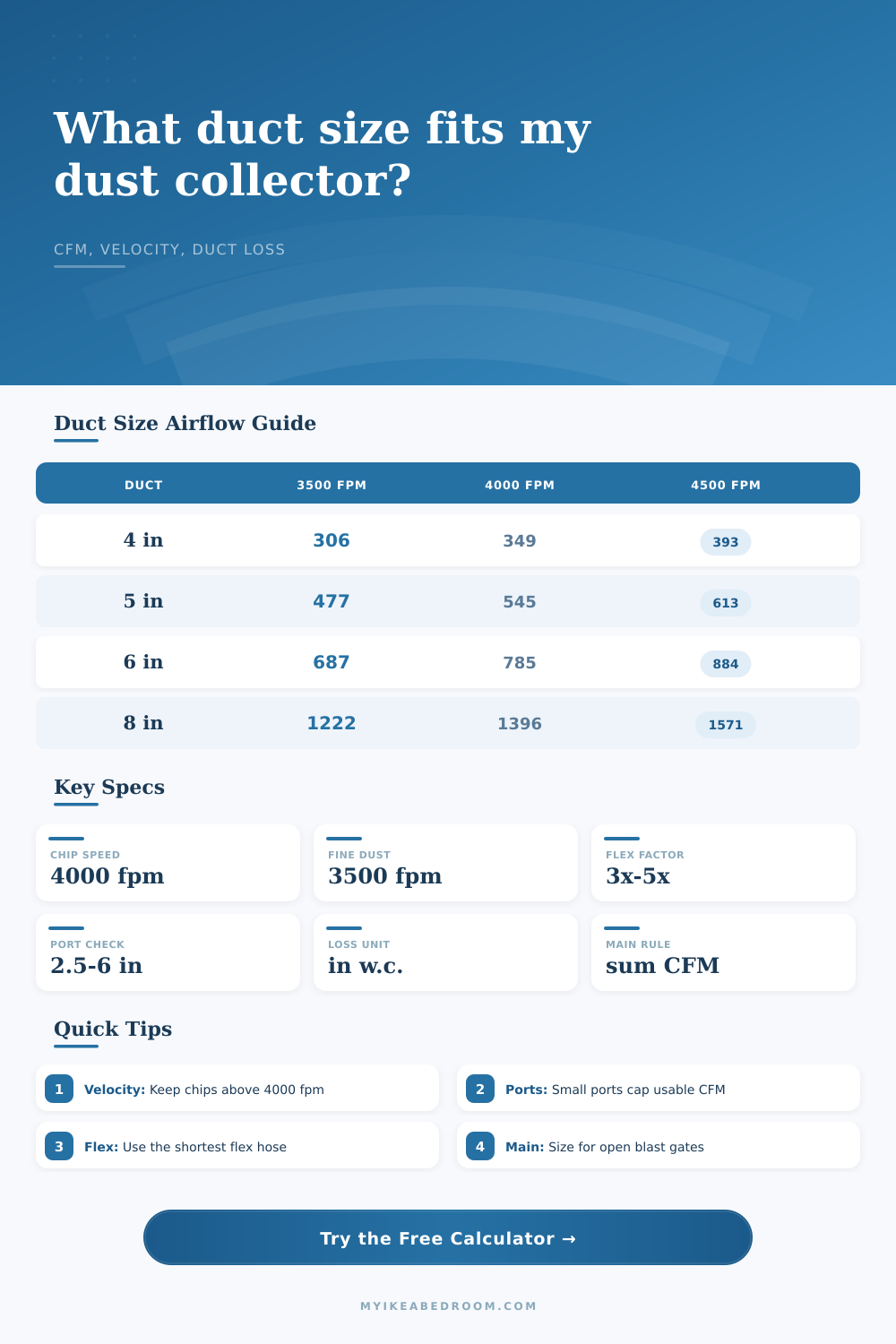
7Airflow By Duct Diameter
| Duct ID | Area | 3500 fpm | 4000 fpm | 4500 fpm |
|---|---|---|---|---|
| 3 in | 0.049 sq ft | 172 CFM | 196 CFM | 221 CFM |
| 4 in | 0.087 sq ft | 306 CFM | 349 CFM | 393 CFM |
| 5 in | 0.136 sq ft | 477 CFM | 545 CFM | 613 CFM |
| 6 in | 0.196 sq ft | 687 CFM | 785 CFM | 884 CFM |
| 7 in | 0.267 sq ft | 935 CFM | 1069 CFM | 1202 CFM |
| 8 in | 0.349 sq ft | 1222 CFM | 1396 CFM | 1571 CFM |
8Velocity And Use Class
| Velocity Band | Use Class | Typical Dust | Calculator Warning |
|---|---|---|---|
| Under 3000 fpm | Low transport | Fine dust only | Likely settling risk |
| 3000 to 3499 fpm | Fine-dust range | Sanding and filter air | Watch chips closely |
| 3500 to 4499 fpm | Balanced shop range | Sawdust and mixed chips | Usually acceptable |
| 4500 to 5500 fpm | High transport | Planer and jointer chips | Check pressure reserve |
| Over 5500 fpm | Restrictive ducting | High-noise, high-loss flow | Upsize if pressure is high |
9Fitting Loss Reference
| Item | Calculator Treatment | Best Use | Loss Note |
|---|---|---|---|
| Long-radius 90 | Lower fitting factor | Main turns and drops | Smoother than tight elbows |
| Tight 90 elbow | Higher fitting factor | Only where space requires it | Raises equivalent length |
| 45 degree elbow | Short equivalent length | Offset runs | Often better in pairs |
| Flex hose | 2.8x to 4.8x duct loss | Last moving connection | Keep short and stretched |
| Tool port | Velocity pressure check | Machine inlet | Small ports can dominate loss |
*Common Tool Targets
| Tool Or Pickup | Typical CFM | Common Branch | Velocity Note |
|---|---|---|---|
| Table saw cabinet | 350 to 500 CFM | 4 to 5 in | Higher CFM helps blade guard capture |
| Planer or jointer | 600 to 900 CFM | 5 to 6 in | Heavy chips prefer 4000 fpm plus |
| Miter saw hood | 350 to 700 CFM | 4 to 6 in | Open hoods need more capture air |
| Drum sander | 600 to 1000 CFM | 5 to 6 in | Fine dust likes steady high volume |
| CNC enclosure | 800 to 1200 CFM | 6 to 8 in | Main duct must match open gates |
!Calculation Tips
Get yourself one of those new-fangled metal-housed, big-collector things, all slick and high-powered. Plug it into a jumble of ill-matched ducts and bendy flex hose and too-many-tight-elbows.
Silence. Not the nice kind. That pricey fan spin its wheels for nothing, as fine dust settles at the bottom of tubing like a lazy river.
Why Your Dust Collector Is Not Working
Surprisingly, more often than you’d guess, size of the duct has nothing to do with strength of the machine. It has everything to do with how eager air is to shove that crud away. So what’s the deal? It’s realy pretty simple, though easy to forget.
When air go through a large tube, it will slow down. If it gets too slow, then the heavier chips fall out of airstream and settle. So if you have a bunch of chip, they’ll eventually settle out of the airstream. This is why conveying velocity are more important than total amount of airflow. To carry the debris, you must provide enough force to suspend it. Usually for sawdust, we aim for about four thousand feet per minute. With heavier planer chips, you’d want something higher.
The calculator at top does all this math for you. Just plug in your desired airflow and your duct diameter, and it figures out if you have too much or not quite enough.
Shop air has a silent killer: the flex hose. Looks harmless, but has a massively turbulent ribbed interior. Each inch of flex can act like three to five inches of smooth metal ductwork. That’s a steep penalty. One perfectly sized trunk line can be choked by a twenty-foot run of kinked hose. The system multiplies that loss by the hose length times its roughness factor. Leave the hose hanging, partly collapsed or even coiled and you’re throwing away pressure.
It’s not a bug in the system; it is feature of friction. It’s friction and it’s a feature. Make it short. Make it stretched tight.
Efficiency also seep out around fittings. A highway curve is a smooth long-radius elbow. A wall is a tight ninety-degree stamped metal elbow. When you’ve got several elbows in a short run, that difference in pressure drop are significant. Often two forty-five-degree bends will flow better then a single sharp ninety bend.
Why? Because the calculator use the type of fitting to calculate the loss and adjust the equivalent length of the run. It’s not theoretical stuff. Because the calculator want to know what kind of fittings you’re using so it can modify the equivalent length of the run. It’s not theoretical stuff. It determines whether you can move air through the branch fast enough to keep the dust from settling, without the static pressure loss exceeding the amount of pressure the fan can deliver.
When it comes to the trunk line size, it’s a bit of a different story than the branch lines. The trunk take air to all your machines that you may be running simultaneously. So, if you have three blast gates set up to feed three saws, you want to size your trunk based off total amount of air each one will require if all are left open. Remember that leaving gates open when not using them is a huge leak. Instead of going to the machine you’re running, it exits through the open holes. Many do this thinking closing the gate shuts off the air. Nope! It sends it to where you need it.
It shows how the duct size impacts velocity given any specific flow rate and helps you understand where bigger pipe becomes a detriment. The same is true for tool ports. For example, say you’ve got a four-inch port on your table saw and you connect a six-inch branch duct. That little hole send the air blasting into the port at a high speed, causing a localized pressure spike that the fan needs to battle. Think of it as drinking a milkshake using a coffee stirrer. This velocity pressure is checked by the calculator and it’ll alert you when it detects a port restriction. It is a small thing, but it matters.
So what’s the take-away? A dust collection system is a game of volume and pressure. If you want unlimited flow, you have to pay for it. You can’t reduce friction without smoothing out path. The trick is to keep that air moving fast enough to transport the chips but not so much that you’re working your fan to death.
Get started by determining the needs of tools. Then, size the branches to keep the speed up. Finally, build the trunk to support the maximum expected load. Inspect the fittings. Reduce the flex. And then turn it on.
If the chips are flying, you’ve got it made. If they sit around, you’ll know it would of been the hose. Listen to the air and it’ll tell you the truth.