🧱 Load planning for drywall
Drywall Weight Calculator
Estimate board weight, layer load, and bundle handling for bedrooms, ceilings, and full-room wraps.
📋Preset room loads
📊Weight results
📦Board weight grid
Lightweight 1/2 in
Regular 1/2 in
Type X 5/8 in
Shaftliner 1 in
📋Board and load tables
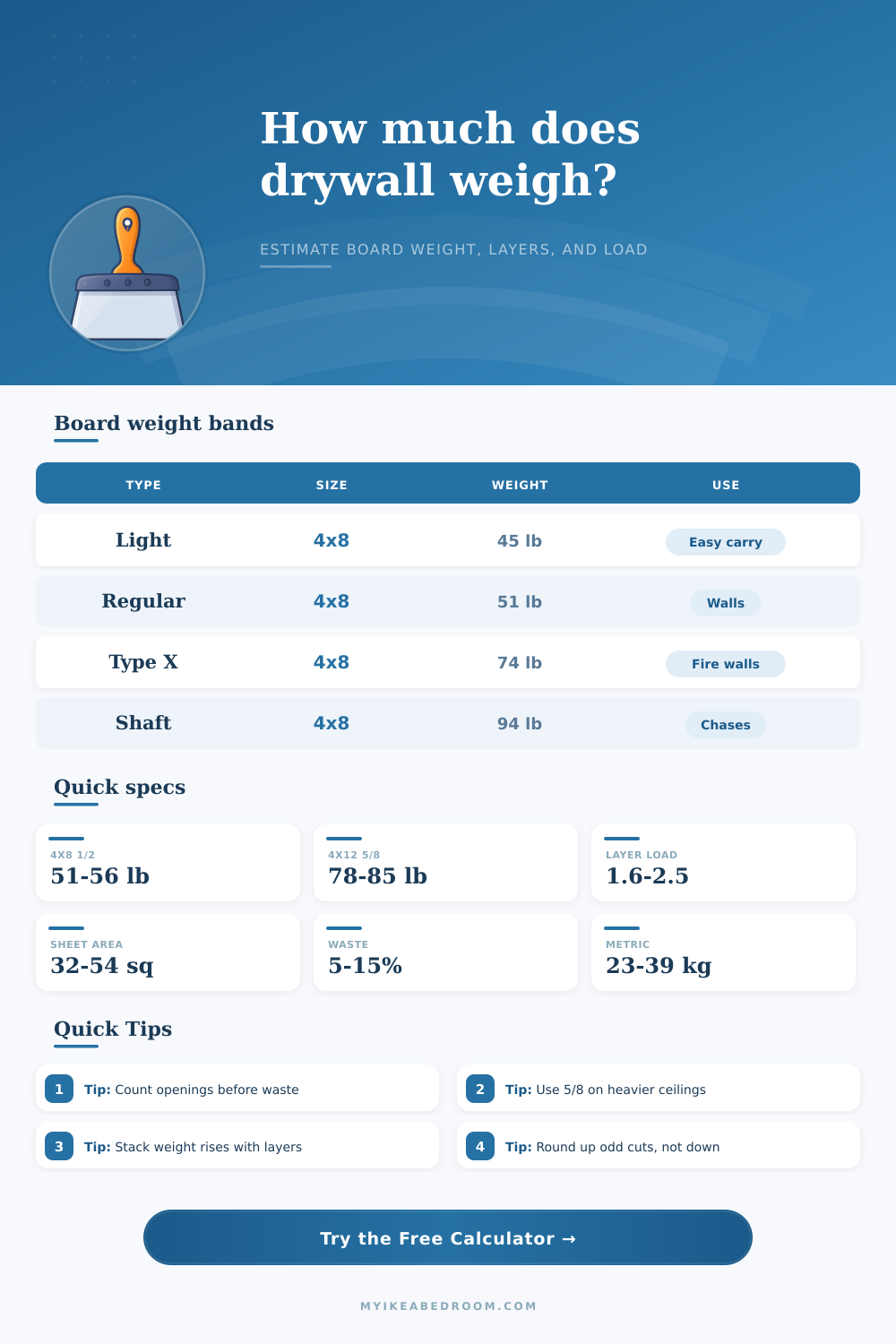
| Board family | 4 x 8 weight | 4 x 12 weight | Typical use |
|---|---|---|---|
| Flexible 1/4 in | 26 lb | 38 lb | Curves and reveals |
| Lightweight 1/2 in | 45 lb | 67 lb | Fast room coverage |
| Regular 1/2 in | 51 lb | 76 lb | Standard wall build |
| Moisture-resistant 1/2 in | 54 lb | 80 lb | Bath and laundry zones |
| Abuse-resistant 1/2 in | 65 lb | 96 lb | Impact-prone walls |
| Type X 5/8 in | 74 lb | 109 lb | Fire-rated assemblies |
| Sound-damping 5/8 in | 80 lb | 117 lb | Quiet media rooms |
| Shaftliner 1 in | 106 lb | 154 lb | Chases and shafts |
| Build type | Area band | Weight band | Handling note |
|---|---|---|---|
| Small patch | under 80 sq ft | under 200 lb | One or two trips |
| Bedroom wrap | 80-220 sq ft | 200-600 lb | Two-person carry |
| Full room shell | 220-500 sq ft | 600-1,300 lb | Use staged bundles |
| Double-layer zone | 500+ sq ft | 1,300+ lb | Pallet or lift-gate |
💡Practical tips
Drywall weights is another critical factor to consider when installing drywall. Drywall weight will determine how you will move the drywall and the physical effort that you must exert in moving it. A standard sheet of half-inch drywall weigh approximately 50 pounds.
This is the weight that a person must account for when planning there drywall installation project. If a person are moving two sheets of drywall, the weight will be 100 pounds. This increased weight can place strain on the physical body of the person moving the drywall.
How Heavy Is Drywall and Why It Matters
Furthermore, the weight of drywall can increase due to moisture in the drywall or due to the thickness of the drywall boards. The composition of the drywall can determine the weight of drywall. Drywall has a gypsum plaster core in two layers of paper.
Thicker drywall will be heavier then thin drywall. Five-eighth inch Type X drywall is use for fire-rated walls. Furthermore, the type X drywall is more dense than regular drywall.
If a person installs two layers of drywall, the second layer will double the weights of the drywall. Ceiling installations are more difficult than installing drywall on walls because gravity pulls the drywall downward making drywall feel heavier when installing on a ceiling. To calculate the total weight of the drywall that will be needed for a room, you has to measure the area of the room.
For instance, if a room is 12 feet by 14 feet but with eight-foot walls, the area of the walls is 560 square feet. If you subtract the area of the windows and doors in the room, the drywall area for the walls could be 500 square feet. If the area of the ceiling is also included in the installation, the total area of the drywall that will be needed could reach 600 square feet.
If a person uses half-inch drywall for the area of 600 square feet, the total weight will be more than 900 pounds. Since some of the drywall will be wasted during installation, ten percent more drywall then the calculated amount should be purchased. Adding ten percent to the total area will increase the total weight of the drywall that will be needed.
If drywall is left outside in the rain, the drywall will absorb water from the rain. The water will add to the weight of the drywall. If drywall absorbs water, the weight of the drywall will increase five to ten percent.
This increased weight will make it more difficult for the person to move the drywall. Furthermore, drywall that is too heavy may sag in areas where there is little support. There are different types of drywall with different weights.
Lightweight drywall is easier to lift so it is used for drywall ceilings. Moisture-resistant drywall, like drywall used in bathrooms, may become heavy if stored in a humid area. Sound-damping panels are used in installations to reduce the sound transmission from one area to the next.
These panels are heavier than standard drywall. Shaftliner drywall is very heavy at over 100 pounds per sheet but is use for specific construction project needs. Furthermore, fire-rated Type X drywall is heavy due to it’s density.
Type X drywall is used in specific locations as required by the building codes. Another consideration of drywall is the dead load. Dead load is the weight of the drywall pressing down on the joist that supports the ceiling.
The weight of a single layer of half-inch drywall is 1.5 to 2 pounds per square foot. If two layers of drywall are used, the total load will be double that amount. If the drywall is too heavy, the ceiling may sag or crack.
In this case, the joists will have to be able to support the drywall. To avoid mistakes when installing drywall, there are certain rules that must be followed. First, you should take the area measurements for the area that will be covered in drywall and subtract any areas for windows and doors from the total area.
Second, use lighter drywall for ceilings to avoid lifting very heavy drywall while on a ladder. Third, round up the total area that will be covered with drywall. A person cant purchase a partial sheet of drywall.
Furthermore, drywall weight must be considered before installing the drywall. If a person underestimates the weight of the drywall that will be needed, they may get physicaly exhausted while installing the drywall. Furthermore, if the weight of the drywall is underestimated, it can lead to the person developing a muscle strain.
By calculating the weight of the drywall needed for the area to be covered, a person can determine how many assistant will be needed to install the drywall and how many trips will be required to transport all the drywall to the project.