Drywall fastening layout
Drywall Screw Calculator
Estimate screws per sheet, total fasteners, and a practical screw length for walls or ceilings using sheet size, framing spacing, board direction, and layer count.
| Assembly | Board | Edge spacing | Field spacing | Common note |
|---|---|---|---|---|
| Wall, single layer | 1/2 in | 8 in | 16 in | Typical residential stud wall |
| Wall, finish-sensitive | 1/2 in | 8 in | 12 in | Tighter field pattern reduces bowing |
| Ceiling, single layer | 1/2 in | 7 in | 12 in | Common overhead fastening band |
| Ceiling, wider framing | 5/8 in | 7 in | 12 in | Used where sag control matters more |
| Total board thickness | Wood framing | Steel framing | Typical use |
|---|---|---|---|
| 1/4 in single layer | 1 in coarse | 1 in fine | Overlay and curved patch work |
| 1/2 in single layer | 1-1/4 in coarse | 1 in fine | Most standard walls and soffits |
| 5/8 in single layer | 1-5/8 in coarse | 1-1/4 in fine | Ceilings and fire-rated board |
| 1 in to 1-1/4 in total | 1-5/8 in to 2 in | 1-5/8 in to 2 in | Double-layer overlays and rated walls |
| Sheet and layout | Coverage | Framing | Approx screws |
|---|---|---|---|
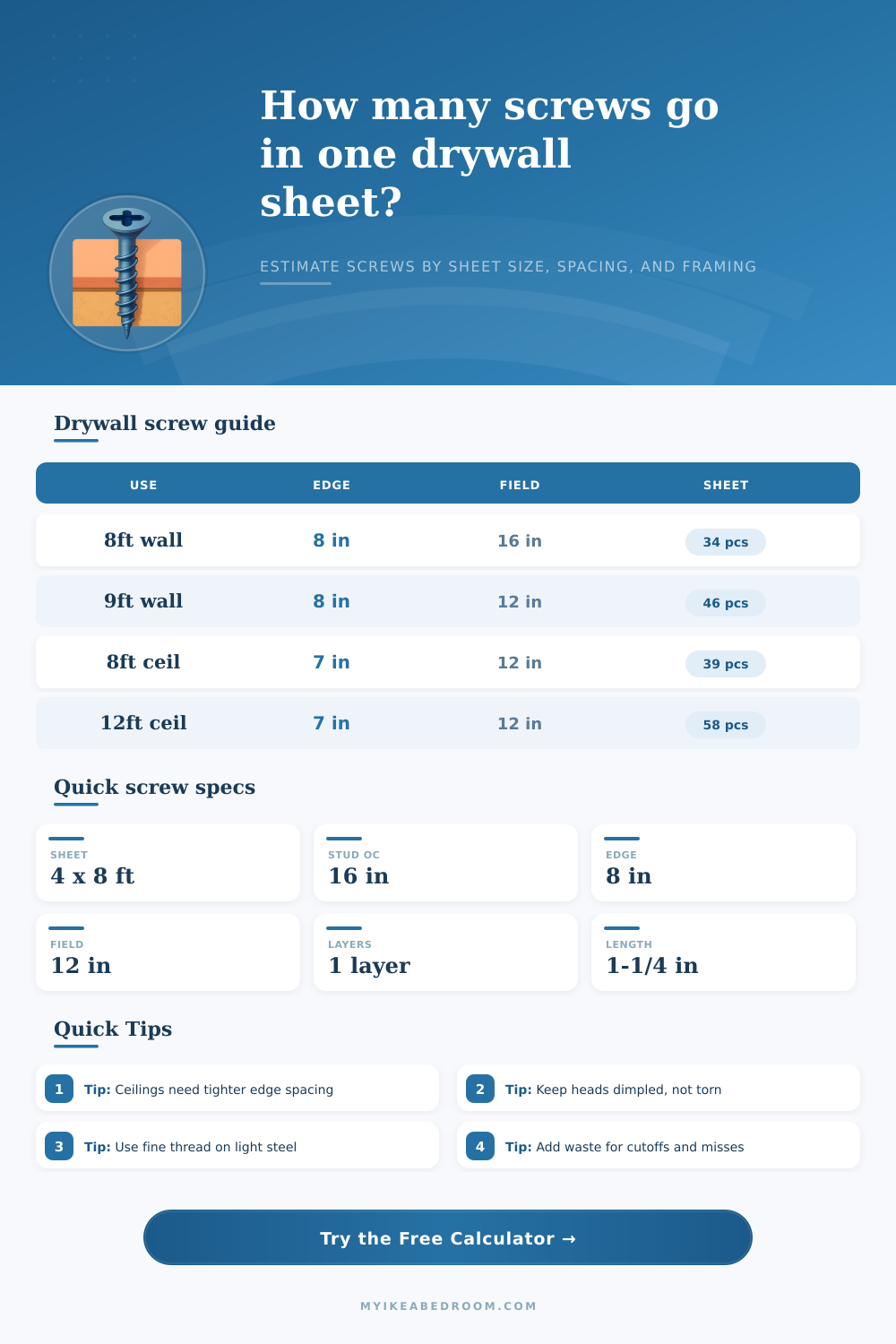
| 4 x 8 wall, horizontal | 32 sq ft | 16 in studs, 8/16 pattern | 34 per sheet |
| 4 x 10 wall, horizontal | 40 sq ft | 16 in studs, 8/12 pattern | 46 per sheet |
| 4 x 8 ceiling, perpendicular | 32 sq ft | 16 in joists, 7/12 pattern | 39 per sheet |
| 4 x 12 ceiling, perpendicular | 48 sq ft | 16 in joists, 7/12 pattern | 58 per sheet |
| Spacing | 4 ft span lines | 8 ft span lines | What changes |
|---|---|---|---|
| 12 in o.c. | 5 lines | 9 lines | Higher screw count but firmer backing |
| 16 in o.c. | 4 lines | 7 lines | Common drywall layout baseline |
| 24 in o.c. | 3 lines | 5 lines | Often paired with 5/8 in ceiling board |
| Mixed backing | Varies | Varies | Add screws where blocking supports seams |
Dimple, do not tear: Set each bugle head just below the paper face. Torn paper weakens the hold and usually needs another screw nearby.
Read the framing first: Ceilings on 24 in centers often need 5/8 in board and a tighter pattern. Blocking at seams can raise the final screw count.
Calculating the correct number of drywall screw is a necessary step in drywall installation. Having the correct number of drywall screws will prevent you from either running out of drywall screws or buying too many drywall screws. If you buy too few drywall screw, you will have to stop installing drywall to purchase more drywall screws.
If you buy too many drywall screws, you will spend too much money on your drywall installation project. In order to calculate the correct number of drywall screws you need for your installation job, you must understand how drywall screw patterns will affect the drywall. If you use too few drywall screws, the drywall will sag in the middle and may crack.
How Many Drywall Screws You Need
If you use too many drywall screws, you may damage the drywall’s paper face. The positioning of drywall screws is important. The edges of drywall have more movement than the field areas of the drywall sheets.
Therefore, you must place drywall screws on the edges of drywall sheets more frequent than you place drywall screws on the field areas of those drywall sheets. The dimensions of drywall sheets and framing member will determine how many drywall screws are needed. For example, 4-by-8 foot drywall sheets will have drywall screws placed along their edges every 8 inches.
Additionally, you will place drywall screws in the field areas of the drywall sheets every 12 or 16 inches. If you hang the drywall sheets vertically, there will be a change in the number of drywall screws needed. Ceilings will require more drywall screws then drywall sheets hung vertically on walls because gravity will pull on drywall sheets installed on ceilings.
To prevent drywall panels from sagging on the ceilings, you must place drywall screws along the edges of drywall sheets every 7 inches instead of every 8 inches. The spacing of the framing members will also affect the number of drywall screws needed for your project. For instance, if the framing members are 12 inches on the center, you will need more drywall screws than if the framing members are 24 inches on the center.
Additionally, you should always allow for the waste of approximately 10 percent of your drywall screws because drywall screws can be dropped during installation or drywall sheets can be cut during installation. The type of screw that you use will depend on the type of framing materials that is used in the construction of the walls. For instance, if the studs are made of wood, you should use coarse thread drywall screws.
Coarse thread drywall screws will grip the drywall fibers of the wood studs effective. However, you should use fine thread drywall screws on steel studs because fine thread drywall screws will not strip the metal studs. Additionally, the length of the drywall screws should be appropriate for the thickness of the drywall.
Drywall screws should penetrate into the studs approximately 1/4 inch after the drywall screw passes through the drywall sheet. Using drywall screws that penetrate too far into the drywall may damage the paper face of the drywall sheets because drywall screws may tear the drywall paper face. This can also lead to drywall screws popping out of the drywall sheets later on.
Many people make several mistake when they dont follow a specific drywall screw pattern. One mistake is placing drywall screws too far apart on the field areas of drywall sheets. This creates the feeling that drywall sheets are hollow or drumlike under the drywall compound.
Another mistake is the type of drywall screws that are used on drywall studs. For example, using coarse thread drywall screws on metal drywall studs will make the drywall screws continually slip on the studs. Additionally, framing installations may not be even on some buildings.
In these situations, the drywall screws may need to be placed more frequently on the blocking placed under the seams on drywall sheets. The placement of drywall screws on these areas may increase the total number of drywall screws needed by 20 percent. The thickness of the drywall that is used will also affect how drywall screws are installed on drywall sheets.
For example, half inch drywall sheets are used on walls because the drywall sheets are thin and flexible. However, people use 5/8-inch drywall sheets on ceilings. Additionally, if fire rated drywall assemblies are used, 2 layer of drywall may be used.
Therefore, if 2 layers of drywall are used, you must double the number of drywall screws. By calculating the number of drywall screws based off the framing members, the thickness of the drywall, and the screw pattern for drywall screws, you can ensure that you have the correct number of drywall screws for your drywall installation job to avoid waste in your drywall installation project.