Drywall Mud Calculator
Estimate joint compound for room shells, seams, patch work, and smooth finish coats.
🛠 Project Inputs
📋 Quick Room Presets
📑 Reference Tables
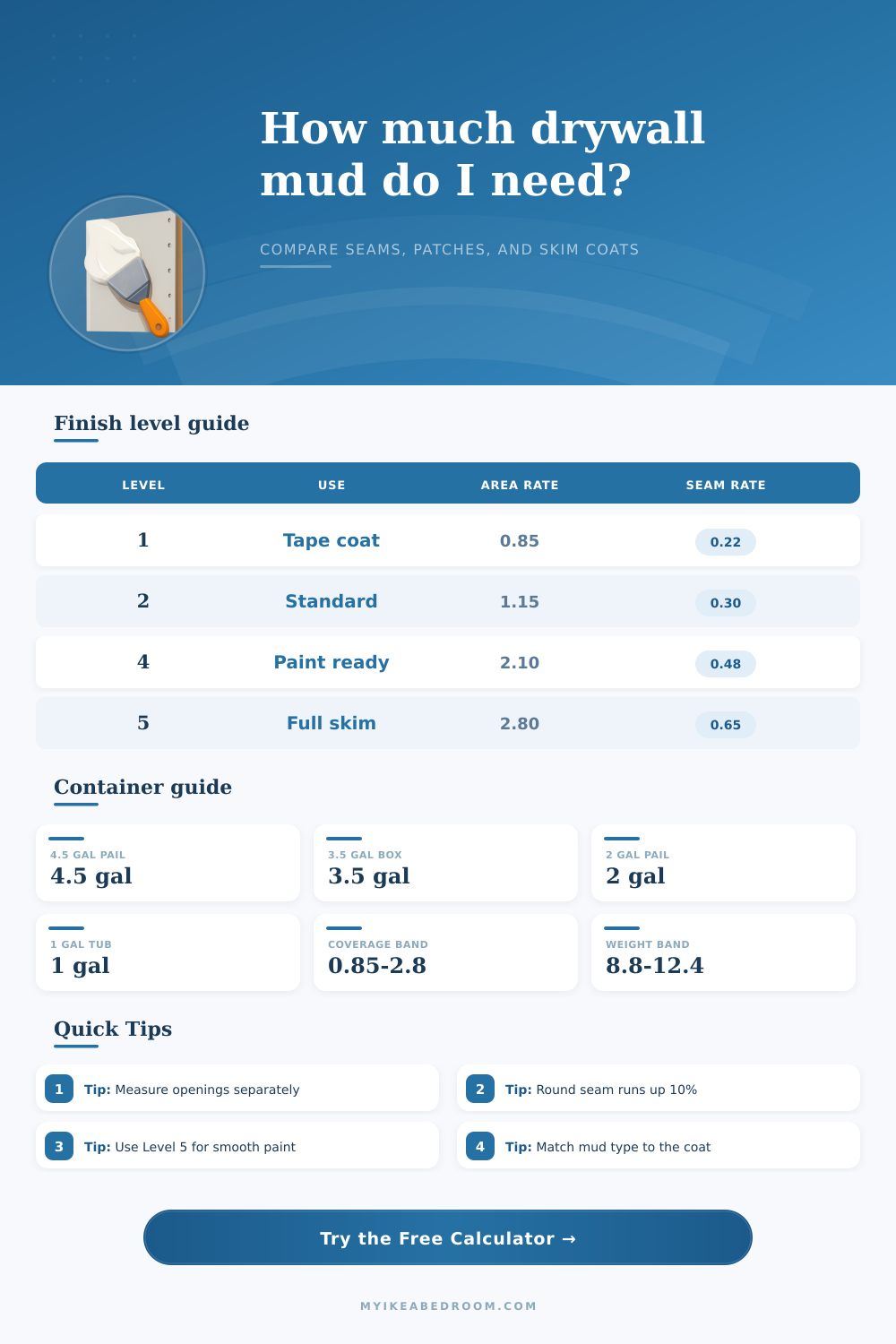
| Level | Typical drywall task | Area rate | Seam rate |
|---|---|---|---|
| Level 1 | Embed tape | 0.85 gal / 100 sq ft | 0.22 gal / 100 ft |
| Level 2 | Standard seams | 1.15 gal / 100 sq ft | 0.30 gal / 100 ft |
| Level 3 | Extra fill | 1.55 gal / 100 sq ft | 0.38 gal / 100 ft |
| Level 4 | Paint ready | 2.10 gal / 100 sq ft | 0.48 gal / 100 ft |
| Level 5 | Full skim coat | 2.80 gal / 100 sq ft | 0.65 gal / 100 ft |
| Mud type | Density | Spread factor | Best use |
|---|---|---|---|
| All-purpose ready mix | 11.2 lb/gal | 1.00 | General finish |
| Lightweight all-purpose | 8.8 lb/gal | 0.90 | Easy spreading |
| Taping compound | 11.8 lb/gal | 1.08 | First coat joints |
| Topping compound | 10.0 lb/gal | 0.95 | Final passes |
| Setting compound 45 | 12.4 lb/gal | 0.92 | Fast patching |
| Setting compound 90 | 12.2 lb/gal | 0.94 | Larger repairs |
| Dust-control finish | 11.0 lb/gal | 1.02 | Cleaner sanding |
| Container | Nominal fill | Metric fill | Typical fit |
|---|---|---|---|
| 4.5-gal pail | 4.5 gal | 17.0 L | Large room runs |
| 3.5-gal box | 3.5 gal | 13.2 L | Most finish jobs |
| 2.0-gal pail | 2.0 gal | 7.6 L | Patch bundles |
| 1.0-gal tub | 1.0 gal | 3.8 L | Small repairs |
| Imperial | Metric | Factor | Use |
|---|---|---|---|
| 1 gal | 3.785 L | 3.78541 | Mix volume |
| 1 sq ft | 0.093 m2 | 0.09290 | Area readout |
| 1 lb | 0.454 kg | 0.45359 | Weight band |
| 1 ft | 0.305 m | 0.30480 | Length input |
📈 Comparison Grid
💬 Job Notes
To prepare a bedroom for painting, you will need calculate the amount of drywall mud that will be required to finish the process. Drywall mud is a paste that you apply to the seams between drywall sheets. If you buy to many drywall mud, you will waste your money on drywall mud that you did not use.
Furthermore, if you dont buy enough drywall mud before you begin your project, you risk the drywall mud hardening and making it impossible to use the drywall mud for your projects. The amount of drywall mud that is required for a bedroom depend on the level of finish that you would like to use on the bedroom walls. For instance, if you choose to use a Level 1 drywall mud finish, you will only embed the drywall tape into the seams between drywall sheets.
How to Figure Out How Much Drywall Mud You Need for a Bedroom
A Level 1 drywall mud finish require less drywall mud than a Level 2 drywall mud finish. A Level 2 drywall mud finish applies a few coats of drywall mud to the seams created by drywall sheets. A Level 4 drywall mud finish requires applying thin coats of drywall mud to the seams to allow for the proper application of flat paint to the bedrooms walls.
Finally, a Level 5 drywall mud finish require applying a full skim coat of drywall mud to the entire surface area of the bedrooms walls. In addition to determining the level of drywall mud finish that you will use, the amount of drywall mud that is required will also depend upon the amount of seams and corners that you have in your bedrooms walls. Each corner that you must tape will require some drywall mud to be applied.
Vertical seams tend to require more drywall mud than horizontal seams due to the influence of gravity. Corners will require you to apply drywall mud to them to prevent the paper tape on those corners from wrinkling. The linear footage of all the seams and corners in the bedroom will be more longer than the total square footage of the bedrooms walls.
The area where doors and windows is located will also play a role in drywall mud calculations. Doors and windows will reduce the total square footage of drywall that is necessary to be painted. However, the edges of the doors and windows will require you to apply additional drywall mud to them.
The type of drywall mud that you use will impact the total weight of the mud that you need for the project. For instance, all-purpose drywall mud is used to fill the gaps created when you tape drywall sheets together. Furthermore, all-purpose drywall mud is more denser and weighs more than lightweight drywall mud.
Lightweight drywall mud has a feathering quality that makes it easier to apply to the drywall and requires less of the mud to complete the job. However, it may require more skill to apply lightweight drywall mud correctly. Taping compounds tend to be heavier per gallon than topping compounds.
Drywall mud is very heavy, so when you calculate how much of the mud you will need, you should also calculate the weight of the drywall mud that will be necessary for transporting it to the job in a vehicle. When calculating the amount of drywall mud that will be necessary for the bedroom that you are preparing for paint, you should also include a buffer for waste. When purchasing drywall mud, it is typical to buy an extra ten percent of the drywall mud that you calculate you will need.
If you are painting with a full skim coat of drywall mud, or if you are a beginner at drywall mud application techniques, you should of double the ten percent waste buffer. Allowing for a waste buffer ensures that you will not run out of drywall mud during your application process. To determine the amount of drywall mud that will be necessary to complete your bedroom for paint, follow a few steps.
First, calculate the total square footage of the walls and ceilings of the bedroom. Second, subtract the square footage of all the doors and windows located in the bedroom. Third, calculate the linear footage of all the seams and corners in the bedroom.
Fourth, calculate the amount of drywall mud that will be necessary for the various levels of drywall mud finishes. Fifth, add a waste buffer to the total amount of drywall mud that you will need. By following these steps, you will have a good idea of the total gallons of drywall mud and the total weight of that drywall mud that will be necessary to complete your project.