📐 Board takeoff layout
Drywall Calculator
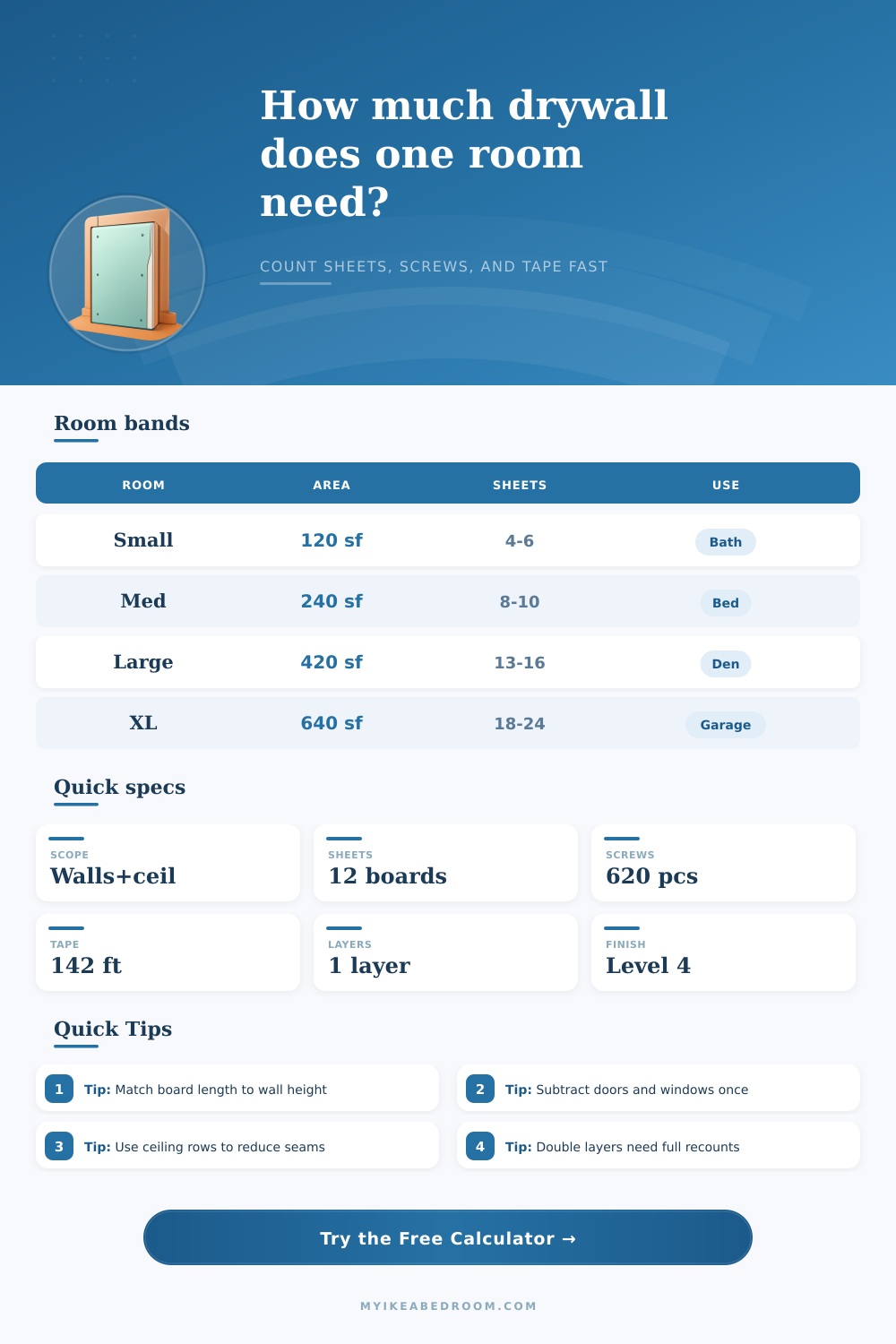
Estimate board counts, screw totals, tape runs, and finishing quantities for a single room. Switch between walls, ceilings, or a full shell and compare common sheet layouts in one place.
Drywall is a construction material use to cover wooden studs within a room. Drywall is used to create the flat surfaces of walls and ceiling within those rooms. When installing drywall, it is important to calculate the amount of drywall, drywall screw, and joint compound that will be needed for the job.
If you dont calculate the amount of drywall and drywall screws that is needed, you could end up either out of materials, or with too many extra materials than those that are needed for the job. One way to calculate these amounts is by performing a material takeoff. A material takeoff is a process in which a worker calculates the amount of drywall and the amount of supplies for a drywall installation job.
How to Measure Drywall, Screws and Joint Compound
To perform a material takeoff for the drywall in a room, the drywall has to be broken down into specific section of the room, such as walls, ceilings, and any opening within those sections. The square footage of the walls and ceilings has to be calculated. The square footage of any openings, such as doors and windows, must be subtracted from the total square footage of the walls and ceiling.
However, if too many opening are subtracted from the total square footage of the walls and ceilings, there may not be enough drywall to cover the area around those doors and windows. Additionally, a waste allowance of approximately 10% of the total area of the walls and ceilings should be added to the total square footage of the drywall that will be needed for the job. The 10% waste allowance account for any scraps of drywall that may be cut from the drywall sheets that are installed but that will not be usable for covering the walls and ceilings.
Another factor in determining the amount of drywall that will be needed for a project is the orientation of the drywall sheets. The drywall sheets can be installed horizontally or vertical on a wall. Installing drywall sheets horizontally on eight-foot walls will create horizontal seam between the sheets.
If installed vertically, the sheets will not require any butt joints if the length of the drywall sheet is equal to the height of the wall. Installing drywall sheets on ceilings require different logic than installing drywall sheets on walls. Drywall sheets should be installed on ceilings in a perpendicular direction to the ceiling joists in order to ensure that the ceiling will remains stiffly.
In addition to calculating the amount of drywall sheets that will be required for a job, the amount of drywall screws also have to be calculated. The number of drywall screws that will be needed for a project can be calculated based off the distance between studs in the walls. For studs that are sixteen inches apart, a certain number of drywall screws will be needed.
However, if studs is located twenty-four inches apart, a different number of drywall screws will be needed. Approximately two drywall screws can be estimated for each square foot of drywall sheets. However, the actual number of drywall screws that are needed for a project may be different.
Additionally, drywall adhesive can be used to help the drywall sheets remain attach to the studs. The level of drywall finish will determine the amount of joint compound that will be needed for the project. A level four drywall finish is a standard drywall finish that is ready to be paint.
A level five drywall finish is the same as a level four drywall finish except the level five drywall finish will yield a glossy finished surface; therefore, it will require more joint compound to achieve a glossy finish than a level four drywall finish. Additionally, the amount of joint compound that is needed for the corner of walls has to be calculated in addition to the amount of joint compound that is needed for the entire walls and ceilings. The thickness of the drywall sheets also change according to the purpose of installing the drywall.
Half-inch drywall sheets are typically use for constructing walls. Five-eighths-inch drywall sheets are typically used for ceilings and for fire-rated drywall assembly. For projects that require soundproofing, two layers of drywall may be installed.
If you install two layers of drywall, the amount of drywall screws and joint compound will have to be double. Each of these choice will impact the total amount of drywall and drywall supplies that are needed for the job. You’ll find that the furnitures size is important too.
You should of checked teh measurements. It is actualy more difficult than it looks. Many people find it too hard to manage the amount of supplies.
They’re often confused about the amount of material needed. Its important to be moddern with your tools. There is alot of work to do.
One should be careful with the its length. Most people dont realize the amount of waste. This makes the project much more difficult than it should.
The room’s size is also important. You’re going to need more screws than you think. Making sure you have enough is key.
Some people might complain about the cost of the material. But you cant skimp on the quality. The sheets must be installed correctly.
The ceiling will be held up by the joists. The worker will ensure the job is done right. This process is very important for a good result.
All the drywall sheets should be checked for damage. The project will be completed by the contractor. If you follow these steps, you will be successful.
One error can ruin the whole job. Making sure the measurements are correct is essential. It is a common mistake to forget the waste allowance.
You should always plan ahead. This will make the process much smoother. The final result will be a beautiful wall.
Everything will be perfect.