Driveway Slope Calculator
Calculate driveway grade percent, angle, fall per foot or meter, drainage score, garage threshold ramp need, curb transition need, and vehicle scrape risk from one measured run and rise.
Imperial mode uses feet for driveway run and inches for rise, threshold, curb, and ramp outputs.
Choose the closest driveway condition, then replace the measurements with your actual run, rise or drop, cross slope, threshold, curb, drainage target, and vehicle type.
Driveway summary
The profile summary updates after calculation.
Ramp need: Measure threshold and curb lips before choosing a transition length.
| Slope percent | Angle | Fall per 10 ft | Typical driveway meaning |
|---|---|---|---|
| 1% | 0.57° | 1.2 in | Gentle drainage fall where the surface is smooth and well crowned. |
| 2% | 1.15° | 2.4 in | Common drainage target for slabs, aprons, and paver areas. |
| 5% | 2.86° | 6.0 in | Noticeable but usually comfortable for most daily vehicles. |
| 10% | 5.71° | 12.0 in | Steep enough to check low bumpers, trailers, and slippery surfaces. |
| 15% | 8.53° | 18.0 in | Very steep driveway; transitions and drainage details matter. |
| Surface condition | Long slope | Cross slope | Drainage note |
|---|---|---|---|
| Concrete apron | 1% to 2% | 1% to 2% | Enough fall for water movement without creating a harsh garage transition. |
| Long driveway | 2% to 8% | 1% to 3% | Use the cross fall to keep runoff away from walls and garage doors. |
| Paver surface | 1.5% to 5% | 1% to 2.5% | Permeable bases still need surface fall so storms do not pond at joints. |
| Gravel drive | 2% to 10% | 2% to 4% | A crown or side fall helps prevent ruts, washboard, and edge erosion. |
| Snow or ice area | Under 8% | 1% to 2% | Gentler slopes are easier to use when traction is reduced. |
| Vehicle type | Clearance profile | Watch grade | Transition note |
|---|---|---|---|
| Low car or sports car | 4 to 5 in, long overhang | 6% to 8% | Use longer feathered transitions at curb and garage threshold. |
| Typical sedan | 5.5 to 6.5 in | 8% to 10% | Most scrape risk comes from abrupt lips, not the steady grade alone. |
| Crossover or small SUV | 7 to 8 in | 10% to 12% | Usually tolerant, but check loaded cargo and hitch accessories. |
| Truck or full SUV | 8.5 in plus | 12% to 15% | High clearance helps, though long wheelbase can still belly at breaks. |
| Loaded van or trailer | Rear overhang sensitive | 7% to 10% | Check hitch, stabilizer jacks, trailer tongue, and rear step height. |
| Lip height | Comfort ramp at 8% | Steeper ramp at 12% | Best use |
|---|---|---|---|
| 1 in | 12.5 in | 8.3 in | Garage threshold feather or small paver transition. |
| 2 in | 25 in | 16.7 in | Apron lip where sedans and crossovers enter daily. |
| 3 in | 37.5 in | 25 in | Curb transition for low cars, vans, or frequent backing. |
| 4 in | 50 in | 33.3 in | Tall street lip that needs a longer blended approach. |
| 6 in | 75 in | 50 in | High curb condition that should be checked carefully on site. |
| Preset | Run and rise | Cross slope | What it stress-tests |
|---|---|---|---|
| Short garage apron | 14 ft, 8 in | 1.5% | Quick check for a short slab before the garage door. |
| Long suburban driveway | 58 ft, 36 in | 2% | Steady grade, usable drainage, and average sedan clearance. |
| Steep hill drive | 42 ft, 72 in | 2.5% | High grade, brake comfort, runoff speed, and scrape risk. |
| Permeable paver drive | 36 ft, 20 in | 1.8% | Paver drainage balance with mild residential slope. |
| Low sports car test | 24 ft, 28 in | 1.2% | Bumper and threshold risk on a compact approach. |
Measure the real wheel path. A driveway can look even while one tire path has a sharper break near the curb, gutter, trench drain, or garage threshold.
Blend the slope changes. A moderate driveway grade can still scrape a car if the curb or garage lip changes angle abruptly over only a few inches.
Driveways are one of those things that most home owners don’t think about until they have a problem. Maybe spring brings water pooling around garage. Or perhaps Monday morning you scrape the curb too hard with your car. Maybe it’s the worst, and water is coming into your basement because the ground can no longer absorbs it.
Nature has gravity pulling at your house. Whether you pave it with concrete or pavers doesn’t matter, gravity will pull everything downward. Plan ahead for this force so you won’t pay for car damages or repairs.
How to Measure Your Driveway Slope Correctly
Measuring accurately requires some mathematical discipline, though math itself is straightforward: To get started with a driveway, you require only two numbers. One is the run (the horizontal distance between where the driveway meets the street and the garage). The other is the rise (the vertical change in elevation along that distance). If the rise is positive, the property sloped away from the house; if it’s negative, then the property sloped toward the house.
The calculator does the rest of the work for you, converting those raw measurements into an angle and a percentage. And it takes into account something called cross slope, how much the ground tilts side to side to shed water, not just flow forward. How about cross slope? Longitudinal slope (downhill) won’t do the trick if the surface itself is level from side to side. For example, even though my driveway appear to have sufficient pitch downhill, there’s no crown to it left to right, so any rainfall pools up in the middle of the lane.
The tool will give you a drainage score that shows how well (or poorly) your system works based off what you input. It’s not a pass/fail judgment, just an indication of efficiency: does water move along easily through it, or is it being held against the foundation wall? Low score? It is time for some French drain action or reshaping the grade. It is much easier to fix before concrete is poured than afterward.
Theory meets real life in vehicle clearance. A five-percent slope doesn’t sound steep, but that’s a six-inch drop over each ten-foot span. That might work for a tall pickup truck with plenty of ground clearance, but it won’t work as well for a lowered sedan or any vehicle pulling a trailer with stabilizer jacks. Why ask about your vehicle? Ride height (and wheelbase) determines the level of risk; for instance, a long-wheelbase SUV could have enough clearance at the wheels while still bottoming out in the center during a break. It’s important to check both grade and abruptness (e.g., curbs or garage thresholds). For low-profile tires, the reference table on this page shows the required ramp transition length for different lip heights to maintain safety.
In our minds, we tend to forget how much driveway design matter as well. For instance, even though a steep driveway is no more likely to be unsafe than any other type, our minds tell us otherwise, particularly in the winter when the ground is covered with snow and ice. If the slope exceeds eight percent, every time you pull into the driveway, you will have to perform some sort of braking maneuver. You’ll grip the brake pedal tighter. Will you slide forward? Will you roll backward? It’s stressful, and if you’re stopping a lot on an incline, it’s also stressful on your transmission and tires.
The calculator warns of steeper grades, so you can decide for yourself: Is the convenience of a straight shot worth the constant struggles of negotiating a steep driveway each day? Nothing about building homes is ever perfect. Soil shifts with trees, asphalt ages and settles, things change over time. It’s not that we expect everything to be perfect, just that it should of been within reasonable and safe working limits.
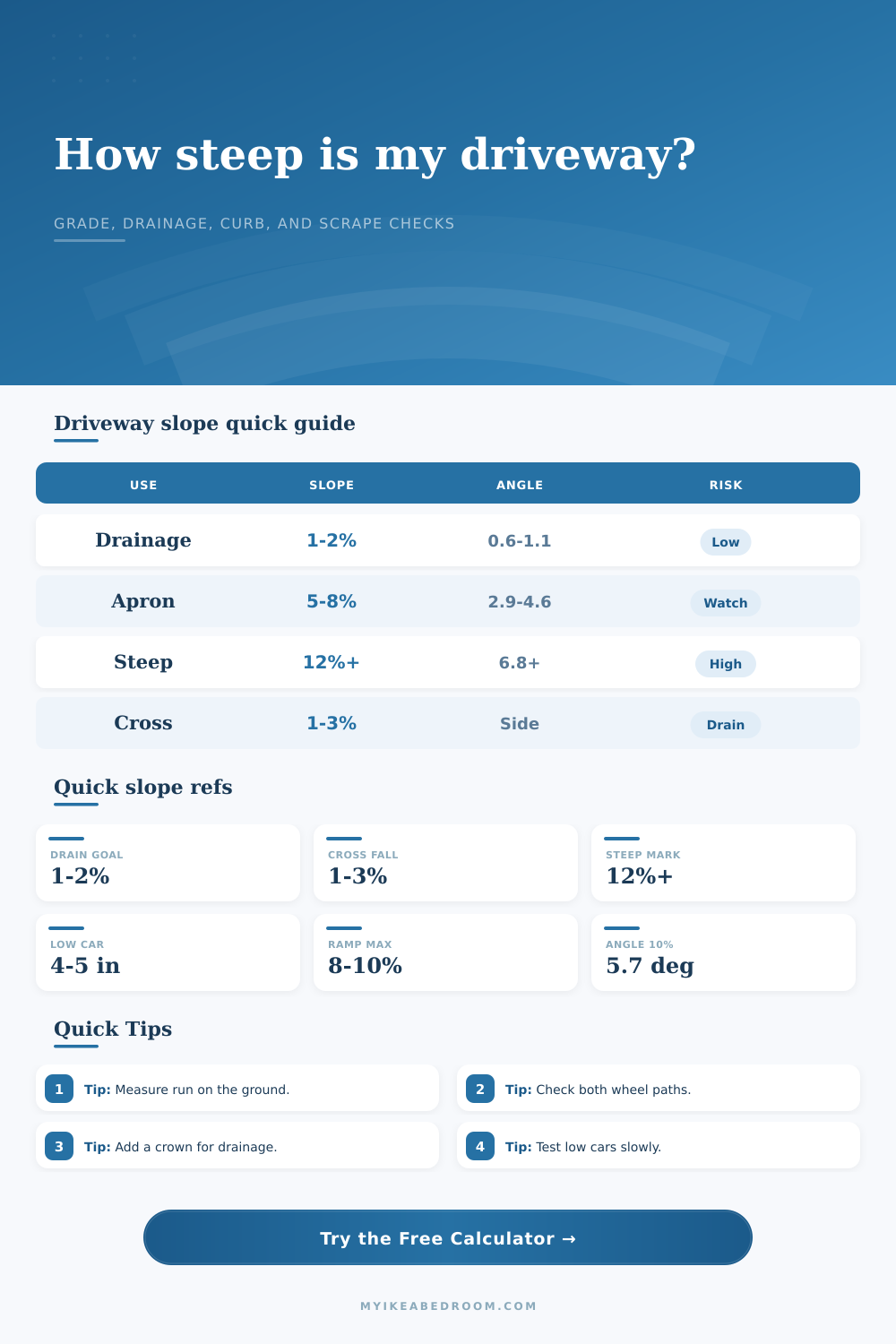
Common guidelines recommend maintaining maximum 1-3% cross slope so water can drain well while also not being slippery when wet. For longitudinal grades, typical recommendations are two to eight percent depending on the length of the drive. When you measure that you’re out of range, this tool will tag it as something more risky.
The driveway is like a transition area, part public street and part personal space. It has to support heavy vehicles, carry away surface water, and create a comfortabley ride every day. You cannot optimize for one requirement without considering the others. How do you make it drain well without impeding vehicles? How do you ensure a comfortable ride without thinking about what happens when it rains?
Running the numbers through the calculator after careful measurement will show you exactly where you’re starting from. It translates a fuzzy feeling like “something doesn’t feel right” into real numbers you can do something with. If you have a problem driveway (new or existing), knowing your grade is the first step in fixing it. Grab the tape measure, check both wheel tracks, and the numbers will tell you what to do next.