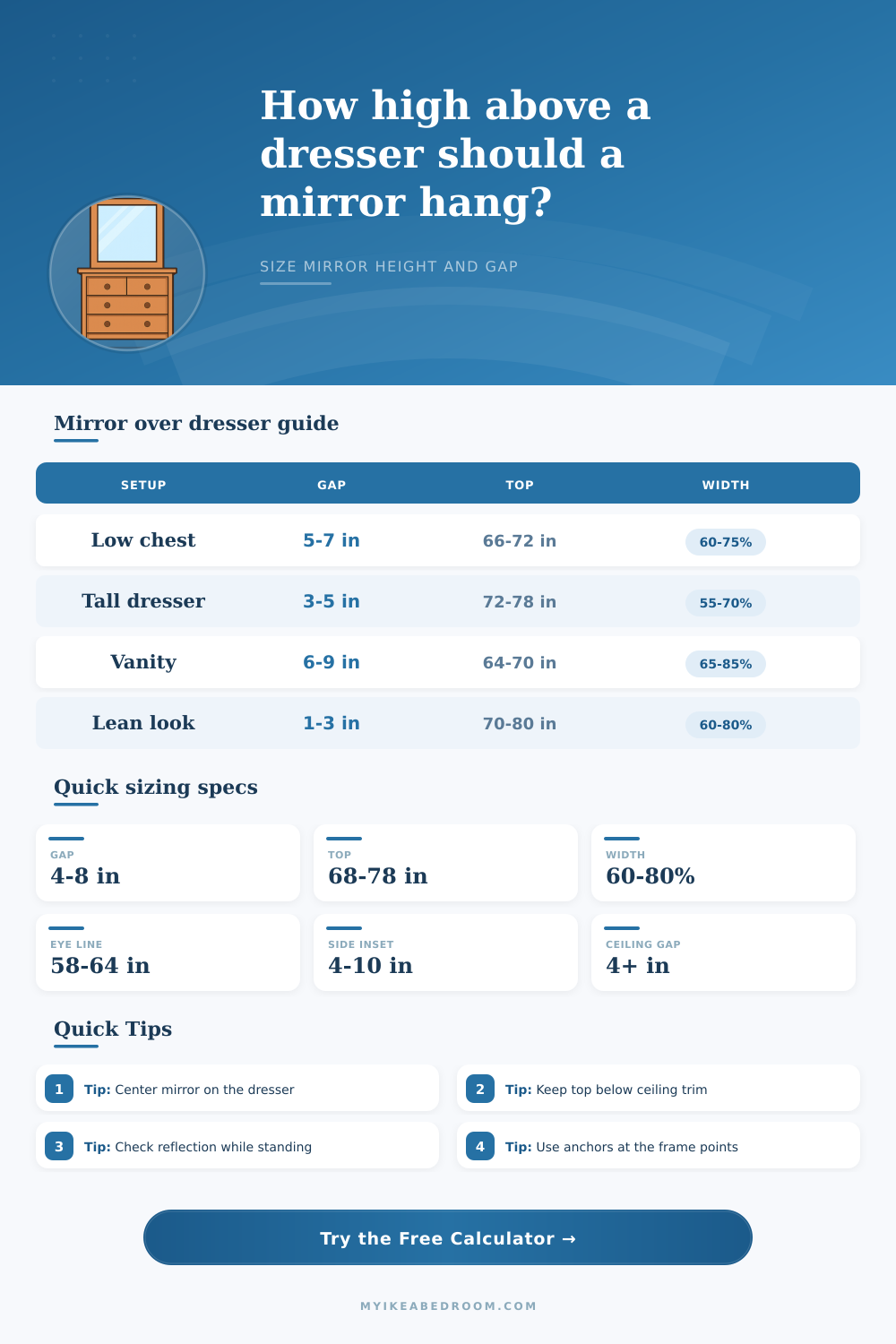
Dresser Height for Mirror Calculator
Plan the mirror bottom height, top height, dresser gap, width ratio, eye-line alignment, ceiling clearance, and hanging mark before you drill above a dresser.
Pick a real bedroom scenario, then adjust the dresser, mirror, ceiling, user height, frame, and hanging hardware for your room.
What the calculator checks
Dresser gap: finds a practical opening between the dresser top and the mirror bottom so the pair reads as one grouped piece.
Eye-line fit: compares the mirror center and reflective area to estimated standing eye height, with adjustments for vanity and child rooms.
Ceiling clearance: checks the top of the mirror against ceiling height, crown molding, and a top buffer before recommending changes.
Width balance: compares mirror width to dresser width and estimates side inset so the mirror is not too narrow or too wide.
| Dresser height | Usual mirror gap | Why it works | Watch point |
|---|---|---|---|
| 28 to 32 in / 71 to 81 cm | 6 to 9 in / 15 to 23 cm | Low dressers can handle a slightly larger opening without the mirror feeling too high. | Check that the mirror top still reaches a useful reflection height. |
| 33 to 38 in / 84 to 97 cm | 4 to 8 in / 10 to 20 cm | This is the most common dresser band for bedroom mirrors. | Wide dressers usually need a mirror with enough width to feel connected. |
| 39 to 45 in / 99 to 114 cm | 3 to 6 in / 8 to 15 cm | Tall dressers push the mirror upward, so the bottom gap often shrinks. | Ceiling clearance and mirror height become the limiting measurements. |
| 46 in+ / 117 cm+ | 2 to 5 in / 5 to 13 cm | Small gaps keep the mirror visually tied to a tall chest. | A large mirror may top out too close to crown molding or ceiling trim. |
| Mirror width ratio | Visual reading | Best use | Adjustment idea |
|---|---|---|---|
| Under 50% | Small accent mirror | Narrow chest, layered art, or intentionally minimal styling. | Use a taller mirror, pair side sconces, or choose a wider frame. |
| 50% to 60% | Light and airy | Small bedrooms where the wall should not feel heavy. | Center carefully and keep side objects balanced. |
| 60% to 80% | Classic balance | Most dresser mirror combinations. | Keep the mirror centered over the dresser, not the room wall. |
| 80% to 95% | Wide statement | Low long dressers, large suites, and strong horizontal layouts. | Leave a visible side inset so edges do not look crowded. |
| Over 95% | Nearly full width | Intentional wall-panel or leaning-style looks. | Confirm drawer clearance, lamp placement, and side trim. |
| Scenario | Dresser and mirror | Typical top height | Planning note |
|---|---|---|---|
| Standard six-drawer dresser | 34 in dresser with 36 in mirror | 74 to 78 in / 188 to 198 cm | A 4 to 6 in gap usually feels connected without crowding decor on top. |
| Low double dresser | 30 in dresser with 34 in wide mirror | 68 to 74 in / 173 to 188 cm | Low furniture can use a slightly larger gap to lift the mirror center. |
| Tall chest | 42 in chest with 30 in mirror | 74 to 78 in / 188 to 198 cm | Shorter mirrors or smaller gaps protect ceiling clearance. |
| Vanity dresser | 30 in desk-height dresser with 32 in mirror | 66 to 72 in / 168 to 183 cm | Seated reflection matters, so eye-line targets sit lower than a standing-only mirror. |
| Kid room dresser | 30 in dresser with 28 in mirror | 62 to 68 in / 157 to 173 cm | Lower the center while keeping enough clearance for top storage and lamps. |
| Hardware type | Measurement to enter | Hanging mark formula | Check before drilling |
|---|---|---|---|
| Sawtooth hanger | Top of frame to tooth notch | Mirror top minus hook drop | Confirm the notch is centered and rated for the mirror weight. |
| D-ring pair | Top of frame to ring center | Mirror top minus ring drop | Level both marks and account for ring thickness. |
| Picture wire | Top of frame to pulled wire apex | Mirror top minus wire apex drop | Pull the wire upward as it will sit on the hook. |
| French cleat | Top of frame to cleat engagement line | Mirror top minus cleat drop | Keep the cleat level and anchored across studs or rated anchors. |
Measure the outside frame. The calculator uses the full mirror height and width because the frame controls top height, side inset, and hardware marks.
Center on the dresser. If the dresser is not centered on the wall, align the mirror to the dresser first so the furniture group reads cleanly.
Mock the bottom edge with tape. A strip of painter tape at the calculated bottom height quickly reveals whether the gap feels too large or too tight.
Measure hardware under tension. For wire hangers, pull the wire upward before measuring the drop from mirror top to hook point.
When you move into an apartment, the first thing you probably see is the old mirror’s gaping hole on the wall. There it is, a black-and-blue reminder of its former self, a bit too tall (or short) for whatever piece of furnitures now inhabits its footprint. It makes sense, intuitively, to hang a mirror over a dresser … until you go measure the room. At that point, the geometry become muddled. How much will I need to clear under my ceiling? What size should the mirror be? Where do I want to stand as I put on makeup and get dressed every morning? You have to balance the visual weight of the glass against the height of the chest. How tall am I going to make the mirror?
Once you input your numbers into the calculator above, it do all of the math for you, saving you any guesses about where these coefficients fall. The gap, most folks begin here. You’ll find design books suggesting 4-8″ separation from the mirror bottom to the dresser top. Why? Because it maintains visual connection between two pieces while still allowing each to retain its own character (as opposed to being one giant chunk of furniture). As your dresser gets taller, that space reduce. A tall dresser (forty-five inch chest) pulls everything up higher. A big gap would cause the mirror to float above crown molding.
How to Hang a Mirror Over Your Dresser
The trick here is that tool allows you to enter exact dimensions of your existing furniture + ceiling clearance. It calculates whether your selected mirror will hang too low or top out uncomfortably close to the trim. This is where many people go wrong: they think only about the bottom edge and neglect the ceiling restriction completely.
Although we tend to think of height before width, that’s not necessarily true. In general, we’d like to see the mirror cover about sixty to eighty percent of dresser width. That allows the mirror to ground the piece, without dominating the space on the wall. Too narrow, and it reads like an afterthought. Too wide, and you lose room for those decorative items you may wish to feature on top of the dresser; also, lampshades gets crowded out by the mirror. The calculator does this math for you (so to speak), and lets you know if your selected mirror matches the classic balance band or tends more towards a statement option. If you want a narrower accent mirror, just change the width number, but the result will show you if it is set too far from the eye to track comfortabley.
Theory and taste collide during eye-line alignment. Most standard mirrors has their centerline positioned around 60″ off the floor, roughly the right place for someone of average standing height. If you use your dresser as a vanity seat, though, that centerline is far too high. That’s where the tool’s ability to switch between contexts comes into play. Switch it to “vanity” mode, and it drops its recommended eye-line target. This lets you keep your neck uncraned and feet off the rug while still being able to see yourself. A little tweak in the input make a big difference in what it draws for you to hang.
The nails: Most homeowners don’t know how important hardware is. At the top of the frame, there’s a saw tooth hanger; then a few inches down are either wire hooks or D-rings. Ignore the difference in height and your mirror will be too high on the wall. To determine exactly where to put the nail, the calculator needs to know the distance from the hook point (where the nail goes) to the top of the frame. Measure the distance after pulling the wire tight to get an accurate measurement.
Tape out the line for your mirror on the wall first before you drill. Take a step back and livig with it for a day. Is the gap too crowded? Is the top hitting into the ceiling trim? Nothing beats seeing it in person rather than digital calculation any time. When you’re happy with the placement, mark out the spots according to the drop of the hardware. It’s not as much about perfect measurements as it is about understanding how the pieces will relate to each other in 3D space. Think it through before you pick up that hammer or you would of had a bruise on the wall.