Dresser Drawer Fit by Width Calculator
Calculate clear drawer width after rails, dividers, side buffers, and folded stack lanes so drawer organizers fit before you rearrange clothing.
No divider
Keeps the full drawer width for one flexible zone. Best when stacks vary from week to week or folded widths are uneven.
One divider
Creates two wide compartments. Useful for splitting shirts from jeans while losing only one divider thickness.
Two dividers
Creates three steady lanes. This is the common balance for shirts, pants, and small folded stacks in a medium drawer.
Three or more
Improves category separation but removes more width. Check average compartment width before adding another panel.
| Folded stack type | Compact lane | Comfort lane | Width note |
|---|---|---|---|
| Socks or underwear rolls | 4 to 5 in | 5 to 6 in | Works well in narrow divider cells |
| T-shirts or light tops | 7 to 7.5 in | 8 to 9 in | Measure after the final fold |
| Sleepwear or leggings | 7.5 to 8.5 in | 9 to 10 in | Soft fabric benefits from buffer |
| Jeans or heavy pants | 8 to 9 in | 9.5 to 11 in | Bulk grows when pairs are stacked high |
| Sweaters or hoodies | 10 to 12 in | 12 to 14 in | Often needs fewer, wider compartments |
| Accessory bin or cup | 3 to 6 in | 6 to 8 in | Use the actual bin width plus lift room |
| Drawer side condition | Per-side allowance | Total side loss | Use when |
|---|---|---|---|
| Clean frameless box | 0 to 0.25 in | 0 to 0.5 in | Organizer sits inside a clear rectangular box |
| Low side rail or lip | 0.5 in | 1 in | Small side hardware touches organizer edges |
| Typical drawer slide | 0.75 in | 1.5 in | Most dresser openings with side runners |
| Thick rail or face frame | 1 to 1.25 in | 2 to 2.5 in | Opening narrows behind the drawer front |
| Stop bracket or uneven side | 1.5 in or more | 3 in or more | One side has hardware that blocks the lane |
| Divider count | Compartments made | Loss with 0.25 in panels | Best width pattern |
|---|---|---|---|
| 0 dividers | 1 compartment | 0 in | One flexible stack zone or a single wide bin |
| 1 divider | 2 compartments | 0.25 in | Two broad folded categories |
| 2 dividers | 3 compartments | 0.5 in | Three shirt or mixed clothing lanes |
| 3 dividers | 4 compartments | 0.75 in | Small items plus two clothing lanes |
| 4 dividers | 5 compartments | 1 in | Accessory-heavy layouts in wide drawers |
| 5 dividers | 6 compartments | 1.25 in | Only if average lane width still clears stacks |
| Drawer scenario | Opening width | Typical divider count | Width planning note |
|---|---|---|---|
| Compact nightstand drawer | 14 to 18 in | 0 to 1 | Small item lanes fit better than full shirt stacks |
| Narrow dresser drawer | 18 to 22 in | 1 | One divider often leaves two useful lanes |
| Medium dresser drawer | 24 to 30 in | 2 | Three folded lanes are usually realistic |
| Wide dresser drawer | 32 to 38 in | 3 to 4 | Check rail loss before adding small compartments |
| Double-width drawer | 40 in or more | 4 to 5 | Use average compartment width to prevent narrow lanes |
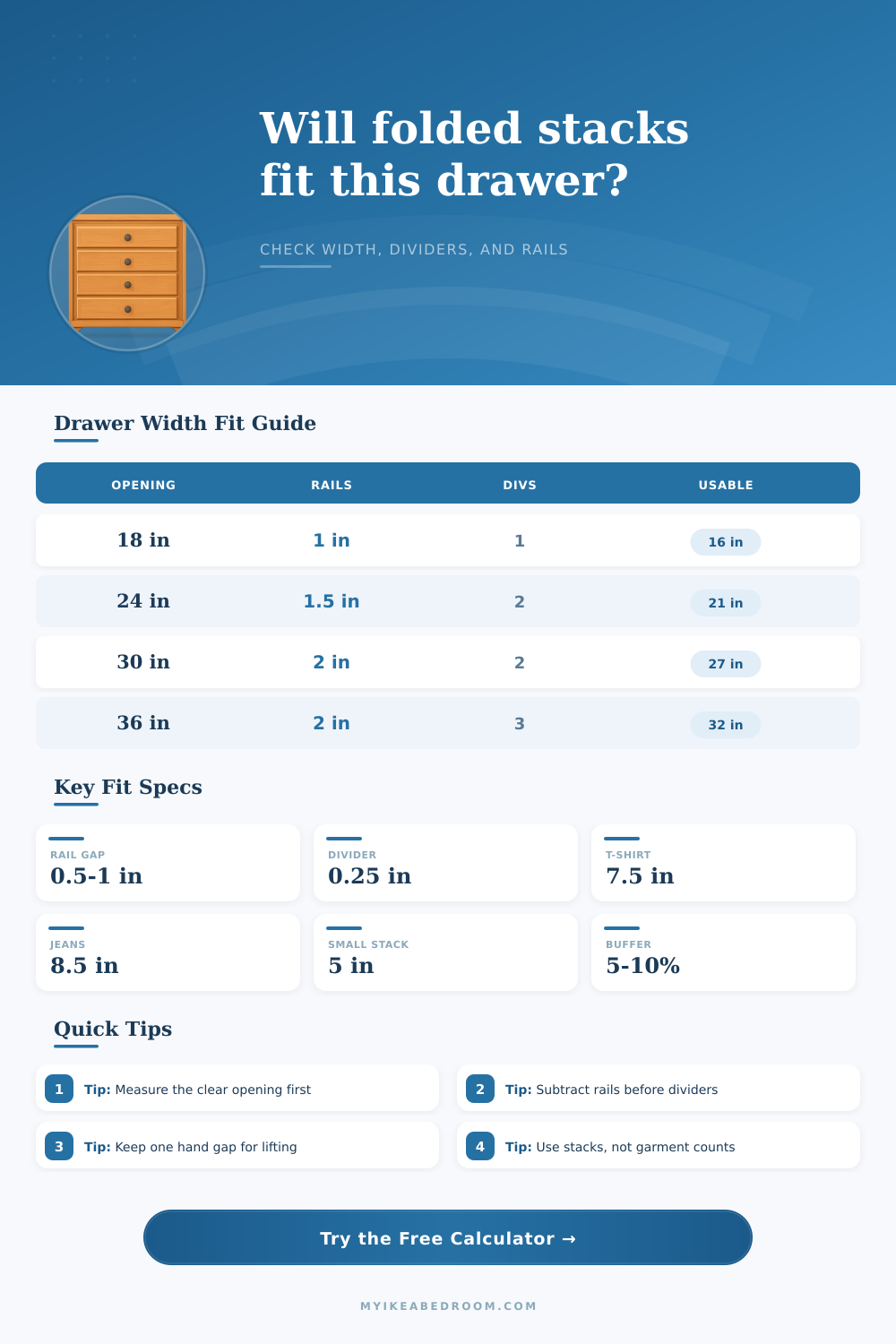
When you measure a dresser drawer, you have to account for the difference between the visible width of the drawer and the usable width of the drawer. The visible width of the drawer is the width of the front of the drawer. The usable width of the drawer is an available width for the clothes after accounting for the hardware in the drawer and any dividers.
Many people dont account for the hardware and the dividers so their clothes wont fit within the dresser drawer. If they dont account for these elements, their clothes will be crammed against the sides of the drawer. To find the total width of the dresser drawer, you must measure from inside wall to inside wall.
How to Measure a Dresser Drawer for Clothes
After you find the total width of the dresser drawer, you must subtract the width that the hardware will take up from each side of the drawer (rail clearance) and the thickness of each divider panel. You should also account for the buffer width to provide space for your finger to remove the clothes from the drawer. The calculator will automatically account for each of these elements and show you the usable width of the drawer after each subtraction.
The width of each lane within the dresser drawer will depend upon the type of clothing that you will store in the drawer. For example, folded shirt lane will have the same measurement for each lane. However, the measurement will change based off the fabric weight of the shirts.
Jeans will require more width then T-shirts, and sweaters will require more width than jeans. You can enter the width of each clothing stack in the calculator to determine if the total width will fit within the usable width of the dresser drawer. The buffer percentage will depend upon the amount of extra space that you want within the dresser drawer.
For example, a five percent buffer will provide extra space for clothes, but it will be less extra space then a fifteen percent buffer. The larger the buffer percentage, the more space will be provided for clothes. However, if too much space is provided for the clothes, the number of lanes that the clothes can take up will decrease.
The calculator will show the difference between each percentage of buffer. Rail clearance will take up part of the usable width of the dresser drawer. The slides for the dresser drawer and the stops that holds the drawer in place within the dresser take up the space.
The clearance for the left side of the dresser drawer might not be the same as the right side. Therefore, you must enter each of the clearances separately into the calculator. If the clearance is not accounted for, the usable width will be less than expected.
Dividers can provide more room for categories of clothing to be separated. However, each divider will take up some of the usable width of the drawer. The calculator can determine the usable width after the calculator accounts for each divider.
Furthermore, the calculator will also calculate the average width of each divider after accounting for the total number of clothing categories. If the average width is less than the width of the clothing categories, some dividers will have to be removed. The calculator will allow you to test various scenarios for different type of dresser drawers.
For instance, nightstand drawers will be narrow so narrow lanes will be used for the items that will be stored in those drawers. Medium dresser drawers may be able to contain three lane of clothing. However, you will have to subtract the width of the rails and the dividers from the total width of the drawer first.
Lastly, wide dresser drawers can allow for many lanes for clothing. However, the wide space will also allow for many dividers to be placed within the dresser which could make the spaces for the clothing too narrow. Therefore, you will have to enter the numbers for your specific dresser drawer into the calculator before purchasing any dividers for the dresser.
The reference tables can help you find the measurements for the different aspects of the dresser drawer. For example, the reference tables can provide the standard allowance for the hardware, the thickness of the dividers, and the width of the clothing stacks. These tables can help you find your own measurements and the width of your clothing.
Though not rules, these reference tables can assist you in determining the measurements for your dresser drawer. Furthermore, by finding your own measurements, the calculator will provide you with a concrete number regarding the usable width of your dresser drawer. The final step is to place the clothes into the dresser drawer to see if the clothes will fit.
While the calculator may provide you with the correct calculations for each aspect of the dresser drawer, you will have to physically place the clothes into the dresser drawer. Furthermore, you will have to ensure that your fingers will be able to reach the bottom of the drawers without disrupting the other categories of clothing within the dresser drawer. If all of these elements match up, the dresser drawer will function correctly.
The dresser drawer will function correctly due to the fact that you have accounted for the rail clearance, the thickness of the clothing dividers and the buffer.