
Choosing the correct size for a drawers involves considering how the size of the drawer will impact the organization of the items place within the drawer. If a drawer is of an wrong size for the items to be stored within it, the items will become disorganized within the drawer, and the drawer may not perform correctly to the function that the furniture is to serve. To avoid these issue with the drawer becoming disorganized, the height, width, and depth of the drawer should be matched to the items that are to be stored within the drawer.
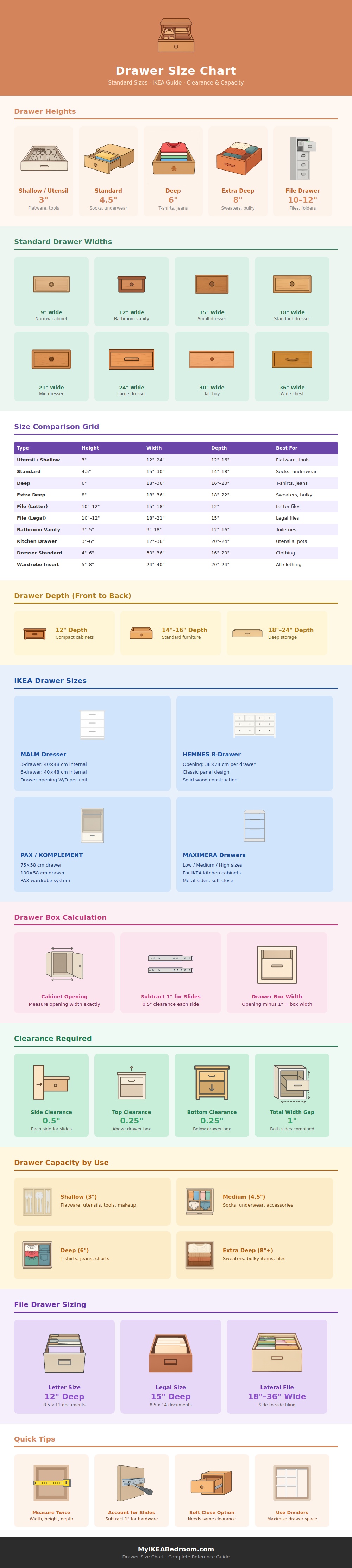
The height of the drawer is the first dimension that should be considered when choosing the size of a drawer. The height of the drawer will dictate the type of items that can be placed into the drawer. For instance, drawers with a height of three inches are best for items that are small and shallow in size, such as flatware or small tool.
How to Choose the Right Drawer Size
If the height of the drawer is too great for these types of small items, the items will be difficult to find within the drawer. Drawers with a height of four and a half inches are suitable for items like socks or underwear. A four-and-a-half inch height is sufficient to allow the items to be stack within the drawer without the items getting crushed.
Drawers with a height of six inches may be appropriate for items like t-shirts or jeans. Drawers with a height of eight inches may be used for bulky items like sweaters. The height of the drawer should be chosen according to the bulk of the items that are to be stored in the drawer.
The bulk of the items will prevent the drawer from feeling empty of items. The second dimension to consider for drawers is the width of the drawers. Drawers with a width of nine or twelve inches is suitable for items like bathroom vanities.
Such narrow drawers are used to store toiletries and take up little space on the vanity. Drawers with a width of fifteen or eighteen inches are often used in dressers. Such a width is suitable for clothing and allow for easy access to these items.
Finally, drawers with a width of twenty-one to thirty-six inches are used in tallboys or chests of drawers. These pieces of furnitures often contain more storage space for clothing and other items. Drawers that are too wide for delicate items will feel cavernous within their furniture, while drawers that are too narrow for items like jeans will feel cramped for those item.
The third and last dimension to consider is the depth of the drawers. Drawers with a depth of twelve inches are often used in kitchens and bathrooms. Such a shallow depth allow the drawers to remain compact within the area of the kitchen or bathroom where they are placed.
Standard depths of furniture drawers are between fourteen and sixteen inches deep. This standard size is typicaly the most convenienty for the majority of tasks. Finally, drawers with a depth of eighteen to twenty-four inches are used for items that require deep drawers, such as kitchen pots or linen storage.
Drawers that are too shallow for these items will cause the items to push against the back of the drawer, and the drawer will not close. When building a drawer, the dimensions for the opening of the piece of furniture should be measured. One inch should be subtracted from the total width of the opening for the drawer for the slide hardware that will be used for the drawer.
The hardware will require clearance of half an inch on each side of the drawer. Additionally, there should be clearance of a quarter of an inch at the top and bottom of the drawer. These clearances will prevent the drawer from rattling or scraping against the sides or the furniture upon which the drawer rest.
If building file drawers, specific dimensions will be required. For instance, files that use hanging folders that are the size of a letter can fit within a drawer that is twelve inches in depth. Files that use hanging folders that are of the size of legal paper will require a depth for the drawer of fifteen inches.
The width of a file drawer can range between fifteen and thirty-six inches in size, depending off whether the files are to be filed laterally or vertically. There are a few mistakes in the selection of drawers that should be avoided. One mistake is to ignore the draws and the slide hardware when measuring the dimensions of a drawer.
For instance, standard side mount drawer slides require that one inch of space be allowed for the slides; other types of slides require other specific depths. Secondly, another mistake is to place shallow items into deep drawers. Deep drawers that are often used to store items like clothing may become disorganized if shallow items is placed in the deep drawer.
Dividers can be used within the drawer to separate shallow items from deep items to maximize the use of the drawer and it’s space. Finally, the last mistake to avoid is not measuring the dimensions of the drawer twice. Errors in the measurement of a drawer will impact the function of the drawer, it may get stuck or may not function altogether.
You should of checked the measurements again.