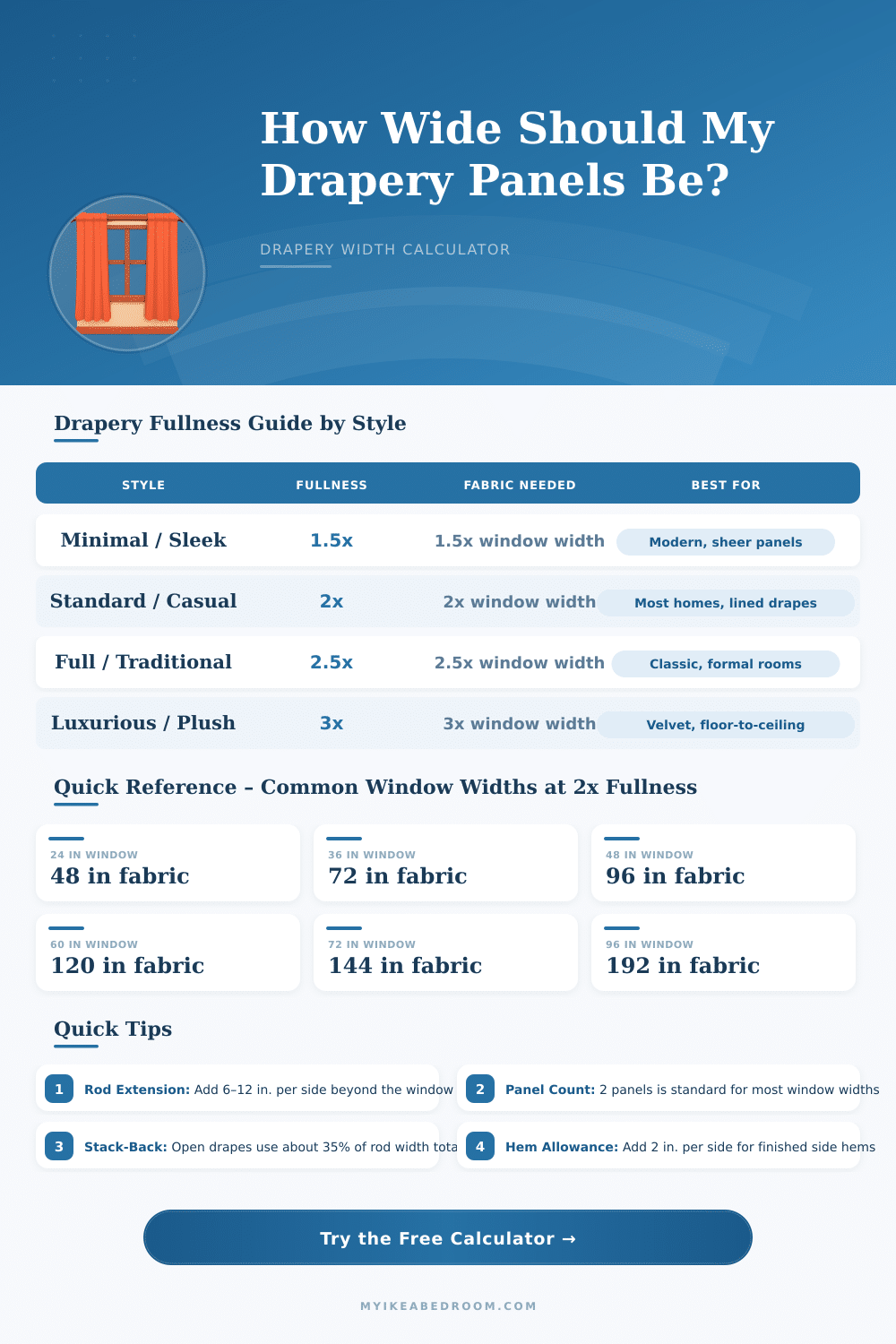
🛏 Drapery Width Calculator
Find the exact fabric cut width, panel size, and rod length for any window
| Window Width | 1.5× Fabric | 2× Fabric | 2.5× Fabric | 3× Fabric |
|---|---|---|---|---|
| 24 in (61 cm) | 36 in (91 cm) | 48 in (122 cm) | 60 in (152 cm) | 72 in (183 cm) |
| 36 in (91 cm) | 54 in (137 cm) | 72 in (183 cm) | 90 in (229 cm) | 108 in (274 cm) |
| 48 in (122 cm) | 72 in (183 cm) | 96 in (244 cm) | 120 in (305 cm) | 144 in (366 cm) |
| 60 in (152 cm) | 90 in (229 cm) | 120 in (305 cm) | 150 in (381 cm) | 180 in (457 cm) |
| 72 in (183 cm) | 108 in (274 cm) | 144 in (366 cm) | 180 in (457 cm) | 216 in (549 cm) |
| 96 in (244 cm) | 144 in (366 cm) | 192 in (488 cm) | 240 in (610 cm) | 288 in (732 cm) |
| Window Width | Base Fabric Width | + Hem Allowance | Total Cut Width | Cut Width Per Panel |
|---|---|---|---|---|
| 24 in | 48 in | + 8 in | 56 in | 28 in per panel |
| 36 in | 72 in | + 8 in | 80 in | 40 in per panel |
| 48 in | 96 in | + 8 in | 104 in | 52 in per panel |
| 60 in | 120 in | + 8 in | 128 in | 64 in per panel |
| 72 in | 144 in | + 8 in | 152 in | 76 in per panel |
| 84 in | 168 in | + 8 in | 176 in | 88 in per panel |
| Window Width | Rod (+6 in/side) | Rod (+8 in/side) | Rod (+12 in/side) |
|---|---|---|---|
| 24 in (61 cm) | 36 in (91 cm) | 40 in (102 cm) | 48 in (122 cm) |
| 36 in (91 cm) | 48 in (122 cm) | 52 in (132 cm) | 60 in (152 cm) |
| 48 in (122 cm) | 60 in (152 cm) | 64 in (163 cm) | 72 in (183 cm) |
| 60 in (152 cm) | 72 in (183 cm) | 76 in (193 cm) | 84 in (213 cm) |
| 72 in (183 cm) | 84 in (213 cm) | 88 in (224 cm) | 96 in (244 cm) |
| 96 in (244 cm) | 108 in (274 cm) | 112 in (284 cm) | 120 in (305 cm) |
| Room / Window Type | Typical Width | Panels | Fullness | Total Fabric |
|---|---|---|---|---|
| Standard Bedroom | 36 in | 2 | 2× | 72 in |
| Master Bedroom | 60 in | 2 | 2.5× | 150 in |
| Living Room | 72 in | 2–4 | 2.5× | 180 in |
| Sliding Glass Door | 80 in | 2 | 2× | 160 in |
| French Door | 60 in | 2 | 2× | 120 in |
| Bay Window | 96 in | 4 | 2.5× | 240 in |
| Bathroom / Small | 24–30 in | 1 | 1.5× | 36–45 in |
| Home Office | 48 in | 2 | 2× | 96 in |
Drapery width is the amount of fabric used to create custom panels. It determines not only the look of the curtains when they are opened or closed but also their efficiency. Because choosing the right width is very serious here the basic rules.
Usually, the panels should be two or three times wider than the window. That ensures that there is enough fullness for the pleats, which gives a nice and polished look. The precise measure depends on the type of fabric, the style, and if the curtains serve for actual closing or only as decoration.
How to Measure Curtain Width and Fullness
To count the necessary width, multiply the length of the rod or track by 1.5 for an airy look, by 2 for standard look, or by 2.5 for richer and full impact. After that, divide that number by the width of one panel and round it upward. Recall, that drapery panel is only one bit of fabric hanging on one side of the window.
For instance, one panel of 57 inces will cover between 28 and 38 inches of the window space.
According to industry standards, most decorator fabrics measure 54 inches wide, although that occasionally ranges. Some fabrics measure between 50 and 60 inches, but that is less common. Curtains bought in stores usually measure around 48 inches wide; that happens because from a 54-inch bit you lose some inches for the seaming and side hems.
Here is a real sample. Assume that the window measures 60 inches, with 12 inches added on every side for the rod extent. If we use double fullness, we will require total 120 inches of fabric to cover the window right.
“Flat width” means how much the curtain can tighten when it hangs. For covers with rod pocket, it is simply about the width of the fabric when it is extended.
When panels are only used to frame the window, almost any width gives enough fullness and works well. Some pinch pleat curtains already have fullness integrated in them. A decorator might favor one and half width on every side, which would mean 54 inches for one full width and 27 inches for the half.
The drapery rod should extend around 6 to 10 inches past the window frame, depending on the size of the window. Smaller windows require less extension. If you measure this way, the final product will extend 5 to 8 inches on every side of the window case.
When the curtains are opened, they stack outside the window to leave the view free. Recall about this position when you count the width, because the longer is the rod, the more fabric is necessary.