🛏 Drapery Panel Width Calculator
Size each panel, the full opening, and the cut width with clean, style-aware logic
📌 Quick presets
⚙ Panel settings
📊 Style guide
💡 Practical tips
📐 Fullness guide table
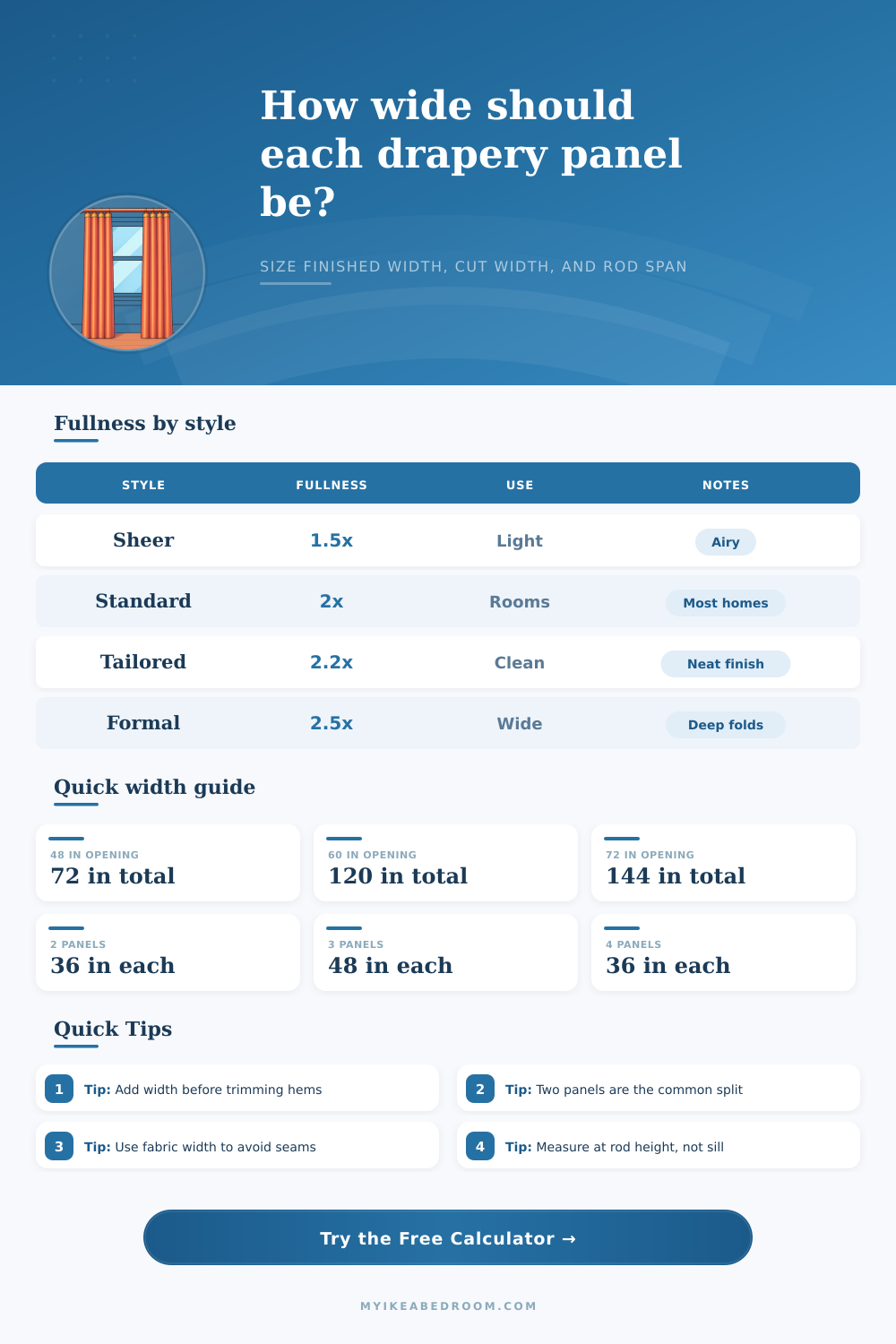
| Style | Fullness | Hem | Best use |
|---|---|---|---|
| Sheer and airy | 1.5x | 1 in | Light, open rooms |
| Standard lined | 2.0x | 1.5 in | Most bedrooms |
| Tailored casual | 2.2x | 1.5 in | Clean, relaxed rooms |
| Pinch pleat | 2.5x | 2 in | Formal living spaces |
| Blackout private | 2.75x | 2 in | Darkening and privacy |
| Luxe formal stack | 3.0x | 2.5 in | Deep, dramatic folds |
📏 Panel count guide
| Opening | 2 panels | 3 panels | 4 panels |
|---|---|---|---|
| 48 in | 24 in each | 16 in each | 12 in each |
| 60 in | 30 in each | 20 in each | 15 in each |
| 72 in | 36 in each | 24 in each | 18 in each |
| 84 in | 42 in each | 28 in each | 21 in each |
| 96 in | 48 in each | 32 in each | 24 in each |
| 120 in | 60 in each | 40 in each | 30 in each |
🛠 Fabric width guide
| Usable width | Single panel | Two panels | Note |
|---|---|---|---|
| 44 in | 1 width | 2 widths | Narrow decor |
| 54 in | 1 width | 2 widths | Common home fabric |
| 60 in | 1 width | 2 widths | Wide drape fabric |
| 72 in | 1 width | 1 width | Extra wide cloth |
| 96 in | 1 width | 1 width | Single panel only |
| 108 in | 1 width | 1 width | Very wide panels |
📑 Rod extension guide
| Opening | Short rod | Medium rod | Wide rod |
|---|---|---|---|
| 36 in | 4 in each side | 6 in each side | 8 in each side |
| 48 in | 5 in each side | 7 in each side | 10 in each side |
| 60 in | 6 in each side | 8 in each side | 12 in each side |
| 72 in | 6 in each side | 8 in each side | 12 in each side |
| 84 in | 7 in each side | 10 in each side | 14 in each side |
| 96 in | 8 in each side | 12 in each side | 16 in each side |
📋 Width reference cards
Sheer
Best when you want daylight, softness, and a slimmer stack at the sides.
Standard
The common starting point for bedrooms, offices, and casual living spaces.
Formal
Use for heavier fabrics, tailored pleats, and a stronger visual frame.
Luxe
Ideal for velvet, dramatic windows, and the widest, richest drape look.
For excellent face matter to reach the right width of the drapery panels. First measure the window that you want to cover. The width estimates between the walls of the window frame.
At typical windows you operate to add fully 12 inches to the whole wide count. Like this covers about 6 inches and have 6 inches for returns what gives nice seamless look. Otherwise you can add 4 until 5 inches of coverage at every side.
How to Measure Curtain Width and Number of Panels
What does whole of 8 until 10 inches to the window width. For instance for 52-inch window use size of 68 inches or more for expand the window sight. Only recall that both sides of the window molding stays visible by means of this solution.
Fullness forms center of the width. For avoid wrong look the cloth width must not be less than double in the window width. Usual rule-of-thumb suggests fabric in 1.5 until 3 times the window width.
This ensures right fullness during pleats. For 100-inch window intend curtain width of 150 until 200 inches. At dense curtain usually 48 until 54 inches wide require 4 panels for central opening.
In bedrooms panels usually follow 2 until 2.5-times width rule. Heavy fabrics well help against drafts here. Decorative panels that does not close intend half window width included apt amount.
Different styles require different rules. At pleated drapery the standard is double fullness so twice the rod width. For ripple folds the panel width matches rod or track width divided by panel number.
Hanging the bottom panel width will be around 2.1 times the upper. The flat draperwidth must be two until three and half times the dressed or stacked back width. Many panels measure 50 until 54 inches.
Standard draperlength accustom 63, 84, 95, 108 or 120 inches. For whole width multiply the rod longon in 1.5 for light face 2 for standard or 2.5 for full fullness.