Furniture dowel drilling planner
Dowel Pin Hole Size Calculator
Choose a dowel size, board thickness, hole depth, glue clearance, wood hardness, edge distance, drill tolerance, and moisture fit to size reliable dowel holes.
Pick a familiar furniture setup, then tune the hole depth, edge distance, and fit to match your jig and stock.
Drilling breakdown
Shelf locator
Clearance: 0.05 to 0.10 mm
Short pins, shallow holes, and close shelf alignment.
Balanced dowel
Clearance: 0.10 to 0.15 mm
Typical fluted dowel fit for cabinets and casework.
Hardwood apron
Clearance: 0.15 to 0.25 mm
Allows glue escape and reduces splitting in dense stock.
Service locator
Clearance: 0.25 to 0.40 mm
Loose positioning fit when the dowel should not lock hard.
| Dowel size | Typical bit target | Common use | Starting hole depth |
|---|---|---|---|
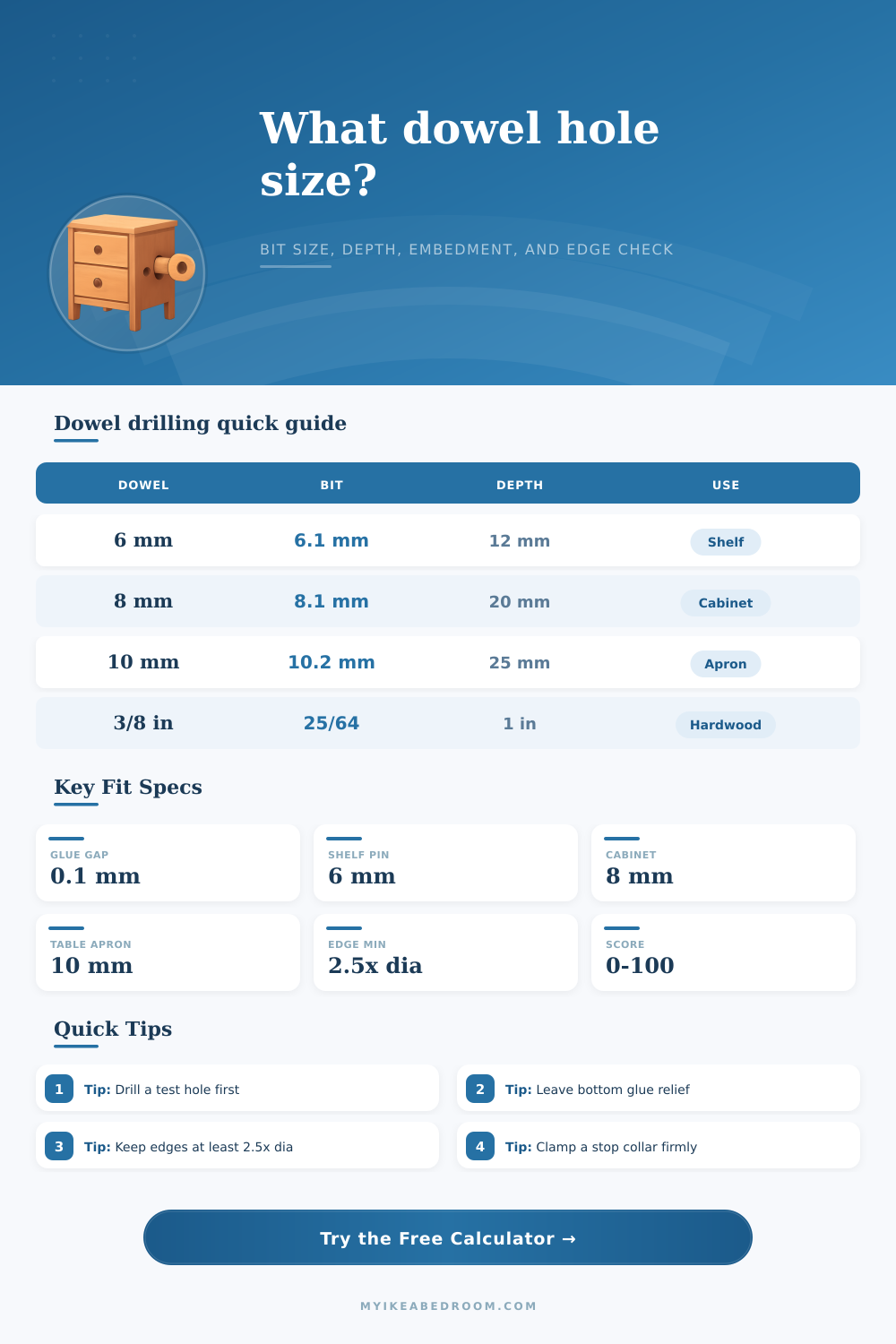
| 5 mm shelf locator | 5.05 to 5.10 mm | Drawer pins, small locators | 8 to 12 mm per side |
| 6 mm cabinet dowel | 6.05 to 6.15 mm | Shelves, light casework | 12 to 18 mm per side |
| 8 mm furniture dowel | 8.10 to 8.20 mm | Flat-pack style panels, cabinet sides | 18 to 25 mm per side |
| 10 mm furniture dowel | 10.15 to 10.25 mm | Table aprons, thicker rails | 25 to 32 mm per side |
| 1/4 inch dowel | 1/4 in to 17/64 in | Jig dowels, light hardwood work | 1/2 to 3/4 in per side |
| 3/8 inch dowel | 3/8 in to 25/64 in | Hardwood frames, aprons | 3/4 to 1 in per side |
| Joint type | Embedment target | Edge target | Notes |
|---|---|---|---|
| Shelf pin or locator | 1.5x to 2x diameter | 1.5x diameter | Alignment work, light load, avoid drilling through thin panels. |
| Face-to-face cabinet joint | 2x to 2.5x diameter | 2x diameter | Good for panel registration and glue-up alignment. |
| Edge-to-edge furniture joint | 2.5x to 3x diameter | 2.5x diameter | Use paired dowels with spacing and clamp pressure. |
| Case corner or butt joint | 2.5x to 3.5x diameter | 3x diameter | More edge distance helps prevent blowout and splitting. |
| Table apron into leg | 3x to 4x diameter | 3x diameter | Check depth against leg size and seasonal movement. |
| Bed rail or stretcher | 3.5x to 5x diameter | 3.5x diameter | Use larger spacing and mechanical support where needed. |
| Material group | Clearance add | Edge factor | Drilling behavior |
|---|---|---|---|
| Softwood or poplar | 0.00 to 0.05 mm | 2.0x diameter | Compresses easily but can wander with dull bits. |
| Medium hardwood | 0.05 to 0.10 mm | 2.5x diameter | Most balanced furniture dowel setting. |
| Hard maple, oak, ash | 0.10 to 0.15 mm | 3.0x diameter | Needs a clean bit and room for glue escape. |
| Brittle hardwood | 0.15 to 0.20 mm | 3.25x diameter | Extra clearance and edge distance reduce splitting. |
| MDF or particleboard | 0.10 to 0.25 mm | 2.25x diameter | Avoid repeated dry fits that loosen fibers. |
| Check | Light work | Furniture work | Heavy work |
|---|---|---|---|
| Center-to-edge distance | 1.5x to 2x diameter | 2.5x diameter | 3x to 3.5x diameter |
| Center-to-center spacing | 3x diameter | 4x diameter | 5x diameter |
| Bottom web left in board | 1 mm plus 0.15x diameter | 1.5 mm plus 0.20x diameter | 2 mm plus 0.25x diameter |
| Combined depth relief | 0.5 to 1 mm | 1 to 2 mm | 1.5 to 3 mm |
Test the fit before drilling the workpiece. A fluted dowel should slide with firm hand pressure after glue clearance is included. If it needs hammering while dry, the final glue-up may bottom out or split a thin edge.
Control depth with a positive stop. Tape flags can move during repeated holes. A stop collar, drill press stop, or doweling jig stop gives more reliable embedment and preserves the bottom web.
When gluing two pieces of wood together with dowels, the holes you drill are important for the strength of the resulting joint. The size and the depth of the holes will determine whether the joint created with the dowels is either strong or weak, stable or frustrating to work with. If the dowel fit too tightly into the hole in the wood, the dowel may split the grain of the wood, or the dowel may not fully seat into the hole.
However, if the dowel fits too loosely into the hole, the dowel may rock within the joint under a load that is placed upon the glued joint, weakening the glue line between the two pieces of wood. Each of these factors, the diameter of the hole, the depth of the hole, and the distance from the center of the dowel to the nearest edge of the wood, is critical to the strength of the resulting joint, whether it is a piece of furniture or an cabinet. A dowel hole size calculator is a useful tool that can allow a craftsman to determine the size of the dowel hole in a piece of wood based off the thickness of the board, the diameter of the dowel that is to be used, and the type of joint that is to be created.
How to Pick the Right Dowel Hole Size
A dowel hole size calculator consider the type of wood that will be used in the project. For instance, hardwoods like hard maple and oak do not permit for oversized dowel holes, while woods like poplar are more forgiving of oversized dowel holes. Additionally, wood types like MDF and plywood have a tendency to split if they are dry-fitted with a dowel.
Such considerations of the type of wood that will be used ensures that a craftsman does not have to guess as to whether the clearance that is calculated for a project will be enough clearance for the wood that is to be used. Another factor that a dowel hole size calculator considers is the edge distance of the dowel from the edge of the piece of wood. If a dowel is too close to the edge of a piece of wood, the wood between the dowel and the edge will have little strength to resist splitting forces.
This lack of strength results from glue pressure against the wood, and the seasonal movement of the wood. A dowel hole size calculator considers the edge distance for both light shelf pins to be made with the dowel, and for the creation of load-bearing table aprons. Additionally, the dowel hole size calculator will also consider the distance between multiple dowels to be placed in a single piece of wood; if the dowels are too close to each other, there is a risk that the dowels will split the wood.
The depth of the dowel hole is an important factor to consider when creating a joint with dowels, and it is an easy factor to get wrong when creating the joint. The dowel must be strong enough to allow for adequate embedment into the wood; it cannot be too deep into the wood, yet there must be an empty pocket within the wood at the deepest point of the dowel hole for the glue to be able to properly fill the joint when the dowel is driven into the wood. If the glue has no place to go into the wood when inserting the dowel, the dowel may bottom out within the wood before the two faces of the wood meet, or the glue pressure may split the wood.
A dowel hole size calculator will ensure that the length of the dowel has enough clearance within the piece of wood being joined. Additionally, the dowel hole size calculator will also ensure that there is enough wood remaining at the back of the hole such that the dowel does not end within a visible face of the piece of wood. Other factors in the formation of a strong, succesful dowel joint include the moisture content of the wood, and the seasonal movement of the wood.
A joint that is created with perfect fit when the wood has a low moisture content may become too tight if the wood gains moisture in the environment in which the furniture or cabinet is to be used. A dowel hole size calculator allows a craftsman to select the type of fit for the dowel within the wood based upon the moisture and seasonal movement of the wood within the environment in which the object is to be used. If an indoor fit is chosen, the joint will allow for modest seasonal movement of the wood.
Yet if the furniture or cabinet is to be used outdoors, or in areas that experience high seasonal movement, there will be more clearance between the dowel and the wood relative to indoor environments. Conversely, if the environment is very dry, the wood may shrink away from the dowel when it dries; shrinking wood will create sloppily within that joint. By using a dowel hole size calculator prior to using a drill to create dowel holes within the wood, a craftsman can avoid many mistakes.
The dowel hole size calculator can reveal to a craftsman if the embedment of the dowel within the wood will create too thin of a remaining piece of wood within the project. Additionally, a craftsman can use the dowel hole size calculator to check if the spacing between two dowels is too close for the type of joint that is to be created. Any adjustment of an input within the dowel hole size calculator will automatically adjust the safety score within the calculator, as well as the size of the dowel bit that is to be used to drill the holes within the piece of wood.
Many wood crafters make mistakes with dowel joints due to not considering each of the factors that go into the strength of the joint. For instance, many crafters use the same size drill bit for every type of project. Additionally, many crafters simply use the same depth for the dowel hole as they used for another project when they created another joint.
For instance, a 10 mm dowel may be required for the creation of a table leg, but a 6 mm dowel may be the size that is used for a shelf pin for a cabinet. While a dowel hole size calculator does not eliminate the need for a craftsman to consider each of the factors that contribute to the strength of the dowel joint, it does make it easier for the craftsman to focus upon the joint itself, rather than upon each of the individual rules regarding each of the factors of the joint. Another consideration for crafters is to always drill test holes into scrap wood that is of the same type as the wood that is to be joined together with dowels.
A dowel hole size calculator can never account for using a dull drill bit, or for drilling the test holes with an off-center jig. A craft tool can drill test holes within scrap wood to feel the fit of the dowel, and to ensure that the pocket for the glue fills correctly and completely. If the dowel fits well into the scrap wood, and if there is a small pocket at the deepest portion of the test hole for the glue to fill, the craftsman can begin the creation of the joint with the wood that is to be joined together.
The goal of using dowels within a project that involves the joining of two pieces of wood is to create a joint that will support a load that will be placed upon the joint, and that will survive the humidity and seasonal changes within the environment in which the finished project will be used. By considering each of the factors that a dowel hole size calculator evaluates, the craftsman is more likely to create a succesful joint between the pieces of wood being glued together.