Dovetail Joint Calculator
Lay out hand-cut dovetails for drawer sides, boxes, cabinet drawers, and blanket chests with tail spacing, pin width, slope angle, kerf allowance, baseline offset, and knife-mark positions.
Choose a common furniture layout, then adjust the board width, thickness, count, slope ratio, spacing style, and waste margin for the actual stock on your bench.
Layout breakdown
Layout marks from left edge
- 0.06 in waste margin
- 0.31 in half-pin shoulder
| Tail slope | Angle from square | Common material | Visual character | Layout note |
|---|---|---|---|---|
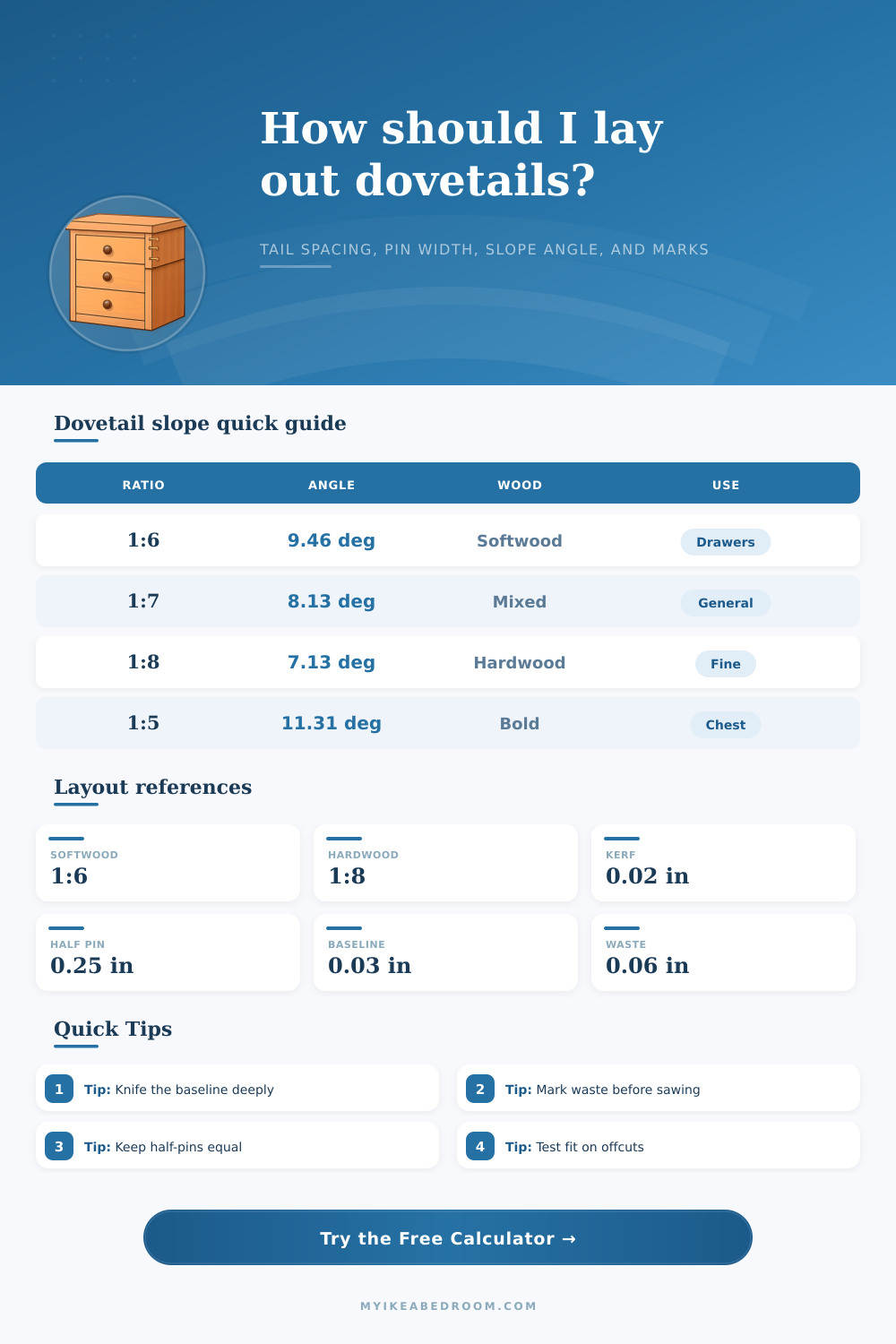
| 1:5 | 11.31° | Bold drawers, thick case sides | Steep and traditional | Leave extra half-pin width on thin stock. |
| 1:6 | 9.46° | Pine, poplar, soft maple | Classic softwood look | Good default for utility drawers. |
| 1:7 | 8.13° | Mixed hardwood and softwood | Moderate hand-cut look | Useful when the wood species are mixed. |
| 1:8 | 7.13° | Walnut, cherry, maple, oak | Fine hardwood detail | Common choice for furniture drawers. |
| 1:9 | 6.34° | Very fine hardwood work | Subtle and restrained | Needs crisp sawing and sharp baseline work. |
| Board thickness | Typical baseline | Baseline offset | Half-pin starting range | Best use |
|---|---|---|---|---|
| 1/4 in | 1/4 in | 0 to 1/64 in | 1/8 to 3/16 in | Keepsake boxes and small trays |
| 3/8 in | 3/8 in | 1/64 in | 3/16 to 1/4 in | Jewelry boxes and light drawers |
| 1/2 in | 1/2 in | 1/64 to 1/32 in | 1/4 to 5/16 in | Furniture drawer sides |
| 5/8 in | 5/8 in | 1/32 in | 5/16 to 3/8 in | Large drawers and case sides |
| 3/4 in | 3/4 in | 1/32 to 3/64 in | 3/8 to 1/2 in | Chests, tool tills, and cabinets |
Even tails and pins
Best for: first practice boards, trays, and small boxes.
Simple pitch makes the marks easy to check, though the pins can look visually heavy on fine furniture.
Narrow pins
Best for: classic drawer sides and cabinet work.
Keeps the tails dominant while leaving enough pin width for clean chopping and glue surface.
Fine pins
Best for: hardwood drawer fronts and show surfaces.
Creates a hand-cut look, but requires careful saw control and a sharp chisel at the baseline.
Graduated
Best for: wide drawers, tool chests, and blanket chests.
Adds visual rhythm by easing the outer tail widths while keeping the middle field balanced.
| Project | Board width | Thickness | Tail count | Suggested slope |
|---|---|---|---|---|
| Small drawer side | 4 to 5 in | 3/8 to 1/2 in | 3 or 4 tails | 1:7 or 1:8 |
| Jewelry box | 2 to 4 in | 1/4 to 3/8 in | 2 or 3 tails | 1:8 or 1:9 |
| Kitchen drawer | 5 to 7 in | 1/2 in | 4 or 5 tails | 1:7 or 1:8 |
| Wide cabinet drawer | 7 to 9 in | 1/2 to 5/8 in | 5 or 6 tails | 1:7 or 1:8 |
| Blanket chest | 10 to 14 in | 3/4 in | 5 to 7 tails | 1:5 or 1:6 |
| Saw type | Typical kerf | Waste margin | Practical note |
|---|---|---|---|
| Fine dovetail saw | 0.015 to 0.020 in | 1/32 to 1/16 in | Best for delicate pins and hardwood drawers. |
| Western backsaw | 0.020 to 0.030 in | 1/16 in | General-purpose choice for furniture-scale stock. |
| Japanese dozuki | 0.012 to 0.020 in | 1/32 in | Thin kerf works well for fine pins and small boxes. |
| Practice or rough saw | 0.030 to 0.040 in | 1/16 to 3/32 in | Leave wider pins so the layout survives cleanup. |
Dovetail joints use angled pins and tails to join two boards together and dont require metal fasteners to hold the dovetail joints together. Dovetail joints becomes stronger with use, and many individuals chooses to cut dovetail joints by hand because the geometry of the joint are forgiving. Many decisions must be made before cutting the wood, each of which will affect an appearance of the dovetail joints.
The layout of the dovetail joints depends upon the width of the board to be joined, the thickness of that board, and the number of tails that will be included in the joint. For instance, a jewelry box will have fewer tails than a cabinet drawer that is meant to open and close wide. The slope ratio of the dovetail joints will affect both the appearance of the joint and its strength.
Using the Dovetail Joint Calculator
Steeper slope are used for cutting softwoods, while gentler angles are used for woods with fine grain, such as walnut and cherry. The thickness of the board will impact the baseline that is drawn on the wood for cutting the dovetail joints; the baseline should account for the thickness of the other board that is to be joined to the board being measured, plus a small amount for planing the joint flush with the other board after it is treated with wood glue. These variable are difficult to remember all at once, so a calculator is provided to assist the craftsperson in calculating these variables.
When given the dimensions of the wood stock and the preferences for the dovetail joints, the calculator will calculate the mathematical variables for each dovetail joint. The calculator accounts for the width of each half-pin, the waste that must be left along each edge before the first line for the dovetail joints will be laid out, and the kerf of the saw that will be used to cut the dovetail joints. The calculator can account for different spacing styles for the dovetail joints, as the spacing style will impact whether the resulting drawer appears as though it is mechanically constructed, or as though it is hand-cut.
Additionally, the craftsperson can change the saw orientation, but the dovetail joint calculator will remind the craftsperson whether the dovetail joint marks should be mirrored along the other side of the box to be constructed, or whether they will be identical should the show face of the box be facing upwards. The kerf of the saw will impact the appearance of the dovetail joints; a fine dovetail saw leave less room for sawn wood to be removed from the edge of the joint than a standard backsaw. The kerf will remain visible on the dovetail joint calculator; this allows the craftsperson to make a decision as to whether the pins should be widened to account for this, or whether more wood will have to be removed than is depicted in the calculations.
The baseline can be offset, as well. A positive baseline offset will leave the tails of the dovetail joints proud of the face of the board; this may be desired if the dovetail joint will later be planed flush with the other board. A baseline offset of zero or negative will leave the dovetail joint visible with flush shoulders.
The spacing style for the dovetail joints can be set according to personal preference. For example, even spacing will allow for ease in cutting dovetail joints when using practice boards. Choosing narrow pins and wide tails will create the appearance of classic dovetail joints.
Fine pins require more care than other spacing styles, as there will be less wood waste between the dovetail pins. However, fine pins are appropriate for display areas. Choosing graduated dovetail joints will allow for the outer tails to be of a different width than the middle tails of the joint.
Gradients are appropriate for wide case sides. Each style of spacing is acceptable, however each style will impact the appearance of the dovetail joints when complete. Many mistakes is made when constructing dovetail joints.
For instance, many craftspersons will use the same width for each half-pin despite the thickness of the board to be joined. Additionally, craftspersons may not account for the difference in width of the dovetail tail on the wide face of the board compared to the narrow face of the same board. The dovetail joint calculator indicate both dimensions for the craftspersons consideration.
Workshop and sawmill stocks may not be even in thickness. Therefore, each piece of wood should be measured individually. For instance, one side of a drawer may be thicker than the other side of that same drawer.
The dovetail joint calculator allows for each piece of wood to be individually measured, so that the baseline will not be too deep for one side of the drawer, or too shallow for the other side. Additionally, the dovetail joint calculator allows for changes in saw during construction of the project. For instance, if a craftsperson changes from a standard backsaw to a dovetail saw, the kerf will be different for each saw.
The dovetail joint calculator will account for this change, so that each dovetail joint will be laid out correctly on each piece of wood. The slope ratio for the dovetail joints will also have an impact on the amount of error that is permitted during construction of the dovetail joint. For instance, a slope ratio of 1:5 is very aggressive and appropriate for a blanket chest.
However, using a 1:5 ratio on a thin piece of jewelry box stock may make the pins too steep for a chisel to reach the baseline. Using a gentler ratio, such as 1:8 or 1:9 will allow for more error in chopping the dovetail joints with a chisel. However, such slopes may not be as appropriate for cutting softwoods.
A table of reference ratios can be used to make a decision about the slope ratio for the dovetail joint. Finally, another area in which many mistakes is made is when laying out the dovetail joint marks from the tail board to the pin board. After sawing the tails of each joint and removing the waste, the craftsperson will have to make marks on the pin board to ensure that they are correctly oriented with the dovetail tail marks on the other board.
The dovetail joint calculator will remind the craftsperson of the orientation of the dovetail joints, and whether the dovetail marks need to be mirrored on the other side of the box. This will help to prevent the craftsperson from making the mistake of creating two identical dovetail joint sides that will not fit together with one another. Thus, the dovetail joint calculator will remove the craftsperson from the mathematics of dovetail joints, and will help the craftsperson to make decisions about the dovetail joints.