Doormat Size for Entry Calculator
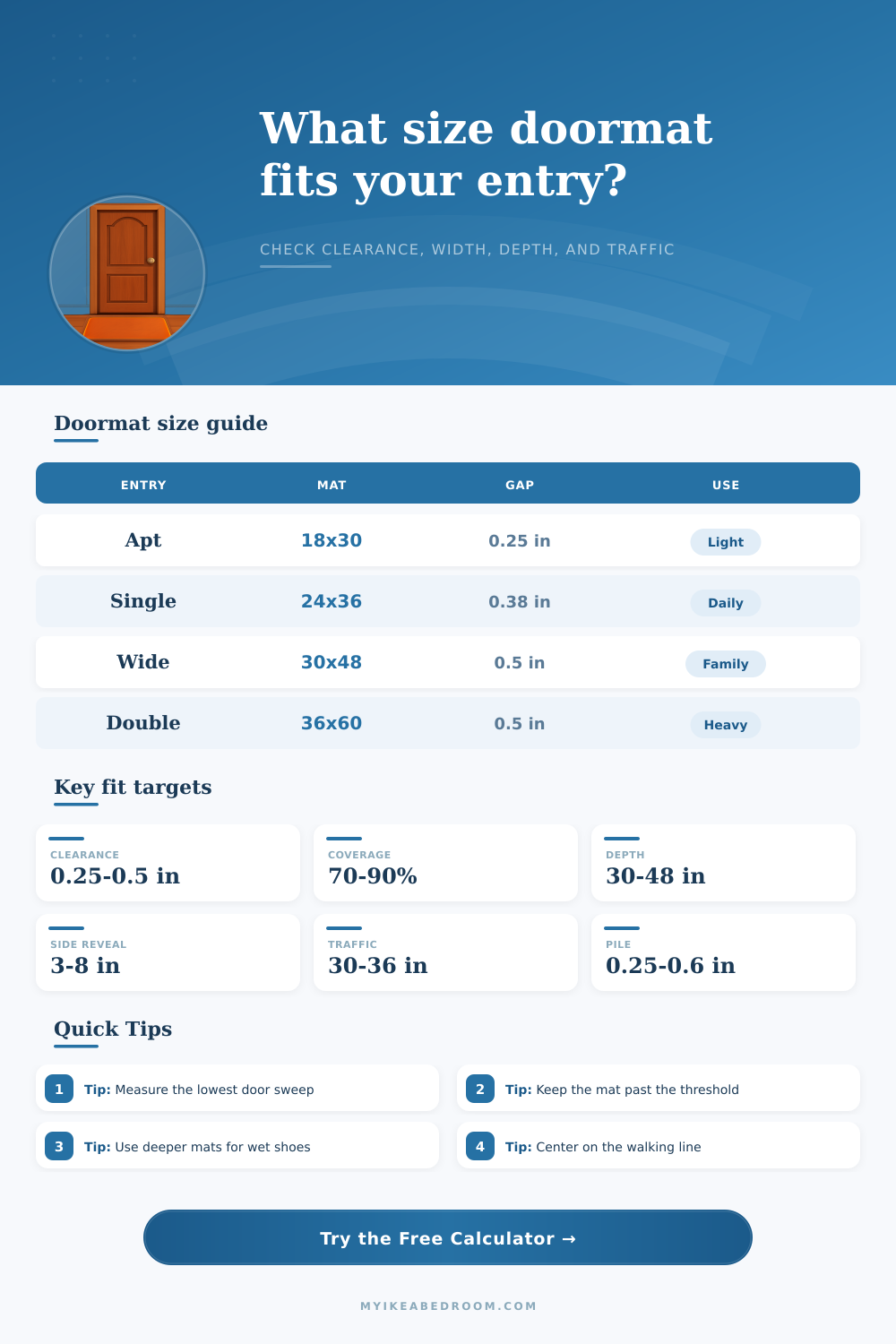
Find a doormat size that clears the door sweep, covers enough of the doorway, leaves a usable walking lane, and gives shoes enough depth for scraping and wiping.
Choose a real entry setup, then adjust the door, landing, mat, pile, exposure, and traffic details for your space.
Reading the result
Coverage: A doormat should usually cover most of the opening without crowding walls or trim.
Clearance: The door sweep gap must be greater than the mat height where the door crosses the mat.
Depth: Wet or muddy entries need more walking contact than a purely decorative indoor mat.
Lane: Planters, benches, and shoe storage can make a technically fitting mat feel too wide.
| Standard size | Best entry | Opening match | Notes |
|---|---|---|---|
| 18 x 30 in | Apartment or narrow interior door | 28 to 32 in doors | Compact, easy to clear under doors. |
| 20 x 32 in | Small front stoop | 30 to 34 in doors | Good when side trim limits width. |
| 22 x 34 in | Covered porch | 32 to 36 in doors | Balanced size for smaller single doors. |
| 24 x 36 in | Standard single front door | 34 to 38 in doors | Useful default for most homes. |
| 30 x 48 in | Wide single door or wet entry | 38 to 48 in doors | More depth for wiping shoes. |
| 36 x 60 in | Double doors or broad porch | 60 to 72 in doors | Better visual span across double entries. |
| Measured door gap | Safer mat height | Risk level | Fit note |
|---|---|---|---|
| 0.25 in | 0.15 to 0.20 in | Very tight | Use thin rubber or keep mat outside swing path. |
| 0.38 in | 0.20 to 0.30 in | Tight | Test the full door arc before relying on the fit. |
| 0.50 in | 0.30 to 0.42 in | Moderate | Most low coir and ribbed mats can work. |
| 0.75 in | 0.45 to 0.60 in | Comfortable | Allows thicker outdoor and drainage mats. |
| 0 in swing | Any practical height | Low | Sliding or outward doors do not sweep across the mat. |
| Entry condition | Minimum depth | Better depth | Reason |
|---|---|---|---|
| Indoor dry entry | 24 in | 30 in | Enough for a short step and light dust. |
| Covered daily porch | 30 in | 36 in | Allows one full foot plant before entering. |
| Open rain or snow | 36 in | 48 in | More contact for water, grit, and slush. |
| Mudroom or pets | 42 in | 54 in | Creates a longer wipe zone for repeated traffic. |
| Narrow hallway runner | 48 in | 72 in | Guides the path while protecting more floor. |
| Scenario | Door opening | Mat size | Primary fit check |
|---|---|---|---|
| Apartment inward door | 36 in | 18 x 30 in | Low height under the sweep |
| Standard front porch | 36 in | 24 x 36 in | Opening coverage and threshold gap |
| Wide single door | 42 in | 30 x 48 in | Deep wipe zone for wet shoes |
| Double front door | 72 in | 36 x 60 in | Wide visual span and side reveal |
| Mudroom side entry | 32 in | 30 x 54 in | Traffic lane and water handling |
Clearance tip: Measure the door sweep at the lowest point, not only at the hinge side. Many doors dip slightly near the latch or rub at the weather strip.
Depth tip: A mat that is wide enough can still feel undersized if it is too shallow. Wet entries benefit from enough depth for two shoe contacts.
A house’s front door is the main way in, but most people thinks about their floor mats as an afterthought. Most people choose a mat that looks nice in the store then throw it down hoping that it will work out. More often than not, they don’t: the mat is too small to catch any mud; too thick so the door can never shut; or positioned so poorly that half the traffic bypasses it entirey.
To do it right, you have to think about both the physics and the geometry of how things work, not just how they look. That means thinking about how wide the door opening appears vs. The actual mechanics of the door swing. Once you put in the thickness and size of your door, and the thickness of your mat, this calculator do all the math for you, no more guessing what the ratio of coverage and clearances should of be.
How to Choose the Right Doormat Size
Remember: Measure your real opening, not just the trim. It’s common for someone to purchase a mat that look like it will fit the decorative casing, only to find the mat won’t allow them through the door or there are annoying side gaps. You want to cover roughly 70-90% of the clear opening. That provides enough floor so the space doesn’t look cluttered, yet still allows the majority of foot traffic to step onto the abrasive surface. For households with kids, pets, or a lot of traffic coming home from school, go toward high end of this range. The broader the mat, the more junk it catches before it scatters out into the hall.
The failure mode for almost all installs comes from clearance. Measure the space underneath your door at its minimum (it may dip just a bit on the latch side for weather stripping and age). A quarter-inch gap won’t clear when your door jams closed each time somebody walks in if you install a heavy-duty coir mat. This margin… How high does the mat sit compared to that crucial sweep distance, is what the tool measures as it checks for fit. And it’s just barely there. It makes or breaks how effectively your entryway work (or annoys you every day). In those cases, thin rubber mats can be a lifesaver: They add grip without increasing thickness.
Width is important, but so is depth (particularly if you get snow or rain). Even though a shallow mat may appear neat, it won’t accommodate a good shoe-wiping session. Aim for at least 30 inches of depth on an average porch, so you can place both feet firmly down before walking onto the surface. If your entry will be muddier, consider going even higher. Forty eight inches gives plenty of wiggle room for shaking and scraping off dirt without making a mess on nice flooring surfaces. A little extra length is always preferable to stopping short of where you wanted to go while cleaning.
Second, choose based off how much weather it will face. If it will be exposed to direct rain, coir fiber mats will retain some moisture. They’re good at scraping off dirt, though synthetic rubber or drainage mats will fare better with water exposure and drain faster. For an open porch situation, those would be best. The table on the page explain this further, pairing the right material with various environmental conditions and traffic levels. You’ll notice that a decorative woven mat may work perfectly inside but not outside. Choosing the right material for the climate will result in longer-lasting mats while keeping your indoor flooring cleaner.
You should also consider any side obstructions like benches, planters, or shoe racks. Even with a technically correct sized mat you may find yourself feeling crowded, not enough space to move around. Best to err on the side of being able to walk comfortabley on either side, so that each side has a clear lane. The result will be an open-feeling entrance instead of a crowded one… even if it means not capturing every last ounce of dirt.
All in all, choosing the proper size will welcome guests into your home with ease. It will also save you money on door hardware over the years and help preserve the floor underneath by minimizing wear and tear caused by friction jams. Measure carefully and think about what happens at this entryway. A properly sized doormat makes crossing the threshold easy and keeps track-in dirt and mud at bay!