Door Swing Clearance Calculator
Check whether a hinged door can open cleanly around furniture, knobs, hinge side, swing angle, and your chosen safety buffer.
📌Room and door presets
⚙Door swing inputs
Your swing clearance result
🗺Swing model snapshot
Plan view cue
How the calculator thinks
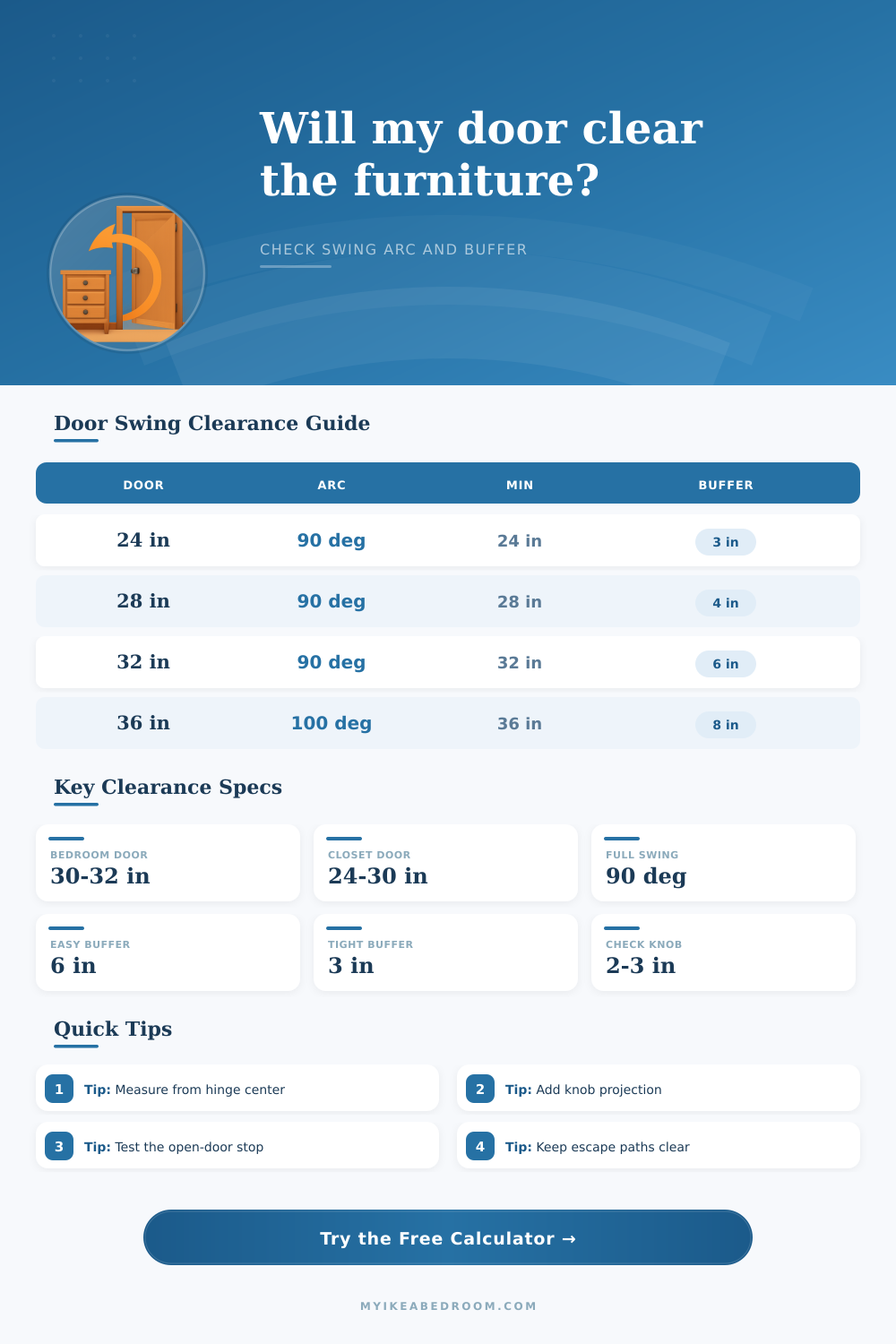
📏Clearance spec grid
📊Door width and swing depth table
| Door width | Typical use | 90 degree clear depth | With 6 in buffer |
|---|---|---|---|
| 24 in / 61 cm | Small closet | 26.5 in with handle | 32.5 in target |
| 28 in / 71 cm | Closet or compact room | 30.5 in with handle | 36.5 in target |
| 30 in / 76 cm | Older bedroom | 32.5 in with handle | 38.5 in target |
| 32 in / 81 cm | Common bedroom | 34.5 in with handle | 40.5 in target |
| 36 in / 91 cm | Wide access route | 38.5 in with handle | 44.5 in target |
🚪Swing angle reference table
| Swing angle | What it feels like | Arc factor | Planning note |
|---|---|---|---|
| 60 degrees | Quick pass only | 0.52 turn | Works for closets, weak for carrying items |
| 75 degrees | Tight but usable | 0.65 turn | Check shoulder and basket clearance |
| 90 degrees | Normal full open | 0.79 turn | Best default for bedroom planning |
| 100 degrees | Comfortable stop | 0.87 turn | Good when the door parks past square |
| 120 degrees | Wide parked leaf | 1.05 turn | Needs more wall-side room near the stop |
🛋Furniture intrusion reference table
| Furniture item | Common intrusion | Risk point | Better placement cue |
|---|---|---|---|
| Nightstand | 4-10 in / 10-25 cm | Corner, drawer pull, lamp cord | Keep outside the latch-edge sweep |
| Dresser | 8-18 in / 20-46 cm | Drawer face and handles | Test with the top drawer open |
| Wardrobe | 10-24 in / 25-61 cm | Deep side panel near hinge | Shift past the door stop line |
| Bench | 6-16 in / 15-41 cm | Cushion bulge and shoes | Leave toe space outside the arc |
| Console table | 4-12 in / 10-30 cm | Knob scrape at latch height | Use a shallower piece near doors |
🧭Comparison grid
Tight
Door may open, but bedding, knobs, or daily clutter can make it annoying.
Usable
Good for closets and low-traffic rooms when the door is opened carefully.
Comfort
Best everyday target for bedrooms, dressers, and shared routes.
Access
Preferred where mobility aids, baskets, laundry, or children use the route.
📋Planning examples table
| Scenario | Door width | Furniture issue | Suggested buffer |
|---|---|---|---|
| Bedroom nightstand | 30-32 in | Lamp and drawer corner | 6 in / 15 cm |
| Closet entry | 24-28 in | Basket or hamper | 3-4 in / 8-10 cm |
| Nursery dresser | 30-32 in | Open drawer and baby gear | 8 in / 20 cm |
| Shared hallway | 32-36 in | Console and wall hooks | 8-10 in / 20-25 cm |
| Mobility route | 32-36 in | Turning and hand clearance | 10-12 in / 25-30 cm |
💡Door swing planning tips
A door swing clearance calculation are used to determine if a door will hit any furniture or walls when the door is opened. It is important to calculate the swing of the door to ensure that furniture and door dont take up too much of the same space within the room. If a person places furniture too closely to the door, the door may hit that furniture when it is opened.
This is because when the door is opened, it travels along an arc and the arc require a certain amount of space within the room to allow for the door to open freely. The first measurement that you must consider when calculating the door swing is the width of the door. However, the width of the door isnt the only measurement that are required to calculate the door swing.
How to Check Door Swing so It Does Not Hit Furniture
The radius of an arc that the latch of the door makes determines the door swing. The radius of the door is wider than the width of the door because it must take into account the width of the door handle and the thickness of the door stop. Additionally, the radius must also take into account the space that the hinge of the door take up, as the hinge does not touch the door jamb.
These calculations can determine the distance that the door will travel through the room. Another measurement that you must understand is the difference between the distance between the furniture and the wall and the intrusion of the furniture into the path of the door. The distance from the wall (on the hinge side) to the furniture is the furniture distance.
The furniture intrusion is the measurement of how far the furniture extend into the path of the door. A nightstand can have a large furniture distance from the wall but have a high furniture intrusion if the corner of the nightstand extend into the path of the door. You are required to enter these two measurements into the calculator to determine if the door will hit the furniture in the room.
Another important factor to consider in the calculation is the swing angle of the door. Not every door will open to a ninety-degree angle; another wall or trim on the door may limit the door. In these instances, the door will have a smaller angle that it can swing open; this reduces the distance that the door must travel to open.
However, this can make it harder for an individual to move heavy objects through the doorway. This factor is important in calculating the total space that the door will require in the room. One final factor that you should consider is the safety buffer.
Many people will not think of this buffer when calculating the door swing; however, this is a critical measurement. In real world environments, there is often shoes, laundry baskets, and other items that could potentially block the doorway. A three-inch safety buffer may seem like a good idea on paper, but a six- or ten-inch safety buffer may be better for most doorways.
You can program this into the door swing clearance calculator to test various safety buffers. Real rooms are not perfect, and there are small variables that you must consider with the calculation. For instance, baseboards on walls can add a small thickness to the door, and the door may not be even with the floor due to the carpet within the room.
The door swing clearance calculator requires the jamb allowance to account for these small variables. Another important feature of the calculator is the reference tables. These tables list various examples of the swing of various widths of doors.
The wider the door, the larger an arc that the door makes when opening; therefore, wider doors take up more space in the room than narrower doors. You can use these tables to see the effect that adding a door handle or implementing a safety buffer will have on the width of the door. Some of the most common mistakes made when calculating the door swing include measuring from the wrong place on the door and forgetting to include the door handle in the measurement.
The distance should be taken from the hinge of the door (the hinge barrel) rather than the face of the door. This is to account for the door handle. If you dont include the door handle in the calculation of the door width, the measurement will be incorrect, and the door may hit the furnitures in the room.
Finally, you can use this calculation prior to placing heavy furniture in the room. The calculation can be used to determine if the furniture provides enough clearance for the door to open. Additionally, it can help to determine the amount of safety buffer that will be required in the doorway.
By performing this calculation, an individual can ensure that the door will not hit any furniture when fully opening.