🚪 Door Header Size Calculator
Find the correct structural header beam size for any door or window opening — residential or commercial
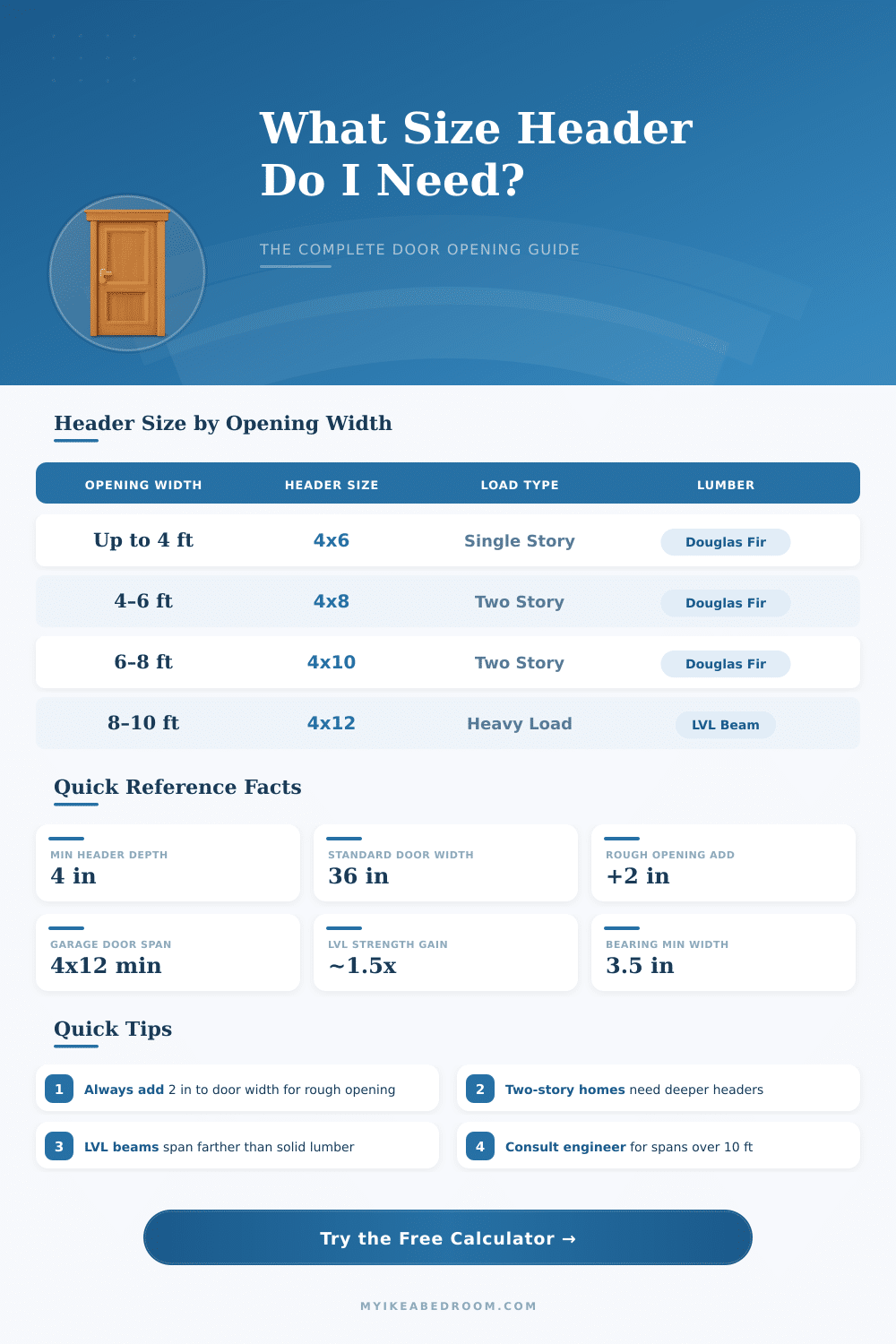
| Opening Width | Single Story (DF #2) | Two Story (DF #2) | Two Story (LVL) | Notes |
|---|---|---|---|---|
| Up to 2 ft (24") | 4x4 | 4x6 | 1.75x5.25 LVL | Interior, non-bearing |
| 2–3 ft (24–36") | 4x6 | 4x8 | 1.75x7 LVL | Standard single door |
| 3–4 ft (36–48") | 4x6 | 4x8 | 1.75x9.5 LVL | Wide single door |
| 4–5 ft (48–60") | 4x8 | 4x10 | 1.75x9.5 LVL | Double door / large window |
| 5–6 ft (60–72") | 4x8 | 4x10 | 1.75x11.25 LVL | French doors / sliding |
| 6–8 ft (72–96") | 4x10 | 4x12 | 3.5x11.25 LVL | Wide openings |
| 8–10 ft (96–120") | 4x12 | Double 4x12 | 3.5x14 LVL | Single garage door |
| 10–12 ft (120–144") | Eng. Beam | Eng. Beam | 3.5x16 LVL | Double garage door |
| Over 12 ft (144"+) | Engineer Required | Engineer Required | Engineer Required | Consult structural engineer |
| Door Size (Nominal) | Rough Opening Width | Rough Opening Height | Min. Header | Header Length |
|---|---|---|---|---|
| 2/0 (24") | 26" | 82.5" | 4x4 | 33" |
| 2/6 (30") | 32" | 82.5" | 4x6 | 39" |
| 2/8 (32") | 34" | 82.5" | 4x6 | 41" |
| 3/0 (36") | 38" | 82.5" | 4x6 | 45" |
| 6/0 French (72") | 74" | 82.5" | 4x10 | 81" |
| 8/0 Sliding (96") | 98" | 82.5" | 4x12 | 105" |
| 9x7 Garage | 108" | 85" | LVL 3.5x14 | 115" |
| 16x7 Garage | 192" | 85" | LVL 5.25x14 | 199" |
| Measurement | Formula | Example (36" door) | Notes |
|---|---|---|---|
| Rough Opening Width | Door width + 2" | 38" | Allows for shimming |
| Header Length | RO Width + 2 x 1.5" trimmers | 41" | Rests on trimmer studs |
| Jack Stud (Trimmer) | RO Height + 1.5" | 84" | Supports header |
| King Stud Height | Full wall height – plates | Per wall | Full length stud |
| Cripple Studs | Top plate to top of header | Varies | Above header |
Figuring out the right size of door header is not easy, there is not one size that works for everything, because too many factors affect the game. Naturally, the basic beams matter, but so does the weight that it must bear from up and down. And then comes the weather as a factor: snow loads, wind pressure, rain exposure.
The bottom line? Each building project needs its own calculation, adapting to those particular conditions.
How to Choose the Right Door Header Size
One practical rule for builders is to take the span in feet, add two to it and use that as depth for the header. For instance, if you have a four-foot opening, add two and get six, which means that double 2×6 timbers would do the task. For a six-foot door, I found that two 2×6 with half-inch strips of OSB or plywood work great.
Stack those three bits, pin them one to the other and the total beam reaches exactly 3.5 inches, which fits well with standard 2×4 wall.
Even so, double 2×12 stays the usual choice for most window and door openings in practice, although the building codes allow other options that could save wood and free up more space for insulation. Consider a 30-inch door, double 2×12 would be too heavy. On the other hand, in a two-story house with a 36-inch door in the ground floor and 70-pound snow load, one could get by with only two 2×6 and a pair of jack studs as minimum.
The length of the header cut also deserves attention. With one jack stud, the typical beam cuts around three inches more then the rough opening. Like this, a 36-inch door with a 38-inch rough opening needs a cut of the beam at 41 inches.
For a wider 72-inch door, cut at 78.5 inches and double up the side beams on every side to give around a 72.5-inch rough opening.
Big openings complicate the process. An 18-foot garage door on a 24-foot gable end could need triple 2×12 beams. For a 16-foot garage opening, the load grows.
When you consider an 18-foot span, something smaller than 14 inches of LVL could fail under its own weight, which explains why LVL beams got popular for long spans, they handle heavy loads much better than regular sized timbers.
Steel beams work well when the head space is tight. They fit in only five inches of depth, and an engineer can design the exact specs for your case. For standard door height, set the header so that the rough ceiling line starts around 82.5 inches from the subfloor, which leaves enough height for a pre-hung unit.
Some builders simply lay thebeams directly against the upper plates to simplify the process.