Dog Door Size Calculator
Size the flap, step-over rise, rough opening, and common S/M/L/XL door category from your dog's measurements.
🐕Breed and Door Presets
📏Dog Measurements
🧰Quick Size Specs
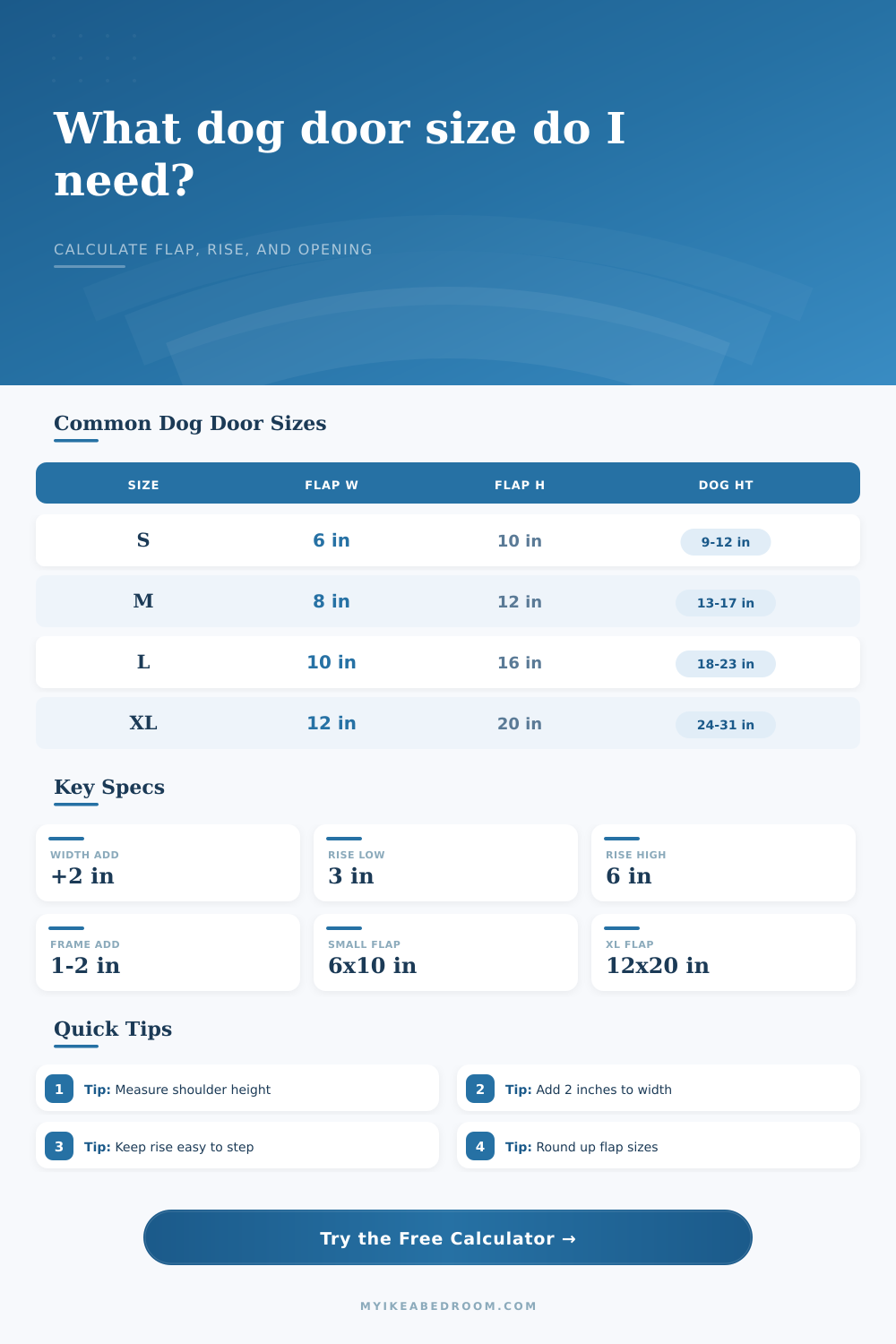
The clear flap is the open passage your dog uses. The rough opening is usually larger because the mounting frame surrounds the flap.
📋Common Flap Sizes
| Door Size | Typical Flap Width | Typical Flap Height | Best For Shoulder Height |
|---|---|---|---|
| Small | 5 to 6 in | 8 to 10 in | 9 to 12 in |
| Medium | 7 to 8 in | 11 to 13 in | 13 to 17 in |
| Large | 9 to 10 in | 15 to 17 in | 18 to 23 in |
| Extra Large | 11 to 12 in | 19 to 21 in | 24 to 31 in |
📐Rise by Dog Height
| Shoulder Height | Suggested Rise | Use When | Flap Height Formula |
|---|---|---|---|
| Up to 12 in | 3 in | Small dogs | Shoulder + 1 to 2 in |
| 13 to 18 in | 4 in | Medium dogs | Shoulder + 2 in |
| 19 to 24 in | 5 in | Large dogs | Shoulder + 2 to 3 in |
| 25 in and up | 6 in | Very tall dogs | Shoulder + 3 in |
🚪Rough Opening Allowance
| Frame Allowance | Add to Width | Add to Height | Typical Use |
|---|---|---|---|
| 0.5 in per side | 1 in | 1 in | Thin trim frame |
| 0.75 in per side | 1.5 in | 1.5 in | Common plastic frame |
| 1 in per side | 2 in | 2 in | Insulated flap frame |
| 1.5 in per side | 3 in | 3 in | Wall tunnel sleeve |
🐕Breed Measurement Examples
| Example Dog | Shoulder Height | Chest Width | Likely Door |
|---|---|---|---|
| Toy Poodle | 10 in | 4 in | Small |
| Beagle | 15 in | 6.5 in | Medium |
| Labrador | 22 in | 8.5 in | Large or XL |
| Great Dane | 32 in | 12 in | Oversize custom |
💡Measurement Tips
I’m sure we’ve all been there, you measure your dog starting at their head, because…that’s what you’ve always done. It’s the most certain measurement of their size, right? And normaly, it is. But if you’re attempting to get your dog through a pet door, head height isn’t even the correct dimension at all. Their shoulders does all the work, pushing forward as they tuck their head down under the flap. So if you size your door by just height, you’ll end up with one that’s too small. Your dog has to go lower then they’d rather, or even worse, get stuck.
Once you enter in those shoulder dimensions, the calculator above do the math for you. You won’t have to guess based off only on breed. But here’s the trick: It’s not just about height, but also width (sometimes even more important than height).
How to Measure Your Dog for a Pet Door
So most folks purchase a door that works for their dogs’ size. Tall enough to fit under, but narrow enough that they has to wiggle through, causing friction and making the door difficult to operate. Which results in them resisting, having accidents, and ultimataly abandoning the door in favor of using the backdoor instead (which has become the “dog” door by default.)
Remember to measure at your dog’s widest point. Typically this is behind front legs. And add two inches. The additional space isn’t wasted. Rather, it’s what sets an awkward shimmy apart from a confident stride.
I think it’s dangerous to use those buckets (small/medium/large/extra large) as your reference table on the page. This is especially true if you’re dealing with a lanky dog or a broad-chested dog. A Greyhound and a Great Dane may be the same height but have widths that is worlds apart.
So now we know how big our flaps need to be, and the next consideration is the rise of the step-over. How far up will the flap sit off the ground? That’s a compromise: The bigger the rise, the more secure the door, but the less accessible (and vice versa). Most dogs does best with a four inch rise. High enough to deter most cats and raccoons, but low enough so they don’t even need to think about stepping up onto it.
You’ll want to drop that if you have a puppy or an old dog who has some joint issues; you may wish to increase that rise if you have a really tall dog. Either way, you’ll need to look at your dog in person, because their rise depends more on their overall physical condition than their height.
The numbers start getting messy with installation. Keep in mind the flap size isn’t necessarily the same as your rough opening. Then there’s the frame. How much does the frame that holds the flap in place take up? It typically adds an extra inch or two to the height and width of the hole you’ll have to cut out of your door or wall.
What if you’re cutting into a thicker exterior wall? Now you may need a tunnel-style insert which will change the whole frame allowance. A little step of measuring how thick your wall is can save you from a big headache down the road. Last thing you want is to drill a perfect hole and then realize the flange won’t sit flush against your drywall.
A pet door can be described as more of a spatial puzzle than a purchase decision. Ultimately, you are trying to fit a moving object (your beloved animal) into a space that stays still (the architecture around it). This requires accurate measuring and patience. Don’t cut corners on the tape, make sure the shoulder height is correct. Make certain the chest width is correct, then use the calculator for the rest: rough openings, frame allowances, etc. You should of checked these first.
Once your dog trots through without any hesitation, and without any scratching or ducking too low, you’ll have it right. It’s all in the shoulders; that’s where we start and where we end.