Dog Crate Size Calculator
Convert your dog's measured length, standing height, weight, bedding thickness, growth allowance, and posture needs into a practical crate length, height, width, and common size.
📌Breed and Life-Stage Presets
📏Measure Your Dog
🧾Common Crate Size Markers
📐Standard Crate Dimensions Reference
| Common crate length | Typical outside dimensions | Dog length fit range | Typical dog weight marker |
|---|---|---|---|
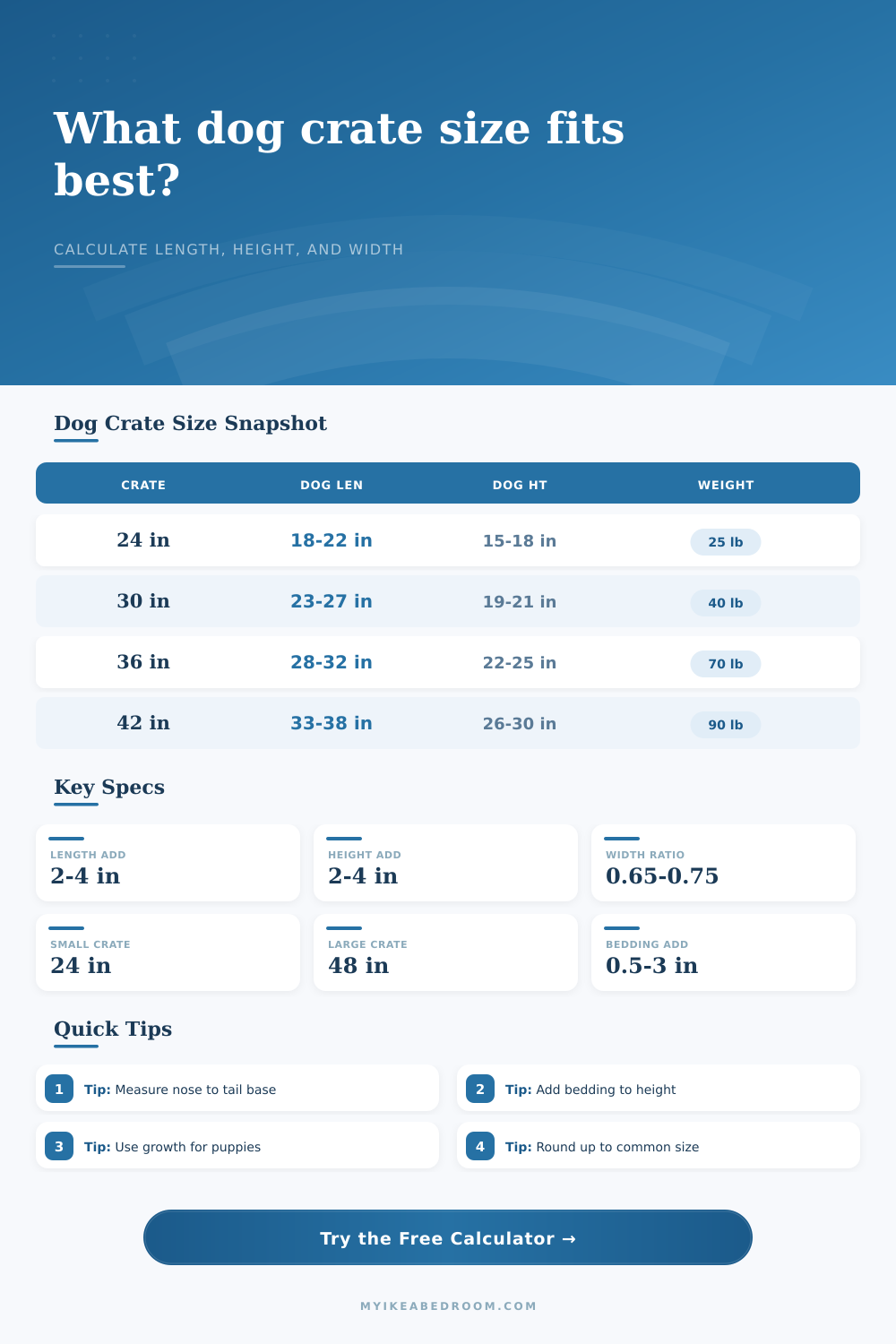
| 24 in crate | 24 x 18 x 19 in | 18–22 in measured dog length | Up to about 25 lb |
| 30 in crate | 30 x 19 x 21 in | 23–27 in measured dog length | About 26–40 lb |
| 36 in crate | 36 x 23 x 25 in | 28–32 in measured dog length | About 41–70 lb |
| 42 in crate | 42 x 28 x 30 in | 33–38 in measured dog length | About 71–90 lb |
| 48 in crate | 48 x 30 x 33 in | 39–44 in measured dog length | About 91–110 lb |
| Oversize planning | 54 in or custom | 45 in or longer dog length | Very tall or giant dogs |
🐕Breed and Life-Stage Preset Reference
| Preset | Starting measurements used | Allowance setting | Likely crate band |
|---|---|---|---|
| Toy adult | 18 in length, 14 in height, 12 lb | 2 in compact allowance | 24 in crate |
| Dachshund adult | 24 in length, 13 in height, 18 lb | 4 in sprawly allowance | 30 in crate |
| Beagle adult | 25 in length, 19 in height, 28 lb | 3 in average allowance | 30 in crate |
| Cocker spaniel adult | 27 in length, 20 in height, 32 lb | 3 in average allowance | 36 in crate |
| Border collie adult | 31 in length, 23 in height, 42 lb | 3 in average allowance | 36 in crate |
| Bulldog adult | 28 in length, 19 in height, 50 lb | 4 in broad allowance | 36 in crate |
| Labrador teen | 32 in length, 24 in height, 55 lb | 2 in growth allowance | 42 in crate |
| Golden retriever adult | 36 in length, 27 in height, 70 lb | 3 in average allowance | 42 in crate |
| German shepherd adult | 39 in length, 29 in height, 85 lb | 4 in posture allowance | 48 in crate |
| Giant breed puppy | 38 in length, 31 in height, 95 lb | 6 in growth allowance | 48 in or larger |
📊Posture, Bedding, and Width Formula Reference
| Calculator setting | Length and height add | Width multiplier | Best use case |
|---|---|---|---|
| Compact sleeper | 2 in comfort allowance | 0.65 x required length | Small adult dog with tidy curl posture |
| Average turn-around | 3 in comfort allowance | 0.70 x required length | Most adult dogs measured accurately |
| Long or sprawly posture | 4 in comfort allowance | 0.75 x required length | Long-backed dogs or relaxed stretch posture |
| Broad chest or heavy build | 4 in comfort allowance | 0.75 x required length | Stocky dogs needing more shoulder room |
| Thin crate mat | Add 0.5–1 in to height | No width change | Low-profile bedding |
| Thick bedding pad | Add 2–3 in to height | No width change | Deep cushion that lifts standing posture |
🚪Door Opening and Growth Check Reference
| Planning check | Formula used | Typical target | Calculator warning |
|---|---|---|---|
| Door head opening | Dog height + bedding + door clearance | Standing height plus 2 in | Door may feel low |
| Adult dog growth allowance | 0 in added to length | Use measured body only | None if fully grown |
| Adolescent dog growth allowance | 1–3 in added to length | Use expected near-term growth | Round up one size if tight |
| Large puppy growth allowance | 4–6 in added to length | Review adult estimate | May exceed standard size |
| Weight cross-check | Compare dog weight with crate band | Within band is consistent | Broad or tall build review |
💡Measurement Tips
When shopping for a dog crate, the size you buy isn’t an estimate; it’s a measurement. Standing in the pet aisle with a metal wire box in hand, you wonder whether or not it will fit your dog. There are charts online, which plot weight against box size. While these charts is a helpful beginning, they are ultimataly a flawed measure. Two dogs might weigh exactly seventy pounds. One is a sleek greyhound, who needs linear space to stretch out. Another is a compact corgi, who curls into a tight ball. Weight doesn’t tell you anything about shape.
That is why, as much as possible, we should of measured the actual dog. Now, after you enter certain body measurements, the calculator do the math for you. You won’t have to use trial and error by buying and returning multiple box.
How to Measure Your Dog for the Right Crate Size
But how do you understand the numbers? Well the first number is length. Take the distance from the tip of the nose to the base of the tail. Don’t go all the way to the end of the tail, because if you do, you’re creating a crate for a dog that doesn’t exist. The tail will bend, but the torso won’t. So a few inches on top of this for comfort is your minimum length. That way the dog can lay down completely flat with no kink in their spine.
Where most folks gets tripped up is in height. To the shoulder, then outta there! Outta my ear hole? Nope. No, if they have erect ears that stand straight up on their heads when they’re standing, you gotta take the height from top of their head.
And then we add an additional wrinkle (pun intended). The fact that bedding will alter the geometry. What’s the effect of putting down a nice plush memory foam pad? The dog is now effectively taller because of how high he sit on the pad. How does the tool handle that? It allows you to add the thickness of the bedding to the required height.
Sounds silly till you go purchase a crate that fits the bill. You plop down the mat, and lo and behold, the dog’s ears are touching the metal ceiling. It is a small detail, but it is important for long term comfort.
Manufacturers standardize width, so they don’t think about it much. The calculator bases the required width based off the length and size of the dog. Even though two dogs may be the same length, a bulldog with a broad chest require more lateral space than a long-legged terrier with a lean body. The presets in the calculator will show you what I mean. As you go to a broader stance you’ll see that the width ratio goes up. This allows the dog to spin around inside the crate. Just as important, a narrow crate makes the dog feel claustrophobic no matter how long the crate is. How freely one moves are as much a factor of space as being able to stretch out.
The wild card is growth allowance. A puppy isn’t an adult, they’re growing variables. Take your 6 month old lab. He’s measured. You purchase the ideal crate sized for him now. In weeks, he’ll be too big for it. The tool allows you to add inches for growth, but requires future thinking. It is better to get a slightly larger crate with a divider than a smaller crate that will eventualy become a cage. Using a divider makes a den like area where he can’t have an accident but has room to grow. So what’s a short term issue becomes a long term solution.
Don’t let the exact number paralyze you. Use your tape measure as a guide, but let your dog’s behavior be the final judge. How does he move around in the space? Does he curl? Does he stretch? If he appears to be cramped up then go up a size. If he looks lost in the space then consider using a divider. Round up based off the standard sizes in the reference table on the page. It’s about comfort not precision.
This is a safe harbor you’re building, not a shipping container. Get the dimensions right plus give him some extra room so that he has a good night’s sleep. The dog settles in. The right size feels like home not like a box.