Dog Bed Size Calculator
Estimate a dog bed footprint from body length, full stretch, shoulder height, weight, sleep style, bolster allowance, comfort buffer, and available floor space.
🐕Dog Size Presets
📏Measurements and Fit
Your Dog Bed Footprint
🧮Formula Reference
📊Common S/M/L/XL/Giant Size Matching
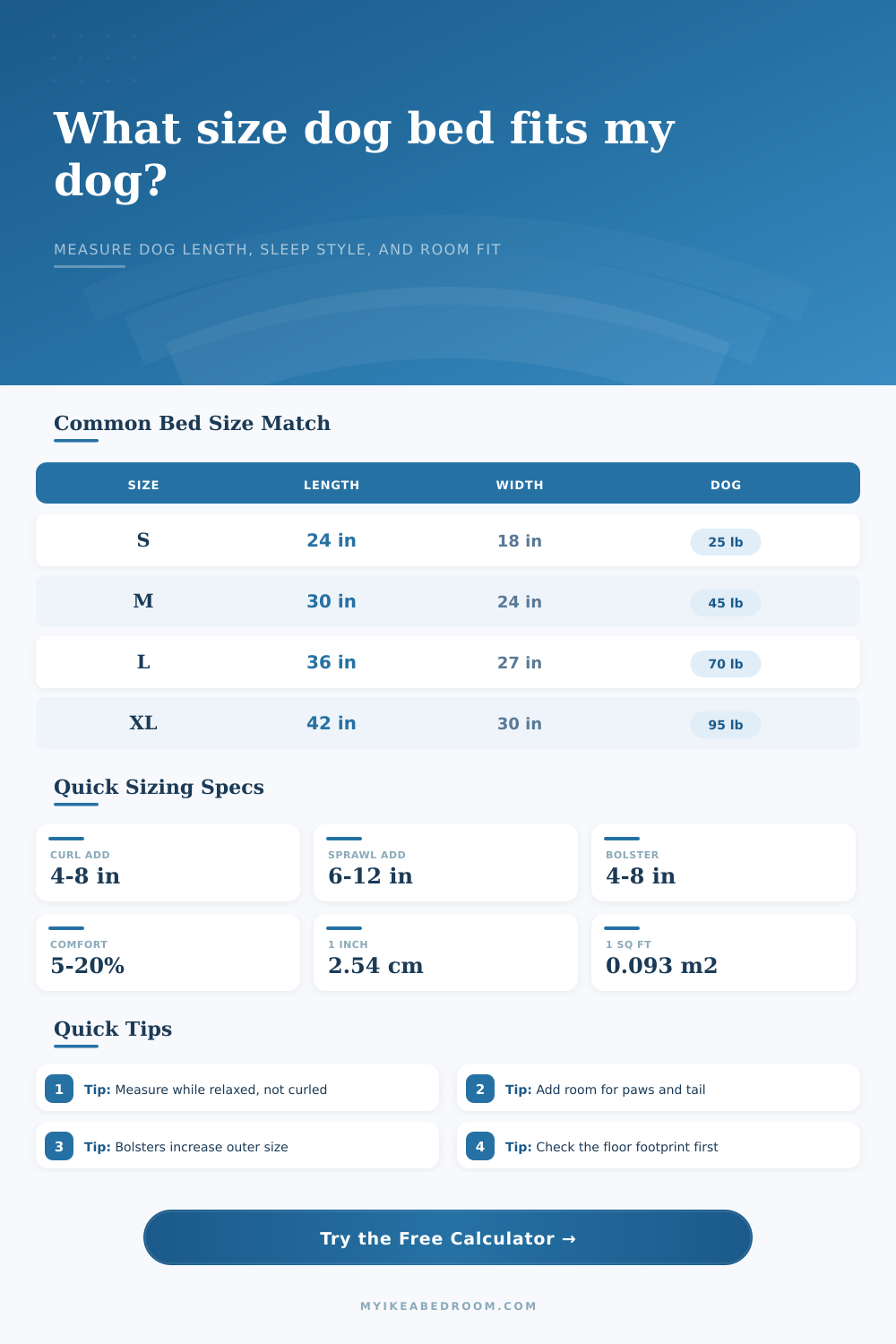
| Common size | Typical outer bed | Metric outer bed | Approx dog weight band |
|---|---|---|---|
| Small | 24 in × 18 in | 61 cm × 46 cm | Up to 25 lb / 11 kg |
| Medium | 30 in × 24 in | 76 cm × 61 cm | Up to 45 lb / 20 kg |
| Large | 36 in × 27 in | 91 cm × 69 cm | Up to 70 lb / 32 kg |
| XL | 42 in × 30 in | 107 cm × 76 cm | Up to 95 lb / 43 kg |
| Giant | 48 in × 36 in | 122 cm × 91 cm | Up to 120 lb / 54 kg |
😴Sleep Style Multipliers
| Sleep style | Length basis | Width basis | Best use |
|---|---|---|---|
| Curled or donut | Nose-rump + 4–8 in | Shoulder x 1.35 | Dogs who sleep in a tight circle |
| Side sleeper | Max body length + 8 in | Shoulder x 1.65 | Dogs who roll onto one side |
| Sprawled stretch | Full stretch + 6–12 in | Shoulder x 1.85 | Dogs with paws extended |
| Senior comfort | Full stretch + 10 in | Shoulder x 1.90 | Easy turning and joint relief |
🛋Bolster and Shape Allowances
| Bed style | Outer allowance | Usable sleep area | Planning note |
|---|---|---|---|
| Flat rectangle | 0–2 in | Nearly full footprint | Best where floor space is tight |
| Oval cushion | 2–4 in | Slightly rounded corners | Use rectangular footprint for room fit |
| Donut rim | 4–8 in | Reduced by raised rim | Add more length for sprawl sleepers |
| Sofa bolsters | 4–10 in | Open front, thick sides | Check drawer and door clearance |
🏠Room Footprint Fit Guide
| Available zone | Fits best | Watch point | Metric guide |
|---|---|---|---|
| 30 in × 24 in | Small to Medium | Leave side access open | 76 cm × 61 cm |
| 36 in × 27 in | Medium to Large | Check nightstand drawers | 91 cm × 69 cm |
| 42 in × 30 in | Large to XL | Preserve walking path | 107 cm × 76 cm |
| 48 in × 36 in | XL to Giant | Rotate if room is narrow | 122 cm × 91 cm |
💡Measurement Tips
The first issue with most dog beds stems from lack of understanding in terms of size. It’s tempting to purchase what seems like a big bed; however, your dog will just sleep on one end, so you paid for more than they need. On the other hand, sometimes people purchase an oversized bed which obstructs other pieces of furnitures and prevents free movement throughout the room. Ideally, you want to have a size that fits the dog while not being overly sized.
So first: measure properly. Don’t do it like I did using the old flat bed under the couch. Get the real measurement of your dog’s body. Of all measurements, the most critical is the nose-to-rump distance (that’s the length). If your dog stands up, lies down, or lies flat, measure them then. That’s the starting point for length.
How to Choose the Right Size for Your Dog Bed
Now think about where they sleep. Do they stretch out? Or are they curled in a little ball? Different dogs requires different shapes. Once you get those entered into the calculator on the page, it will do the math for you. Meaning you don’t have to guess at whether a big dog really needs extra length vs. Extra width.
The right shape for the bed depends off the dog’s sleep style. For example, dogs that curl up prefers circular or donut style beds. The circular and donut shapes help retain heat. In addition, since the dog tucks its body around itself, it doesn’t require additional length. It does require a rim to provide support.
Dogs that sprawl out requires a long, rectangular bed. Since they stretch their entire body out, each inch of the bed is important. Give a sprawling dog a small square bed and guess what? He’ll probably sleep next to it on the floor.
The usable space is also affected by bolsters. While thick edges may be more comfy looking, they do take away from the area that the dog will lay on. A four-inch bolster on each side reduces the usable sleeping area by eight inches total. So it increases the size of the outer part of the bed but decreases the inner part.
Many folks fail to consider this when setting out their room floor plan. On paper you may think a bed will fit into a corner but the bolsters could then restrict a doorway or pathway.
So weight matter less than you might imagine. Size will put you in the bucket of big, medium, small, giant… But it won’t tell you exactly what that means. Some dogs is going to be larger than others even if they’re all 40 pounds. Is your 40 pounder muscle bound? Lean?
So that’s why we ask for stretch and body length as well as weight. We want you to consider the animal itself, not just the number on the tag.
The last hurdle is limited space. Measure the available space on your floors that the bed will occupy. Allow a couple of inches for clearance for furniture and walking space. The area will feel tight if the bed takes up all the space. Dogs likes a little wiggle room. Typically a ten percent comfort buffer allow for an adult dog to turn around. You may want more space depending on whether you have a puppy or an older dog with joint problems. This way they can stretch without hurting their bodies.
On the page there’s also a reference table comparing common size bands with typical dog weights. It provides a fast check for your own calculations. So if your numbers tell you a small dog needs a large bed, go back and double check your measurements. Make sure you’re measuring the body length (not the stretch length). Otherwise you may end up with a bed that’s too big for the dog or too small for the room.
The dog bed has to be big enough without being too big; comfortable without dominating the space. It has to fit the dog’s sleeping position and how much thickness they likes around their body. It also needs to work in your home. When you get all those particulars correct it goes from a generic buy to a personal answer. You reclaim your floor, and the dog enjoys having a dedicated spot to crash on.