Dining Room Size Calculator
Test whether a table, chairs, pullout zone, walkway, buffet or sideboard, rug overhang, door swing, and room shape can work together before moving furniture.
Pick a common setup, then adjust the actual table, room, chair, rug, door, and storage clearances.
Fit breakdown
Results will explain the tightest dimension after calculation.
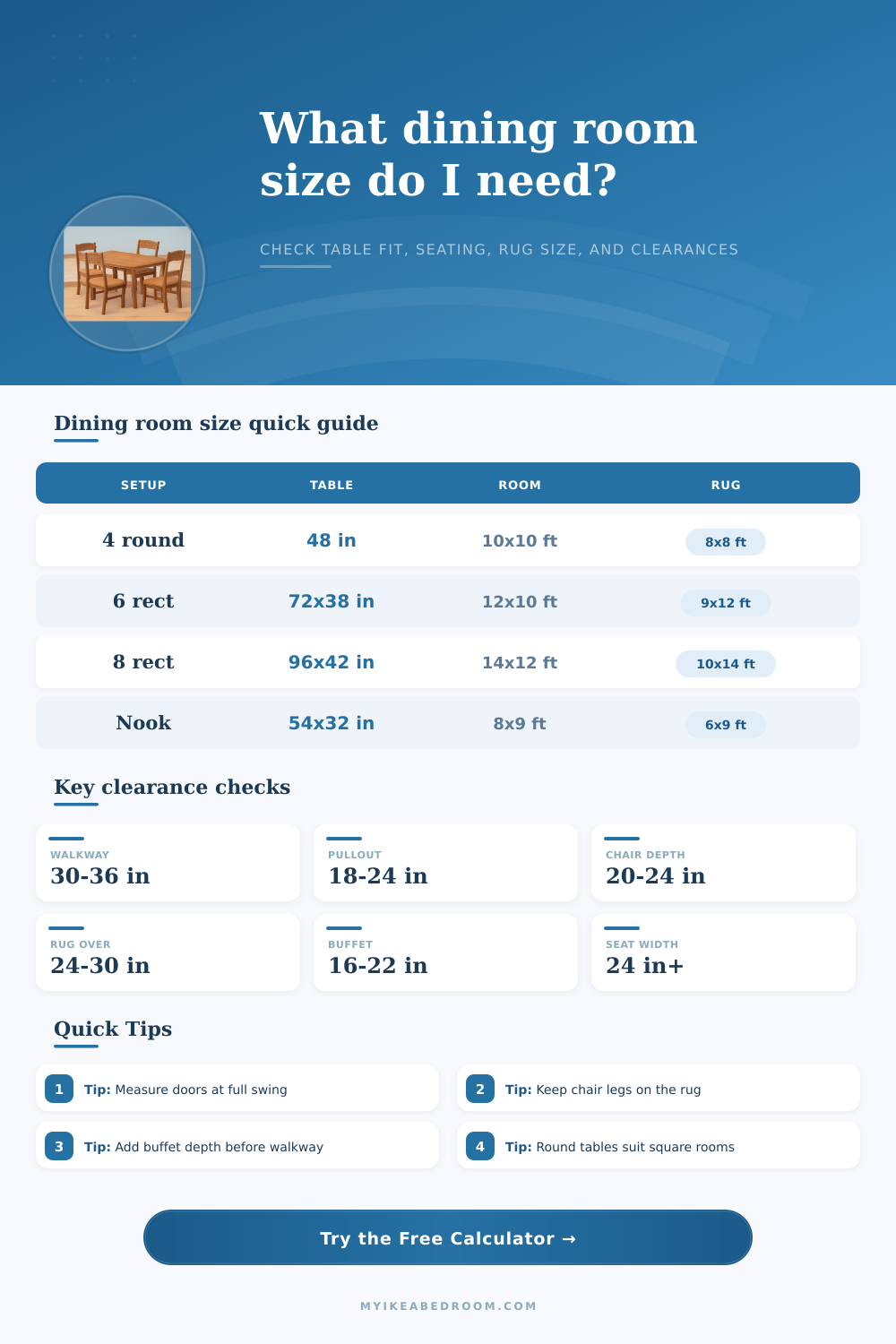
| Clearance | Compact | Comfortable | Use when |
|---|---|---|---|
| Chair depth in use | 18 to 20 in | 21 to 24 in | Measure the chair from front edge to back. |
| Pullout behind chair | 12 to 18 in | 18 to 24 in | Allows a diner to slide back from the table. |
| Walkway behind chair | 24 to 30 in | 30 to 36 in | Needed when people pass behind seated guests. |
| Shared serving path | 30 in | 36 to 42 in | Use near kitchens, patios, and entry doors. |
| Seats | Table shape | Typical table | Comfort room start |
|---|---|---|---|
| 2 to 4 | Round or square | 36 to 48 in diameter | 8 x 8 ft to 10 x 10 ft |
| 4 to 6 | Rectangle or oval | 60 x 36 in to 72 x 40 in | 11 x 9 ft to 12 x 10 ft |
| 6 to 8 | Rectangle or oval | 84 x 40 in to 96 x 42 in | 13 x 11 ft to 15 x 12 ft |
| 8 to 10 | Long rectangle | 108 x 42 in to 120 x 46 in | 16 x 12 ft to 18 x 13 ft |
| Table shape | Rug rule | Compact overhang | Comfort overhang |
|---|---|---|---|
| Round | Diameter plus both sides | 24 in | 30 to 36 in |
| Rectangle | Length and width plus both sides | 24 in | 30 in |
| Oval | Use widest length and width | 24 in | 30 to 36 in |
| Banquette | Size to free-chair sides only | 18 in | 24 in |
| Item | Typical depth | Add behind it | Why it matters |
|---|---|---|---|
| Shallow sideboard | 14 to 16 in | 30 in walkway | Good for apartment dining walls. |
| Standard buffet | 18 to 22 in | 36 in walkway | Allows serving and drawer access. |
| In-swing door | 28 to 36 in | 6 in buffer | Keeps the swing clear of chairs. |
| Corner entry | 30 to 36 in | 12 in buffer | Protects the tightest corner path. |
Round Table
Best for: Square rooms and compact traffic paths.
Priority: Equal clearance on all sides.
Watch: Large diameters reduce reach comfort.
Rectangle Table
Best for: Longer rooms and formal seating counts.
Priority: End clearance and side walkways.
Watch: Buffets can make the width tight.
Banquette Nook
Best for: Small kitchens and breakfast corners.
Priority: Free-chair pullout at open sides.
Watch: Table pedestal and bench access.
Open Plan
Best for: Dining zones beside living spaces.
Priority: One generous circulation edge.
Watch: Rug and chair zones crossing paths.
When you plan a dining room, you have to consider the space around the dining table. The space around the dining table will determine how the people will move in the room. While many people consider the size of the table when selecting a dining table, you must consider the total size of the floor space in the room.
If there is not enough space for the guest to move in the room, the dining room will feel to crowded for the guests. Dining rooms are meant to be functional spaces for movement, not just for the placement of furnitures. To plan a dining room correctly, you should understand three specific zone of movement in the room.
Plan Space and Movement in the Dining Room
The first zone of movement is the static zone, which is the area in which you will place the dining table. The second zone of movement is the pull-out zone, which is the area needed for the guests to slide their chairs away from the table when they stand up. The third zone of movement is the circulation zone, which is the area for the guests to move through the dining room.
These zones must not overlap in the dining room, or it will feel more smaller for the number of guests who are to use the room. Using a calculator can help you plan for these zones without guessing at the size of the dining room. Aside from the dining table, you must also account for the depth of the chairs when the guests is use the chairs.
When the chairs are empty they may appear to take up little space in the dining room. However, when the guests are seated in the chairs, the chairs will take up more space. You are not measuring the size of the chairs, but the space that the human body require when they are sitting in the chairs.
If there is not enough space for the guests to move their chairs away from the table, they will feel as if they are trapped while they are in the dining room. Other piece of furniture that will take up space in the dining room are sideboards and buffets. These pieces of furniture will take up nearly two feet of width in the dining room.
You must account for the depth of these pieces of furniture and the space needed to open the doors to the sideboard. If there is no way for the guests to walk in front of the sideboard, this will create a bottleneck in the dining room. The guests need to be able to walk past the sideboard without hitting the sideboard or the other guest standing next to it.
The shape of the dining table will also impact the movement of the guests in the room. Round dining tables work best in square rooms. The round shape of the table will allow for the guests to move easy around the table without hitting the corners of the table.
Rectangular tables are best for dining rooms that is long and narrow. They will not create narrow passages for the guests if the dining room is wide enough. Test each shape of dining table against the dimension of the walls in the dining room to determine which shape will create the most space for the guests to move in the dining room.
Rugs are common in dining rooms. However, the size of the rug must provide enough space for the chairs. If the rug is too small for the number of chairs in the dining room the back leg of the chairs may end up catching on the edge of the rug.
This will create a tripping hazard for the guests in the dining room. Select a rug that is large enough to allow for the dining room to have a stable area for each of the guests chairs, even when the guests are moving them away from the dining table. Another consideration for the dining room is the door swing.
Any door that swings into the dining room will create a dead zone in the dining room. You cannot place furniture in the path of the door swing. If you place the dining table in the path of the door, there will be issues with the use of the table when the door is open.
You must account for the door swing in the design of the room prior to placing any furniture. Finally, you should prioritize the clearances for the dining room. If you prioritize the clearances for movement in the dining room, it will feel effortless for the guests while they are dining.
The guests will feel comfortabley with the movement in the dining room and will be able to move and move their chairs without difficulty. If you take the time to check the margins and the clearances for the guests to move in the dining room, you will have a functional space for the guests to eat and move in their meal. You’ll have a space that is much better then a crowded one.
It would of been better to check this earlier.