Dining Room Chandelier Size Calculator
Size a dining chandelier by room length and width, table dimensions, ceiling height, table shape, fixture count, shade diameter, table-edge clearance, hanging height, and chain or rod allowance.
Start with a common dining setup, then adjust the fields to match the actual room, table, and fixture body.
Calculation breakdown
The fixture is sized to stay inside the table edge while still matching the room scale.
| Dining room size | Room rule | Usual fixture width | Best use |
|---|---|---|---|
| 8 by 10 ft nook | 18 in | 18 to 24 in | Small round, square, or breakfast table. |
| 10 by 12 ft dining room | 22 in | 24 to 30 in | Four to six seat everyday dining table. |
| 12 by 14 ft dining room | 26 in | 28 to 34 in | Six seat rectangular or oval table. |
| 14 by 16 ft dining room | 30 in | 32 to 40 in | Eight seat table or larger chandelier body. |
| 16 by 20 ft great room | 36 in | 36 to 48 in | Large dining zone with stronger room scale. |
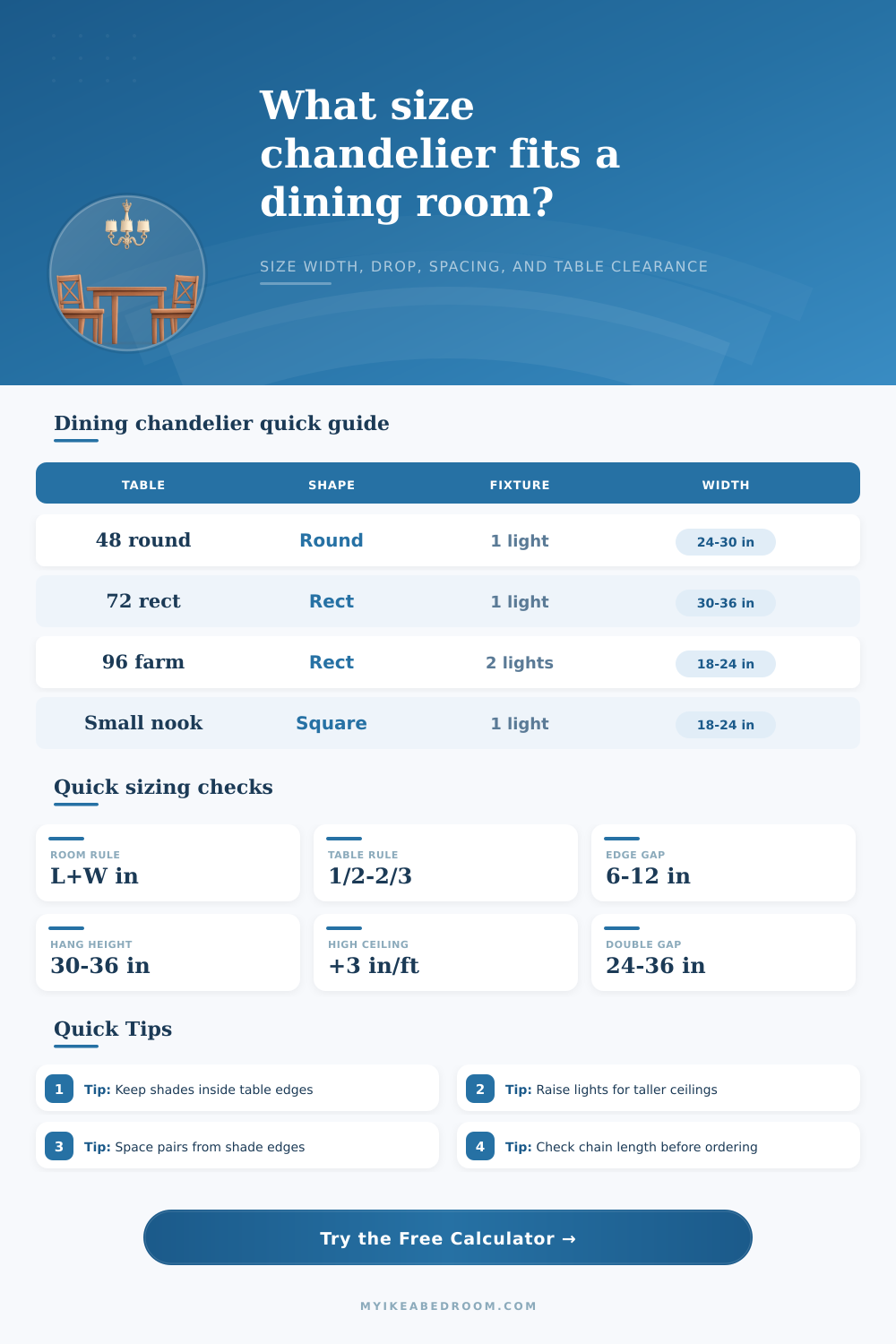
| Table size | Single fixture target | Table edge clearance | Layout note |
|---|---|---|---|
| 42 to 48 in round table | 22 to 30 in diameter | 6 to 10 in from table edge | Round or drum fixtures usually read balanced. |
| 60 to 72 in rectangular table | 30 to 36 in wide | 6 to 12 in from table side | Use one linear chandelier or a broad single pendant. |
| 84 to 96 in rectangular table | 36 to 48 in wide | 8 to 14 in from table side | Long linear fixtures or two pendants can work. |
| 108 in plus farmhouse table | 48 to 60 in wide | 10 to 18 in from ends | Pairs or triples keep light spread along the table. |
| Ceiling height | Shade bottom above table | Typical fixture bottom from floor | Adjustment check |
|---|---|---|---|
| 8 ft ceiling | 30 to 34 in | 60 to 64 in | Most dining rooms use this as the baseline. |
| 9 ft ceiling | 33 to 37 in | 63 to 67 in | Add about 3 inches above the table. |
| 10 ft ceiling | 36 to 40 in | 66 to 70 in | Raise for sightlines while keeping table focus. |
| 11 ft plus ceiling | 39 in plus | 69 in plus | Use room scale, fixture height, and chain length together. |
| Fixture count | Best table length | Center spacing | Edge rule |
|---|---|---|---|
| One chandelier | 36 to 84 in | Centered on table | Fixture body stays inside table perimeter. |
| Two pendants | 72 to 108 in | 24 to 42 in apart | Keep outer shade edges 12 to 18 in from table ends. |
| Three pendants | 84 to 120 in | 22 to 34 in apart | Equal spacing reads cleaner than exact room thirds. |
| Linear chandelier | 72 in plus | Single body | Length often lands near one-half to two-thirds table length. |
Single Round
Best for: Round, square, and compact dining tables.
Priority: Diameter fits inside the narrow table dimension.
Watch: Oversized drums can crowd the table edge.
Linear Chandelier
Best for: Rectangular and oval dining tables.
Priority: Visual length follows the table centerline.
Watch: Ends should not hover too close to seats.
Double Pendants
Best for: Long tables with two clear lighting zones.
Priority: Center spacing leaves shade-edge gaps.
Watch: Small shades need enough distance between them.
Triple Pendants
Best for: Very long tables or island-style dining.
Priority: Equal spacing across the table length.
Watch: Shade diameter controls end clearance quickly.
When choosing a light fixture for a dining room, two measurement must be considered: the dimension of the dining room and the dimension of the dining table. Often, people will choose a light fixture based only on how it look in a photograph. However, you should size the fixture according to the space in which it will be installed.
If the selected light fixture is too small for the dining room, it will appear unfinished in the space. If the selected light fixture is more large for the dining room, it will make the dining room feel too crowded. Thus, it is important to ensure that the chosen light fixture is sized in a way that is balanced with the dining room itself and the dining table that will be located within the space.
How to Choose the Right Light for Your Dining Room
Beyond the consideration of size, there are two different element that will help to determine the size of the fixture: the dining room itself and the dining table. Many people make the mistake of choosing a light fixture based only on the square footage of the dining room. However, choosing a fixture based on the square footage of the dining room alone will lead to incorrect sizing of the fixture.
While the square footage of the dining room will help to determine the maximum size that a fixture can be, the size of the dining table will help to determine the intimately size of the dining room. For example, a large chandelier will appear incorrect if it is placed above a small dining table within a large dining room. Additionally, a small chandelier will dissapear if it is placed above a large dining table within a small dining room.
Thus, the fixture should respect the boundaries of the dining room and the dining table. The relationship between the light fixture, the dining table, and the dining room also include the consideration of proper clearance. The width of the light fixture should not extend beyond the dining table.
If the light fixture does extend beyond the table, it will encroach upon the walking zone within the dining room. If the dining room becomes cluttered in this manner, it will detract from the visual comfort of the space. To avoid this issue, ensure that there are several inch between the widest part of the light fixture and the edge of the dining table.
Addition to the clearance between the table and the fixture is the consideration of the height of the light fixture. The hanging height of the light fixture should not extend too low into the dining room. If it does, it will prevent the audience from viewing the individual dining at the table.
Thus, the bottom of the shade of the fixture should be well above the tabletop. However, if the height of the ceiling within the dining room change, then the height of the light fixture must change accordingly. If the dining room has high ceiling, the fixture will have to be raised to avoid looking disconnected from the ceiling of the dining room.
Thus, ensuring that the height of the fixture will be taken into consideration when the height of the ceilings change. One additional consideration is if the dining table is especially long. In such a case, one fixture may not provide the light necessary to the entire tabletop.
In this instance, multiple light fixture can be used to provide the necessary light to each part of the long dining table. For example, multiple pendants can be used. In this instance, you must calculate the distance between the center of each pendant to ensure that the pendants are not too close to each other.
Ensuring that each pendant has enough space to shine its light will avoid any fixture cluster. Additionally, when multiple pendants are used, they should be arranged such that they create a visual line that matches the length of the dining table. Finally, the hardware of the fixture, such as the chain and the rod, must be considered.
The hanging hardware must be long enough to extend from the ceiling to the dining table. If you dont consider this in advance in the selection of the fixture, it is possible that the hardware will not be long enough to extend to the tabletop. Thus, the vertical measurement of the space should be calculated in advance so that the correct length of hardware is purchased for the fixture.
Through careful consideration of the scale of the fixture to the dining table and the dining room itself, the fixture will be appropriately integrated into the architecture of the dining room.