Dining Pendant Hanging Height Calculator
Calculate pendant bottom height, ceiling drop, cord or stem length, and seated sightline clearance from your dining table height, ceiling height, fixture body height, and preferred table gap.
Choose a real dining setup, then adjust the measurements to match the room and fixture you are hanging.
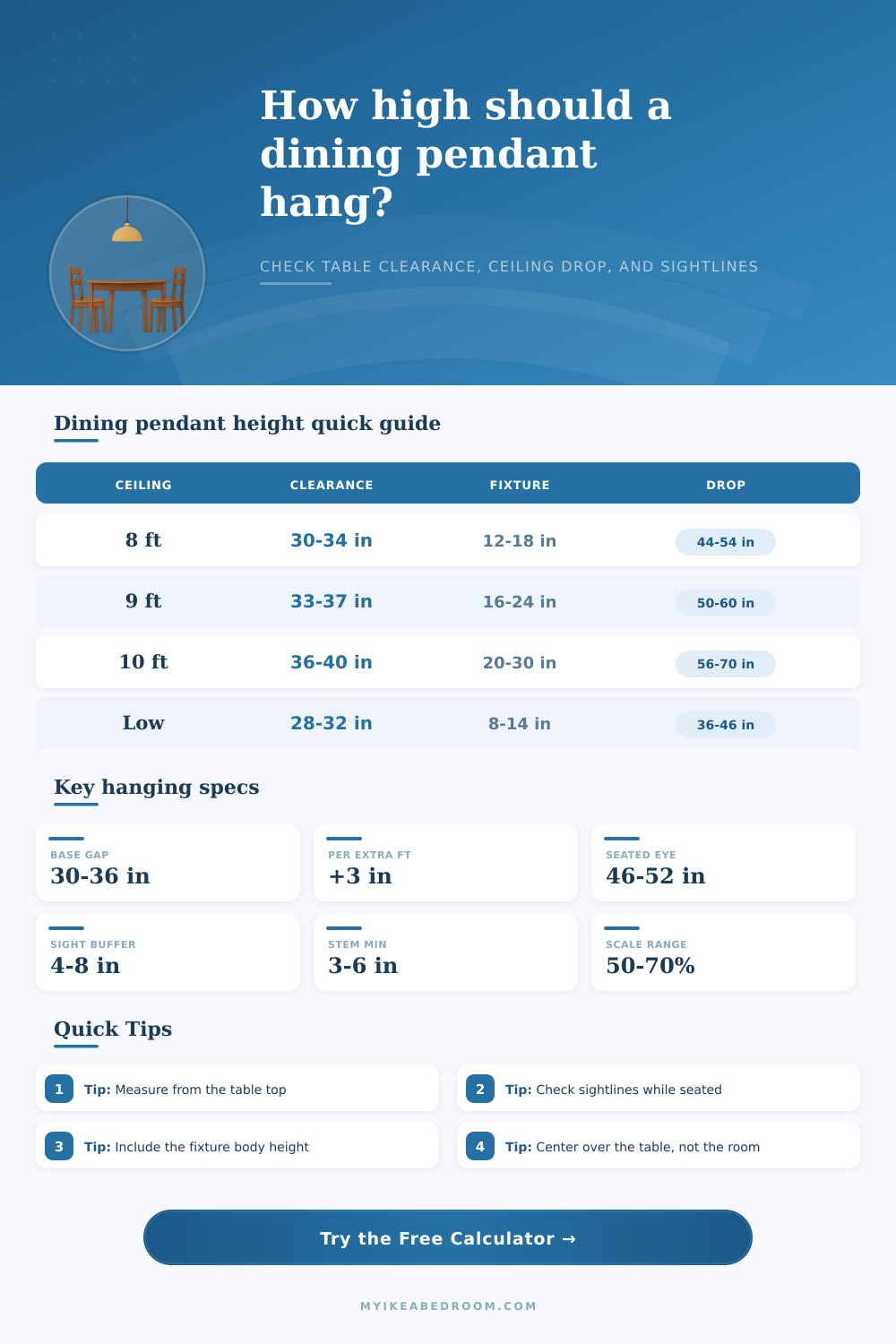
| Ceiling height | Starting clearance | Common usable range | Formula note |
|---|---|---|---|
| 7 ft 6 in to 8 ft | 30 to 32 in | 28 to 34 in | Keep compact fixtures shallow so the stem still fits. |
| 8 ft to 8 ft 6 in | 32 to 34 in | 30 to 36 in | Bottom height = table height + selected clearance. |
| 9 ft | 34 to 37 in | 33 to 38 in | Add about 3 in over the 8 ft baseline. |
| 10 ft | 37 to 40 in | 36 to 42 in | Raise enough to feel proportional, then recheck glare. |
| Over 10 ft | 40 in plus | 38 to 46 in | Large fixtures may need a longer chain to stay connected to the table. |
| Fixture style | Typical body height | Good ceiling fit | Watch point |
|---|---|---|---|
| Shallow saucer or flat shade | 6 to 10 in | Low ceilings and compact nooks | May need a higher clearance to avoid glare at seated eye level. |
| Small globe pendant | 10 to 14 in | Round tables and breakfast corners | Check that the bottom edge clears faces across the table. |
| Dome or drum pendant | 14 to 20 in | Most standard dining tables | Include shade height before choosing rod length. |
| Linear pendant | 12 to 22 in | Rectangular 60 to 96 in tables | Length matters more than diameter for table proportion. |
| Tall lantern or cluster | 22 to 36 in | 9 ft or taller ceilings | Can run out of stem room on 8 ft ceilings. |
| Check | Formula | Good target | If it fails |
|---|---|---|---|
| Table clearance | Bottom height - table height | 30 to 36 in for most dining tables | Raise or lower the fixture before cutting chain or rods. |
| Seated sightline | Bottom height - seated eye | At least 4 to 8 in above seated eye | Raise the pendant or choose a smaller shade. |
| Cord or stem length | Ceiling - bottom - body - canopy | At least the fixture minimum | Use a shorter body fixture or raise the bottom height. |
| Ceiling-to-bottom drop | Ceiling height - bottom height | Body + canopy + safe stem length | Confirm the supplied rods can create this length. |
| Fixture scale | Fixture size / table size | About 50% to 70% | Downsize if guests feel crowded visually. |
| Dining setup | Table height | Fixture body | Starting clearance |
|---|---|---|---|
| Small round breakfast table | 29 to 30 in | 10 to 14 in globe | 30 to 33 in above tabletop |
| Standard 6-seat rectangular table | 30 in | 14 to 20 in dome or drum | 32 to 35 in above tabletop |
| Long family dining table | 30 in | Linear 12 to 22 in tall | 33 to 37 in above tabletop |
| Counter-height dining table | 34 to 36 in | 12 to 18 in pendant | 30 to 34 in above tabletop |
| Banquette dining nook | 29 to 30 in | Shallow or small shade | 32 to 36 in above tabletop |
Best for: low ceilings, small shades, intimate table zones.
Risk: may interrupt sightlines if the seated eye level is high.
Best for: most 8 ft dining rooms and medium pendants.
Risk: tall fixture bodies can still run short on stem space.
Best for: 9 ft ceilings, linear fixtures, and open sightlines.
Risk: small pendants can feel detached from the table.
Best for: tall ceilings and large statement fixtures.
Risk: light may spread beyond the dining surface.
Mark the bottom edge first. Tape the target pendant bottom height on a wall or broom handle beside the table, then sit at the table and check whether the lowest edge cuts through faces, artwork, or a window view.
Do the stem math before trimming. The visible cord or rod length is ceiling height minus pendant bottom height minus fixture body height minus canopy allowance, so a tall shade can use up more drop than expected.
To hang a dining pendant light corectly above a dining table, a person must consider several different measurement and factors that will affect the amount of light that falls onto the dining table and the comfort of the individual who are dining at that table. If a person hang the pendant too low, it may obstruct the view of individuals who are seated at the table and it may sit too close to the eyes of individuals who are dining at that table. In contrast, if a person hang the pendant too high, it may not effective illuminate the dining table, and it may begin to look like a decoration for the ceiling instead of a pendant that provide light to those dining at the table.
Thus, specific measurement will help to determine the correct hanging height for that pendant. The first measurement to determine is the amount of table clearance that the pendant will provide. Table clearance is the amount of space between the table and the pendant that must allow for individuals to reach across the table for various item or to pass serving dishes without knocking into the pendant.
How to Hang a Dining Pendant Light
The shape of the pendant will determine the amount of table clearance. For example, tall pendant will provide less table clearance than those that are more shallowly in their design. Thus, an individual will have to measure the total height of the pendant to ensure that there is enough table clearance for the individuals who will be using the table.
The second measurement that an individual will consider is the sightline of the individuals who will be sitting at the table. The sightline is the path that an individual’s eyes takes when they are looking across the table at another individual who are dining at the same table. Thus, the bottom of the pendant should be hung above the eye level of the individuals who are to be dining at the table to avoid any obstruction of their sightline.
If the pendant was hung at the same height as the eyes of the individuals who are to be dining at the table, it would become a potential distraction from the individuals dining at the table. Thus, an individual will have to calculate the height of the individuals’ eyes while they are seated to determine the height of the bottom of the pendant. The third measurement to consider is the ceiling height in the room in which the pendant is to be installed.
The height of the ceiling will dictate the length of the pendant’s cord that will be use to suspend the pendant from the ceiling. An individual will have to account for the minimum length of hardware that the pendant will have to ensure that the pendant will not extend too far into the room from the ceiling, but also that there is enough clearance between the pendant and the dining table to allow the pendant to effectively illuminate the table. Additionally, you should consider the pendant in relation to the size of the table.
The pendant should not be too wide for a narrow dining table, and should not be too narrow for a long dining table. Finally, once an individual has determined each of the measurement for the pendant, they will have to physically test the pendant at the height that they calculated. One method of doing this is to use a piece of tape or a broom handle to mark the pendant at the height that was calculated.
Then, an individual will have to sit at the dining table and visual inspect the pendant relative to their dining area. If the pendant appears to be blocking the faces of the individuals who are dining at the table, the height of the pendant should be raised. However, if the pendant appears to be too far from the dining table when physically test at the height that was calculated, the height of the pendant will have to be lowered.
By using these step and measurements, an individual will be certain that the pendant will provide both light and comfort to the individuals who are dining at the table.