Dining Bench Length for Table Calculator
Estimate the right dining bench length from table length, leg inset, end reveal, target sitter count, seating width, bench depth, and pull-out clearance.
Start with a common table and bench setup, then tune the table length, leg inset, end overhang, sitter count, and clearance inputs.
Best when: legs or apron blocks sit inside the table ends.
Use the inside leg span minus a small clearance at each end as the hard maximum.
Best when: the bench stays visible and does not need to slide fully under.
Use table length minus twice the end reveal for a balanced look.
Best when: open pedestals or narrow supports do not block the bench.
The bench may be longer, but still keeps a reveal at both tabletop ends.
Best when: the seat is fixed to a wall or built into a nook.
Prioritize sitter width and side clearance because the bench will not tuck away.
| Seating type | Space per sitter | Metric | Use case |
|---|---|---|---|
| Kids or very tight bench | 18 in | 46 cm | Short meals, small children, or occasional seating. |
| Casual compact adult | 20 in | 51 cm | Works when elbows are close and meals are informal. |
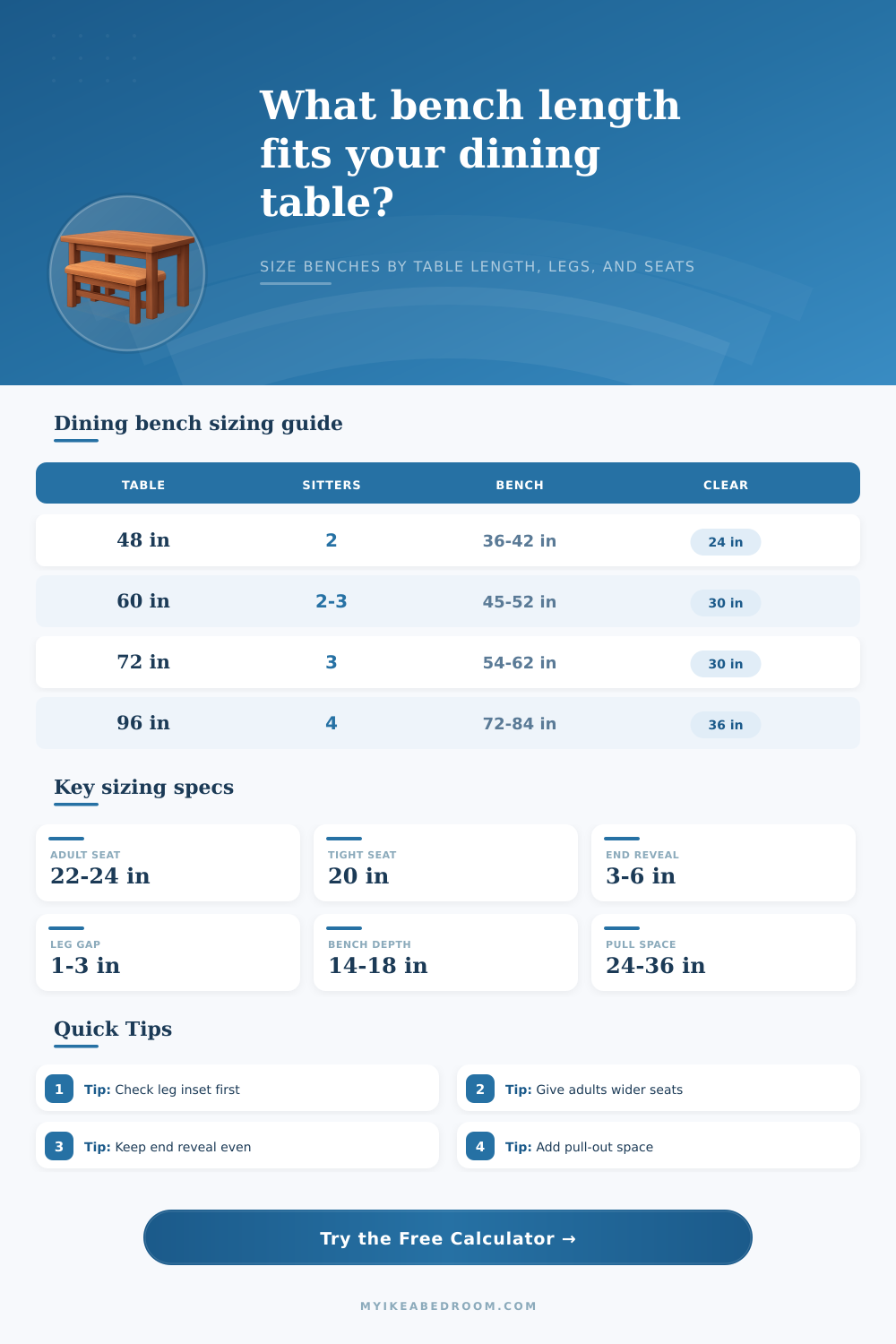
| Standard adult | 22 in | 56 cm | Good everyday starting point for most benches. |
| Roomy adult | 24 in | 61 cm | Better for long meals, larger adults, and mixed seating. |
| Table length | Common bench range | Likely sitters | Notes |
|---|---|---|---|
| 48 in | 36 to 42 in | 2 adults | Use a small end reveal and check leg inset carefully. |
| 60 in | 45 to 52 in | 2 to 3 | Three sitters need compact spacing or an outside-leg fit. |
| 72 in | 54 to 62 in | 3 adults | A common size for a tuck-in family bench. |
| 84 in | 66 to 74 in | 3 to 4 | Four adults need roomy leg clearance and support spacing. |
| 96 in | 72 to 84 in | 4 adults | Works well with trestle or open pedestal tables. |
| Support style | Leg inset to check | End clearance | Bench planning note |
|---|---|---|---|
| Corner legs | 3 to 6 in | 1 to 2 in | Bench often fits close to visual table length. |
| Inset legs | 6 to 10 in | 2 to 3 in | Inside leg span may become the limiting number. |
| Trestle base | 10 to 18 in | 2 to 4 in | Check knee room around feet, stretchers, and crossbars. |
| Open pedestal | 0 to 4 in | 1 to 2 in | Seating width usually matters more than tuck length. |
| Clearance behind bench | Metric | Comfort level | Use case |
|---|---|---|---|
| 18 to 22 in | 46 to 56 cm | Very tight | Only for fixed benches or no-walkway nooks. |
| 24 in | 61 cm | Compact | Enough to sit down if no one must pass behind. |
| 30 in | 76 cm | Comfortable | Good dining target for most bench sides. |
| 36 in | 91 cm | Passage friendly | Better when people walk behind the seated bench. |
Let the table legs set the hard limit. A bench can look perfect on paper and still scrape the legs when tucked in. Measure the inside span between obstructions, then subtract a small clearance at each end before choosing the final length.
Separate visual fit from seating fit. A shorter bench may look balanced under the tabletop, but sitter count depends on usable seat width. If the calculator flags a shortfall, reduce sitter count or use chairs at the ends.
When choosing a dining bench for a dining room, one must consider the length of the dining bench in relation to the length of the dining table. If the length of the dining bench is too long in comparison to the dining table, the dining bench will either become an obstacle for the dining table or it will be too short to allow for all of the individual that are to dine at the table. However, if the length of the bench is the correct length, it will be able to slide under the dining table to save space in the kitchen and it will allow for enough room for all of the individuals to dine at the table without collide with others at the table.
The length of a dining bench can be determined by measuring the space between the legs of the dining table. Because a dining bench cannot pass through the legs of the table, any bench that is purchased for that dining table cannot have legs that extend beyond the space between the legs of the dining table. Additionally, the amount of overhang of the dining table’s end can also be considered; if the dining table has an overhang of its ends that extends past the legs of the table, then there will need to be an overhang of the dining bench to create the appearance of balance between the two table.
How to Choose the Right Size Dining Bench
Another consideration for the purchasing of a dining bench is the width of the dining bench relative to the number of individuals that are to dine at the bench. For example, a width of twenty inches for each individual that is to dine on the bench is a narrow width. Conversely, twenty-two inches is a standard width for adults to dine, and twenty-four inches is a generous width for which extra comfort can be provided to the guests that are to sit on the dining bench.
A calculator can be used to determine the length of the dining bench by altering the length based on the width that is selected for each individual that will dine on the bench. Another consideration for the purchasing of a dining bench is the depth of the dining room behind the dining bench. Dining benches tend to be deep in relation to the space that must be provided for each of the individuals to pull the dining bench out of the dining room.
Thus, if the dining room is narrow, the size of the dining bench may not be considered prior to purchasing the bench; the depth of the dining bench and the amount of floor space that it will claim within the dining room is an important consideration. Additionally, the calculator that is used to calculate the size of the dining bench will also include the depth of the dining bench in its calculation to provide an idea of the amount of floor space that the dining bench will claim. The style of the dining table base may also have an impact upon the length of the dining bench.
For instance, if the dining table includes corner legs, there will be more space that is provided for the dining bench. However, if the dining table has trestle base or pedestal bases, there will be less space for the dining bench. The type of support bases that the dining table has will impact the length of the dining bench, so that selection should be made in the calculator that is used to calculate the length of the dining bench.
The depth of the dining bench will not have an impact upon the length of the dining bench. The number of individuals that will dine on the bench and the placement of the legs of the dining table will impact the length of the dining bench. However, the depth of the dining bench will only impact the comfort of those that dine on the bench.
Reference table can also be used to determine the length of the dining bench. For instance, reference tables may show the number of inches of a dining table that commonly pair with dining benches of a specific length. For example, a seventy-two inch dining table may have reference tables that indicate that a dining bench between fifty and sixty inches in length is required to complement the dining table.
To determine the length of the dining bench for the dining room, the space between the legs of the dining table should first be measured. Additionally, the number of individuals that will dine on the bench should be determined. Once you have determined each of these measurement, the calculator will indicate the other dimensions of the dining bench that is to be purchased.