Furniture sewing planner
Dining Bench Cushion Yardage Calculator
Estimate top and bottom panels, boxing strips, fabric repeat waste, piping cord, zipper length, and total yardage for bench pads, banquettes, mudroom cushions, and window seats.
The calculator estimates fabric as a practical cutting layout, then adds repeat matching and waste. Always compare against the fabric's nap, stripe direction, and store cutting rules.
| Boxing style | Formula used | Best fit | Planning note |
|---|---|---|---|
| Boxed edge | 2 x length plus 2 x depth | Most bench cushions | Clean square edge with one long strip when fabric allows. |
| Split boxing | Perimeter plus seam joins | Long cushions | Adds side seams so strips can be easier to cut and align. |
| Knife edge | No boxing strip | Thin pads | Uses larger top and bottom panels joined around the edge. |
| Waterfall front | Back plus two sides | Soft front edge | Front is treated as part of the panel wrap, not a separate strip. |
| Fabric width | Typical usable width | Panel fit clue | Common cushion use |
|---|---|---|---|
| 45 in fabric | 42 to 44 in | Short benches only | Small nook pads and chair cushions. |
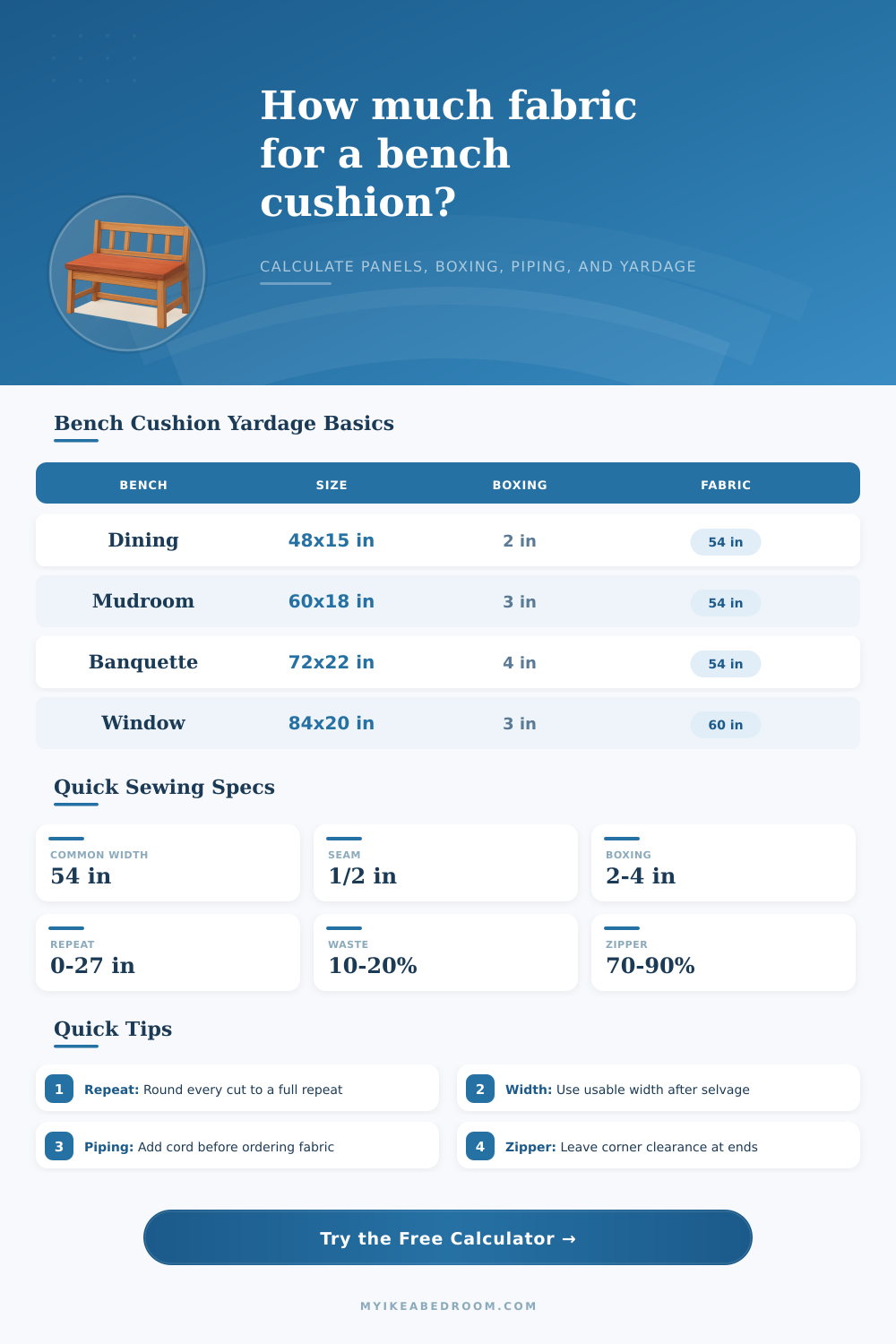
| 54 in fabric | 52 to 53 in | Most depths fit across | Dining benches and mudroom pads. |
| 60 in fabric | 58 to 59 in | Better for deep seats | Window seats and daybed-style benches. |
| Railroaded fabric | Varies by roll | Length may run across width | Long single cushions with no center seam. |
| Pattern repeat | Yardage effect | Match priority | Practical note |
|---|---|---|---|
| 0 to 3 in | Minimal | Low | Small textures usually behave like solids. |
| 4 to 12 in | Moderate | Medium | Round panel lengths to repeat intervals. |
| 13 to 27 in | High | High | Center the top panel before cutting boxing. |
| Directional stripe | Layout dependent | High | Check whether stripe should run lengthwise or front-to-back. |
| Bench scenario | Typical size | Thickness | Suggested allowance |
|---|---|---|---|
| Dining bench pad | 44 to 60 in long | 1.5 to 2.5 in | 10 to 12 percent waste |
| Mudroom bench | 48 to 72 in long | 2.5 to 4 in | 12 to 18 percent waste |
| Banquette cushion | 60 to 96 in long | 3 to 5 in | 15 to 22 percent waste |
| Window bench seat | 60 to 96 in long | 2 to 4 in | 12 to 20 percent waste |
How big should a cushion be? Seems simple enough to get out your tape measure…until you pick up some upholstery fabric. Then you’re standing there holding a yard of fabric in one hand and a tape measure in the other. You have no idea what those flat measurements will look like as 3D object with seams, a zipper, or even piping.
It’s all too simple to forget about the length needed for a boxed corner, or the fact that you need to match a repeat when cutting out pieces so there will be waste. So you end up with a cushion that looks nice at the top but has nothing left for bottom few inches, resulting in either a raggedy seam or an obvious patch job.
Why You Need a Fabric Calculator
Most of us overlook the fact that a cushion isn’t two rectangles but a box. What does that mean? You need more fabric because you need something for those sides! Add all that up and suddenly you realize how much longer your total cut list will be.
The tool considers the wasted fabric from cutting on bias (or lining things up to match motifs) and helps figure out exact geometry of your layout. It considers side boxing strips, top panel, and bottom panel. Do your panels fits across the width of your average 54 inch fabric? Or do they need to be seamed together?
It even figures out the correct size of zipper needed and length of the piping cord, so you can order enough notions to complete this project with clean finishes.
The repeat of the pattern can be one of the trickiest variables. For example, if you’re using a tiny texture or a solid color, then cutting out panels back-to-back will not cause much waste because those patterns function as a blank canvas. But if you have a large stripe or a large floral print, all bets is off!
In this case, you’ll need to round every cut up to the next full repeat so that the motif aligns along the seams. To account for this, the calculator lets you plug in the repeat distance (how far apart does the repeat go vertically?). So, for instance, if your fabric’s repeat is eighteen inches long, it’ll add that additional length so that top panel lines up perfectly on the design.
It is a small thing, but it makes a difference if you want your cover to look professional instead of pieced together.
The amount of material also depends on whether you use a boxing edge. A plain old knife-edge cushion has big panels wrapping around foam, less side strip needed but bigger cuts of fabric. And then there’s a boxed edge (which adds some structure to the look), so each side needs its own strip. The calculator knows what kind of box you’ve chosen and makes adjustments in layout accordingly.
For example, if you have a really long bench with a split boxing, it factors in all those extra seams and seam allowances you’ll use to join two side panels together. That’s important, because if you gets the width of the boxing wrong, your cover will either fit too snugly and bunch up at the corners or be too loose and sloppy on the bench.
Another important entry is the width of the fabric. Upholstery fabric, unless it’s really heavy duty outdoor stuff, is typically just 54 inches wide. But outdoor fabric can be as wide as 60 inches. There are some slight adjustments. Since we don’t want to sew through the selvages on either side, there isn’t quite as much fabric to work with. Make sure to enter in the real usable width so it will fit inside the bounds of the fabric.
Also, if your bench is wider than one piece cut from edge-to-edge (across) you’ll have to seam more pieces together. This impacts both the amount of yardage required and how finished piece looks.
How our calculator accounts for waste
This is the reality. Nothing is ever cut perfectly. Fabric stretches. Grainlines move. Sometimes there’s an errant fold here and there. Give yourself some wiggle room (about 10-20% extra will do) in case one of those little disasters happens. This feature rounds out your total order to the next closest quarter/half yard, which reflects actual retail fabric store practices. They don’t sell exactly 42″; they sell three-quarters of a yard.
Knowing this ahead of time saves you from that panic at the cutting counter when you discover you’re two inches shy of what it takes for the zipper strip.
The amount of fabric and the foam density are equally critical. You want a tight fit in the cover with higher-density foam (high resilience). Otherwise it will be flat as a pancake in no time. The thickness entered into the calculator also affects the boxing height. This ensures side strips are the right height to completely enclose the foam and hide all edges.
But in conclusion: Accurate = less frustrating and cheaper. Six extra inches of fabric > no fabric at all. By translating those vague numbers into a real-life shopping list, the calculator gives you confidence. And armed with your zipper specs, piping specs, and yardage needs, you’ll head off to the store feeling confident and focused.
You won’t have to guess if it is going to fit. Would of I get enough for the sides? How will I line things up? You know what to purchase and you’re free to concentrate on the sewing, not the shortage. That clarity transforms an intimidating upholstery job into a reasonable weekend task.