🖌 Deck Stain Coverage Calculator
Estimate gallons, cans, coverage, and weight for new, weathered, or recoated decks with imperial or metric input support.
📋Deck presets
🔧Calculator inputs
📋Stain coverage grid
📊Reference tables
💡Practical tips
📈Calculation results
Calculating the amount of wood stain needed for a deck requires understanding that the wood will absorbs the stain at different rates. It is crucial to consider the type of wood, the application method, the type of stain, the condition of the wood, and any other consideration before purchasing the stain required for staining the deck. If you purchase too little stain, you will have to return to the store to purchase more stain.
However, if you purchase too much stain, you will waste your money. The type of wood used for the deck will determine how much stain the wood will absorbs. For instance, fresh pressure-treated pine has tight grain, and tight grain will cause the wood to absorb less stain than other type of wood.
How Much Stain Do You Need for a Deck
In contrast, old wood will absorb more stain because it becomes porous with exposure to the elements. Additionally, cedar is a very porous wood and will absorb oil-based stain rapidly. Therefore, you will have to account for the age and type of wood when calculating how much stain is need for staining the deck.
The method used to apply the stain will also determine how much stain will be used for staining the deck. For example, if you use a brush, very little stain will be wasted during the staining process. Using a roller will cause the roller to absorb some of the stain, and using a sprayer could result in some of the stain evaporating as a mist.
Using a rag to wipe the stain on the deck will allow for precise control over the amount of stain that the wood will absorb. Additionally, two thin coats of stain will penetrate the wood better than one heavy coat. Finally, one heavy coat of stain could result in puddling or peeling of the stain; two thin coats will provide the best coverage and longevity for staining the deck.
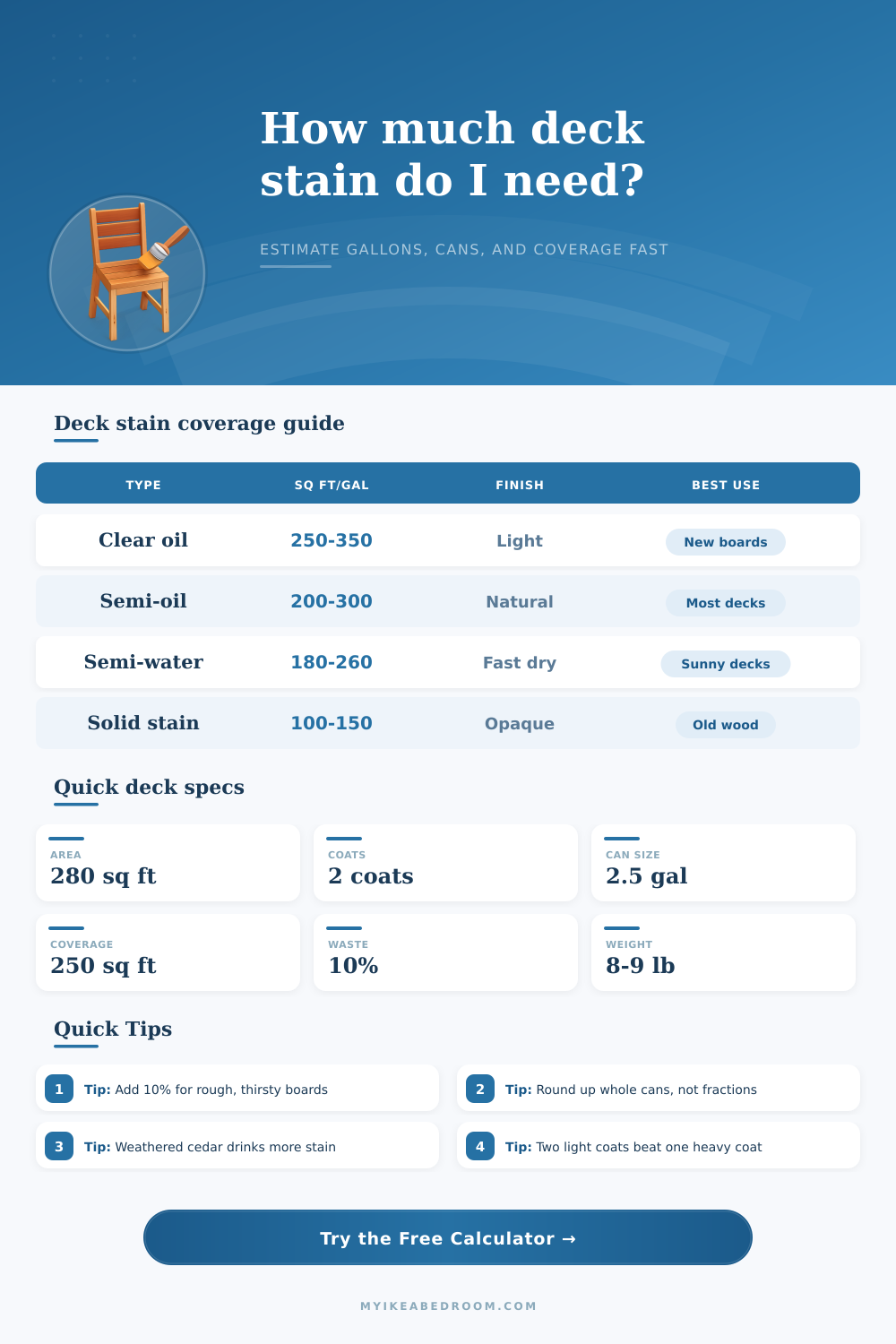
Another factor to consider is the type of stain that will be used on the deck. For example, clear penetrating oil will remain on the deck’s surface and allow the wood to breathe. Additionally, semi-transparent stains will add color to the wood while allowing the natural texture of the wood to show through.
Water-based stain will dry quickly but may require more of the product to cover the wood than oil-based stains. On the contrary, solid stains will add coverage to the wood’s flaws but will build up on the wood’s surface. The condition of the wood for the deck will also impact how much stain is needed.
For example, smooth and new wood will require less stain than old and cracked wood where the stain must fill the crack in the wood. Additionally, if staining a surface that has already been seal, the wood will resist the stain. The existing seal on the wood will cause the stain to stretch the surface more further.
When purchasing wood stain, consider the entire structures dimension, including the railings and stairs. The area of the railings will require an additional 100 square foot of stained area for every 20 linear feet of railing. Additionally, stairs will require 50 square feet of stained area.
Subtract any area that is taken up by built-in planter; however, you can always add an additional allowance for stained areas in complex areas of the deck. If you overestimate the amount of stain required for the entire deck, you will ensure that each board is stained evenly and that you will not run out of stain before staining is complete. The other considerations for purchasing wood stain include the dimensions of the entire structure.
For instance, if you calculate the stained area to be 420 square feet, you can purchase two 2.5-gallon pail of stain. This will ensure that you will have enough stain to treat the entire deck with an allowance for staining mistake. Additionally, you will need to calculate the dimensions of the structure’s other areas.
You will stain the area for the railings by adding 100 square feet of stained area for every 20 linear feet of railing. For instance, if there are 100 linear feet of railings, the stained area will be 500 square feet. The stained area of the stairs will be calculated by adding 50 square feet of stained area for every set of stair on the deck.
Any area stained by built-in planter can be subtracted from the total stained area. However, you may want to overestimate the area required for any complex areas on the deck. Finally, you can calculate the total amount of stain needed by adding all stained areas together.
Once you have the total amount of stain needed, add 10 percent to account for waste. The standard waste percentage for staining decks is 10 percent for the amount of stain wasted on the edge and spills of the wood stain. However, if the deck is made of rough cedar, you may need to add a larger waste percentage when calculating the total amount of stain needed.
If the total calculated area is 420 square feet of stained wood, you will need to purchase two 2.5-gallon pails of stain. This will ensure that you have enough stain to coat the entire deck and accommodate staining mistake.