Deck guard layout
Deck Railing Post Height Calculator
Dial in level or stair post cut height, account for caps and base shoes, and see how rail stack dimensions change the space left for your baluster or cable field.
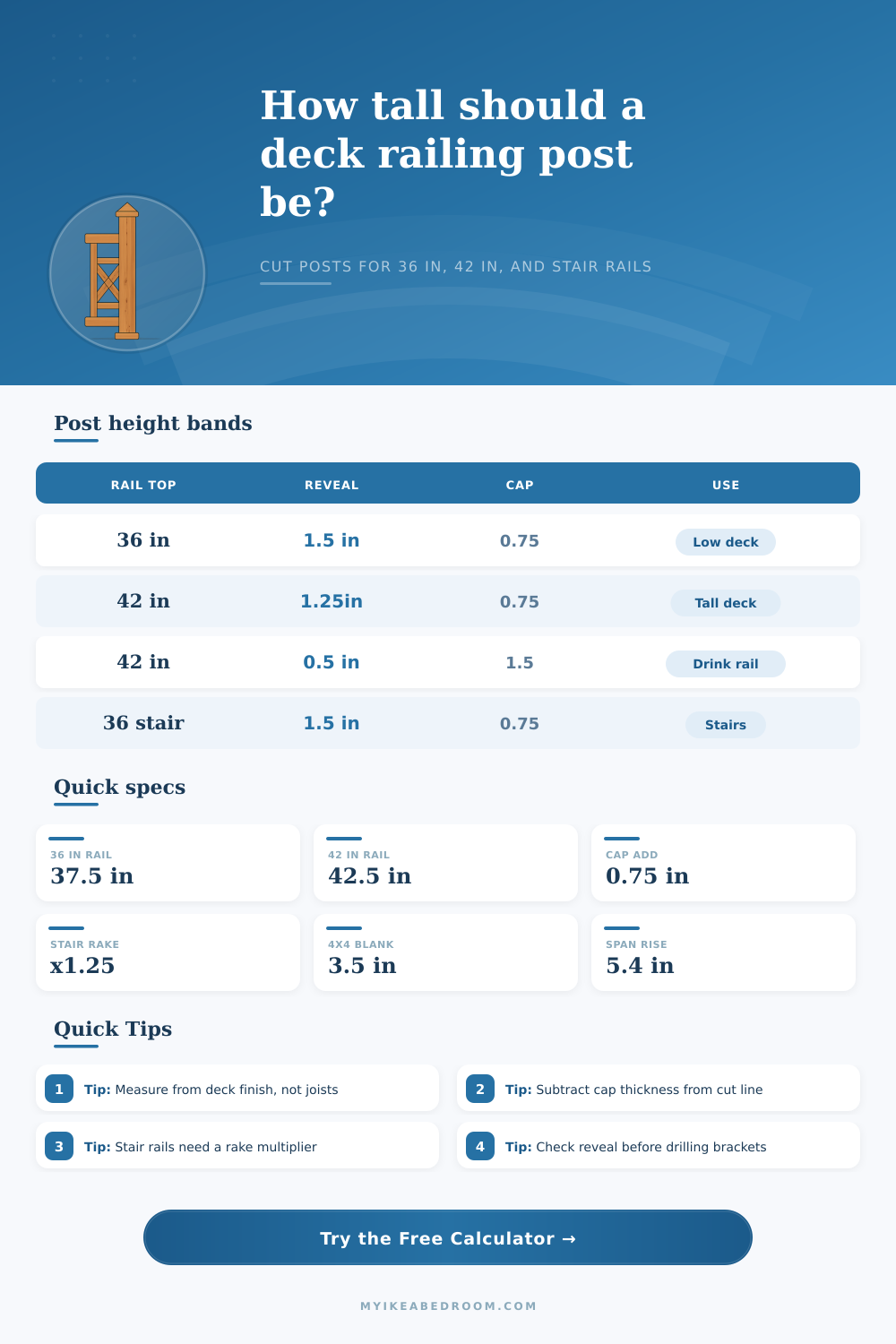
These presets cover common 36 in and 42 in deck guards, drink-rail builds, and stair runs so you can start from a real framing pattern instead of a blank form.
These guides anchor the calculator with common guard targets, actual post blank sizes, and the stair rake multipliers that usually catch people off guard during layout.
When you are installing a deck railing, you need to calculate the height of the posts that will support the railing. The height of the posts will impact the way that the cook will install the rails along the deck. If you dont calculate the height of the posts correctly, you may end up with a railing that is too low or too high to the finished deck surface.
In this case, you will have to recut the posts in order to make the installation of the balusters possible. You can calculate the height of the posts by considering the height of the finished deck surface. The height from the finished deck to the post should be measured, not from the joists that rest beneath the decking boards.
How to Measure Deck Railing Posts
Additionally, the thickness of the decking boards should be accounted for in the calculation of the height of the posts. The height of the posts should also be reduced according to the thickness of the railing cap that will sit upon the posts. If the posts will be elevated with base shoes or standoff-brackets, then you should also account for those heights in the measurement of the posts.
In decks that contain stair railings, you must calculate the height of the posts according to the angle of the stairs. The vertical height of the railing will be the same throughout the deck, but you will have to install the railing at an angle according to the stairs. For instance, stairs with a common pitch will cause the distance between the top rail and the bottom rail to become stretched out.
Additionally, measurements must be taken from the nosing line of the stairs rather than from the stair treads because the thickness of the stair treads may not be the same throughout the deck. The bottom rail, the top rail, and the space in between form the railing stack. The thickness of the top rail will impact the amount of space available for the balusters.
For instance, a thick drink rail will take up more of the vertical space of the deck allowing for few balusters. The space between the bottom rail and the deck should also be accounted for. For instance, if the bottom rail is too high the balusters may be crowded at the top of the deck.
Additionally, if the bottom rail is too low it may interfere with the feet of the individuals who walks on the deck. Finally, the height of the railing must provide enough space for the balusters to be placed in accordance with local building codes, and the spacing of the balusters must be correct even on sloped stairs. Many people use preset measurements for installing deck railings.
For instance, people often use 36-inch guard presets for decks that is relatively low in height. In decks that have high platforms, 42-inch guard presets may be used for the height of the deck posts. Presets, however, are not always accurate in determining the height of the posts required for each individual project.
Therefore, you should verify the dimensions of the posts using a sample post and tape measure placed upon the deck to be used for installing the railing. Some of the most common errors in installing deck railings are measuring from the joists rather than from the finished deck surface. Additionally, individuals often do not account for the thickness of the base hardware or the railing cap.
It is also important to remember that the actual dimensions of the wood posts may be different then the dimensions of the nominal measurements of the wood. For instance, a nominal 4-by-4 post is actualy 3-1/2 inches in each dimension. You should account for these actual dimensions of the posts when installing the brackets and rails onto those posts.
Finally, individuals should also be sure to read and understand the local building codes regarding the height of the railing and the maximum spacing of the balusters.