Deck Railing Paint Calculator
Estimate exposed paint area, coat-adjusted coverage, and container mix for deck rails, posts, and balusters in imperial or metric units.
📈Calculator Inputs
Use total run length, exposed height, and component sizes. The calculator updates paintable area, finish volume, and quart rounding automatically.
📊Live Results
Full breakdown
🧹Material and Spec Comparison
📃Reference Tables
| Material | Factor | Primer | Notes |
|---|---|---|---|
| PT pine | 1.15x | Yes | Open grain |
| Cedar | 1.05x | Often | Stable grain |
| Composite | 0.92x | Bonding | Low soak |
| Iron | 0.85x | Rust prime | Prep edges |
| Paint system | Sq ft/gal | Best for | Coverage note |
|---|---|---|---|
| Std acrylic | 350 | Most wood | Balanced finish |
| High-build | 325 | Trim detail | Thicker film |
| Primer-top | 275 | Raw wood | Extra seal |
| Metal system | 400 | Smooth rail | Lower soak |
| Component | Typical size | Area rule | Use |
|---|---|---|---|
| Post | 4x4 | Perimeter x height | Support |
| Rail | 2x4 | Perimeter x length | Hand support |
| Baluster | 1.5 in | Perimeter x span | Infill |
| Cap | 4x4 top | Top face only | Top trim |
| Scenario | Length | Posts | Need |
|---|---|---|---|
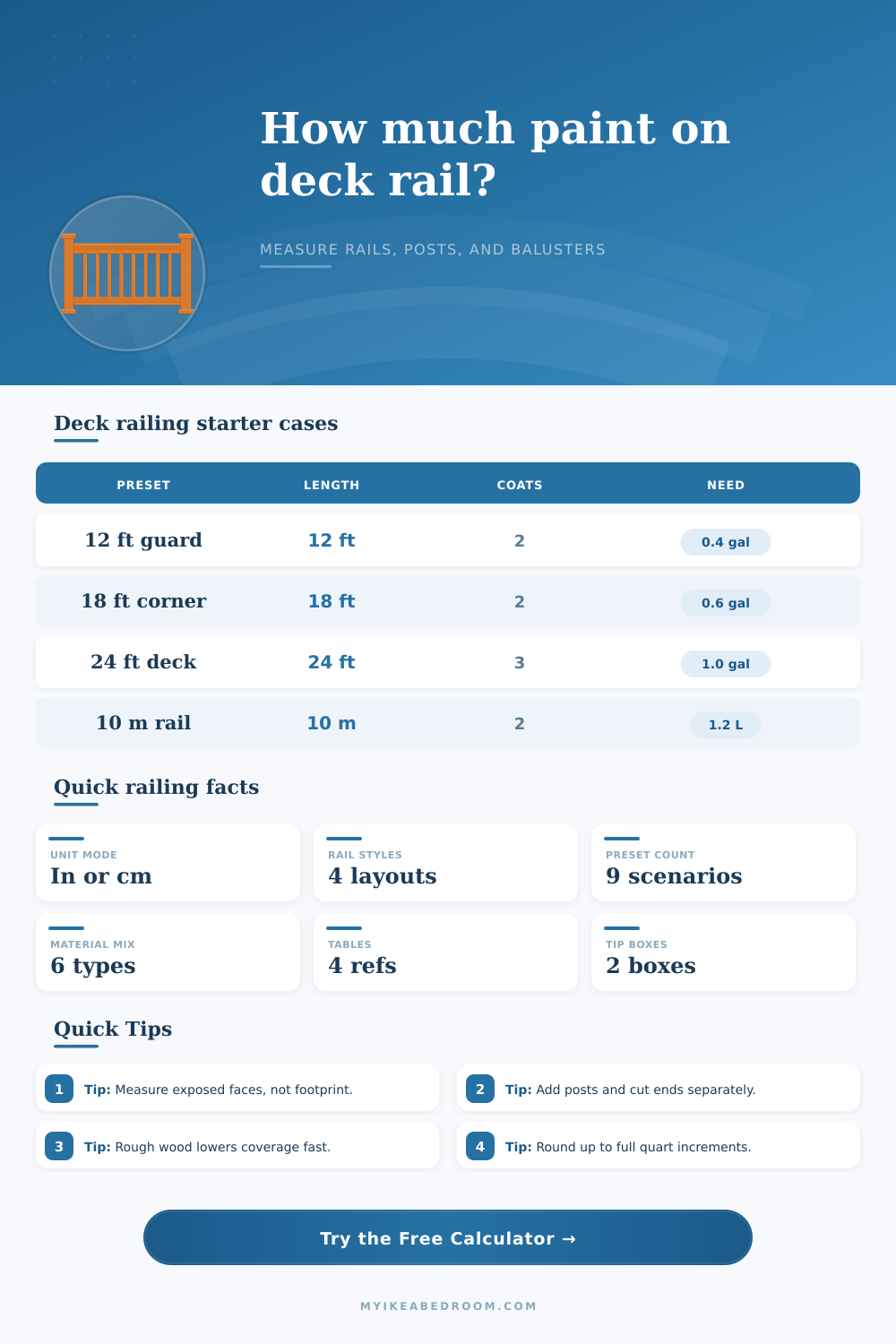
| Porch rail | 12 ft | 3 | 0.4 gal |
| Corner deck | 18 ft | 4 | 0.6 gal |
| Pool rail | 24 ft | 5 | 1.0 gal |
| Balcony | 10 m | 4 | 1.2 L |
Paintable area uses component geometry, then adjusts for layout complexity, material absorption, coats, and waste to give a practical finish estimate.
To estimate an amount of paint that will be needed for a deck railing, an individual must understand the surface area of the deck railing and the material of the deck railing. The surface area of the railing include the posts, the rails, and the balusters that make up the railing system. An individual must measure each of these components in order to calculate the total amount of paint that will be needed to evenly coat each part of the railing system.
The material of the deck railing will impact the amount of paint that the railing will absorb. If the railing are composed of pressure-treated pine, the railing will absorb more paint than materials with fewer pores. Materials like cedar and redwood is denser than pine, but may require a primer prior to painting because of the tannins that are present in those types of woods.
How to Estimate Paint Needed for a Deck Railing
Metal deck railings will require less paint than wooden deck railings due to the nonporous nature of metal. Finally, composite deck railings will have low porosity, but will require specific types of paint to ensure that the paint adheres to the composite materials. The type of paint that the user chooses for the deck railing will impact the coverage that the paint provide.
For instance, standard exterior acrylic paint covers approximately 350 square feet with one gallon of paint, but high-build enamels cover less square feet with the same volume of paint. Additionally, most paint projects will require two coats of paint to even out the color throughout the railing, but the user will require three coats of paint if the wood structures are raw wood. In each instance, 10% of the total amount of paint can be purchased with an additional gallon of paint to account for paint waste during the application process.
When calculating the amount of paint that will be needed for the project, only calculate the area of the railing that will be painted. For instance, if the bottom of the posts are in contact with the deck, those portions doesnt need to be painted. Additionally, if the railing covers the underside of the balusters, those areas does not need to be painted.
Additionally, painting calculators are available that will calculate the square footage that must be painted, and can even convert that square footage into gallons and quarts of paint that is required for the project. Additionally, you should purchase paint in full gallons and quarts of paint to ensure that there is enough paint to complete the project, and to ensure that there is some left over after the project is completed. The railing itself may introduce additional geometric complexity to the paint estimation process.
For instance, the straight portions of the railing can be easily measured to determine the total area of the railing that will be painted, but the corner section of the railing will increase the total area of the railing that must be painted. Additionally, if the deck includes a set of stairs with that decking system, the stairs will increase the complexity of the project due to the angled portions of the rails for those stairs. Finally, if the deck features a privacy railing that includes many tight balusters, those portions will require more paint than a standard railing system.
These measurements for width of the posts and depth of the railing must be accounted for in order to ensure that the paint estimate are accurate. In order to successfully paint the deck railing, the railing must be prepared. Preparing the railing includes sanding the railing to create a smooth surface, power washing the railing to remove any dirt that may be trapped in the pores of the wood, using painter’s tape to protect the deck boards from any paint that may drip onto the wood decks, and choosing the appropriate sheen of paint for the project.
For instance, satin sheen paint is good for handrails, since it hides the fingerprints of those who use the railing. In contrast, gloss sheen paint may show dusts on the balusters. Additionally, using exterior paint that contains UV blockers will protect the railing from the sun, and will allow the paint to remain on the railing for longer period of time.