Deck edge planning
Deck Railing Calculator
Turn guarded deck edges, stair openings, and spacing targets into a practical railing layout with post counts, baluster fill, and waste-adjusted rail stock.
When building a deck railing system, there are several important measurement that must be followed in order to create both a safe and visually appealing deck railing. A deck railing is necessary to ensure that individuals doesnt fall off the platform if it is three foot or higher above the ground. To determine the length of the railing that is to be built, one must measure the length of the deck’s edge and subtract the width of the stairs or gates that exist on that deck.
This remaining length of the deck railing will inform the builder of the number of deck railing posts and balusters that will be needed for the project. The distance between the deck railing posts is another critical measurement for the builder. The distance between the posts will determine the strength of the railing as well as it’s visual appearance.
How to Measure and Build a Safe Deck Railing
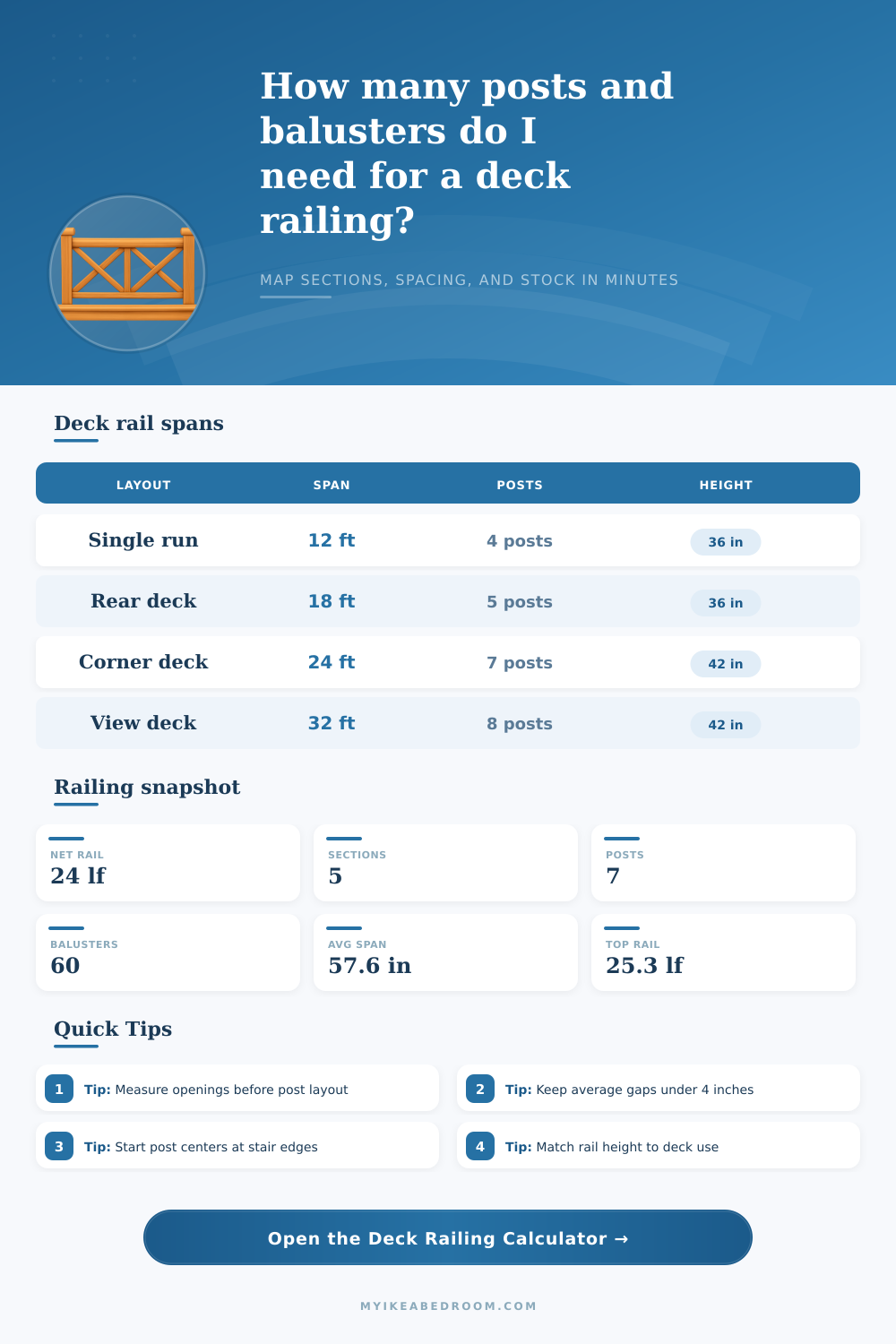
Placing the posts too far apart will result in the railing sag under the weight of individuals standing on the deck. If the posts are too close together, however, it will result in the use of more lumber for the deck railing. Many wooden decks use five-to-six-foot post spacing.
Aluminum decks can have an eight-foot post spacing. Using even spacing between the railing posts will produce an even and visual balanced deck railing. To achieve even spacing, divide the length of the deck railing by the number of spans desired between the posts.
Mark the edges of the stairs to begin measuring the deck railing. The size of the gaps in the balusters should not exceed four inches, according to building codes. This is to ensure that an individual cant fall through the gap in the railing system.
To meet building codes, ensure there is 3.75 inches between each baluster. The thickness of the balusters will inform the railing builder of the size of the gaps between the balusters. For example, wood balusters are typicaly 1.5 inches in thickness.
Metal balusters are typically thinner than 1.5 inches. Before installing the entire deck railing system, dry-fit the balusters on saw horses to ensure that the gaps are even. The height of the railing is another measurement that must be followed.
The height of the railing should be 36 inches. However, in some area of the country, the railing must be 42 inches high to accommodate the movement of the wind. If building a taller railing than 36 inches, ensure that the posts are stiff and the top rails are wider to allow for the stability of the railing system.
Additionally, the width of the posts will affect the railing system. For example, a 4×4 post is 3.5 inches in width. This will reduce the available space between the posts.
The materials for the railing will change the calculation of the spacing of the balusters or other component of the railing. Common materials for railing systems include pressure-treated wood. However, the posts for this railing must be sturdy to support the weight of the pressure-treated wood.
Another common material is cedar wood. Cedar wood is lighter than pressure-treated wood but require a sealant to protect the wood from the weather. Aluminum is another material that can be used for the deck railing and allows for longer spaces between the posts.
These kit are typicaly easier to install than wooden decks. Composite materials can cover lumber for the railing. For cable decks, there are no balusters but tensioned line.
However, the posts for the railing must be rigid to support the tension of the cables. Ordering the materials for the deck railing system, order more than the measurement suggest. As the lumber is cut and sanded for the various components of the railing, some waste will occur.
Order 10 percent more than the total measurements for the railing to allow for this waste. If ordering the top railing for the deck, ensure that the length of the board is considered for the amount to order. For example, a 16-foot board can provide two 6-foot boards.
Order the number of boards required for the spans on the deck. Common mistakes when building a deck railing system include not accounting for the center of the posts and not properly aligning the stair railings with the stair treads. Additionally, ensure that any gate for the deck are attached to doubled posts because the gates are heavy.
Finally, always check local building codes because they may differ from the national building codes for the height of the railing or the width of the gap in the railing system. To build the deck railing system, use tools like chalk line to mark the center of the posts. Consider the different style for the railing system.
Vertical balusters are the most common but come in other styles like cocktail cap or cable systems. Cocktail caps are useful if one wants a flat area on the railing system for serving drink. Ensure that the railing is even, sturdy, and conforms to all building codes.