Deck Post Spacing Calculator
Set deck geometry, beam rows, loads, and footing depth options in the upper input row, then review spacing and post results in the row directly below.
| Spacing | Post load | Footing | Status |
|---|
| Post size | Height cap | Use band | Notes |
|---|
| Depth | Frost zone | Typical use | Flag |
|---|
Post spacing are essential to consider when building a deck because the spacing between the posts will determine the amount of weight that each post will has to support. If you set the post spacing incorrectly, the deck may sag or become unstable when individuals stands on the deck or when snow accumulates on the deck. Therefore, you must perform the calculation of the post spacing and the size of the footings that is required to ensure the stability and safety of the deck.
The shape of the deck and the way in which it is attached to the house will play a role in the calculation of the load on the posts that will support the deck. If the deck is attached to the house with a ledger, then that ledger will act as one beam row, and the ledger will allow each post to only carry half of the total load that is place onto the deck. In the case, however, that the deck is not attached to the house with a ledger, the deck will require an extra row of posts to provide stability to the structure.
Deck Post Spacing and Footing Size
Additionally, beam rows can help to divide the span of the deck, and each row of beams will require an additional row of posts to support the beams. Each row of posts will allow for the even distribution of the weight of the deck. Finally, the soil on which the deck is to be constructed will also play a role in the calculation of the total load on each post.
Different types of soil has different bearing capacities. For instance, clay soil has a lower bearing capacity than soil that consist of rocks. When calculating the total load on the posts, it is necessary to consider the different types of loads that will act upon the deck.
Loads that move is referred to as live loads. For instance, live loads can be the weight of the individuals that stand on the deck or the weight of objects that are placed on the deck, such as an hot tub. The live load for most decks of families is 40 pounds per square foot, but if the deck is to support a pool, the live load will be greater then 40 pounds per square foot.
Loads that do not move are referred to as dead loads. Dead loads include the weight of the decking material, the weight of the railings, and the weight of any structures place onto the deck, such as a pergola. To calculate the total load per post, you multiply the dead load and live loads by the area of the tributary of the post.
A safety factor should also be incorporated into these calculations. A safety factor of 1.15 is typically use, but if the soil is weak, a safety factor of 1.25 should be used. The diameter of the footing upon which each post will be placed can be calculated through the total load that will act upon each post divided by the strength of the soil upon which the posts will be placed.
The resulting area can be used to calculate the required diameter of the circular footing. The depth of the footing should be deep enough to reach beneath the frost line in the soil. If the footing is too shallow, frost heave will potentially cause the ground to shift, which will move the posts and potentially damage the deck.
In many areas, the footing must reach a depth of 36 inches beneath the surface of the ground. However, local building codes may vary in the depth that is required for footings. There is a trade-off between post spacing and footing size.
For instance, if the posts are closer together, then each post will have less of a load place upon it. Consequently, the load upon each individual post will allow for smaller footings to be used to support each post. However, using smaller distances between the posts will require an increase in the number of posts to be constructed, which will increase the cost of the lumber that is required to build the deck.
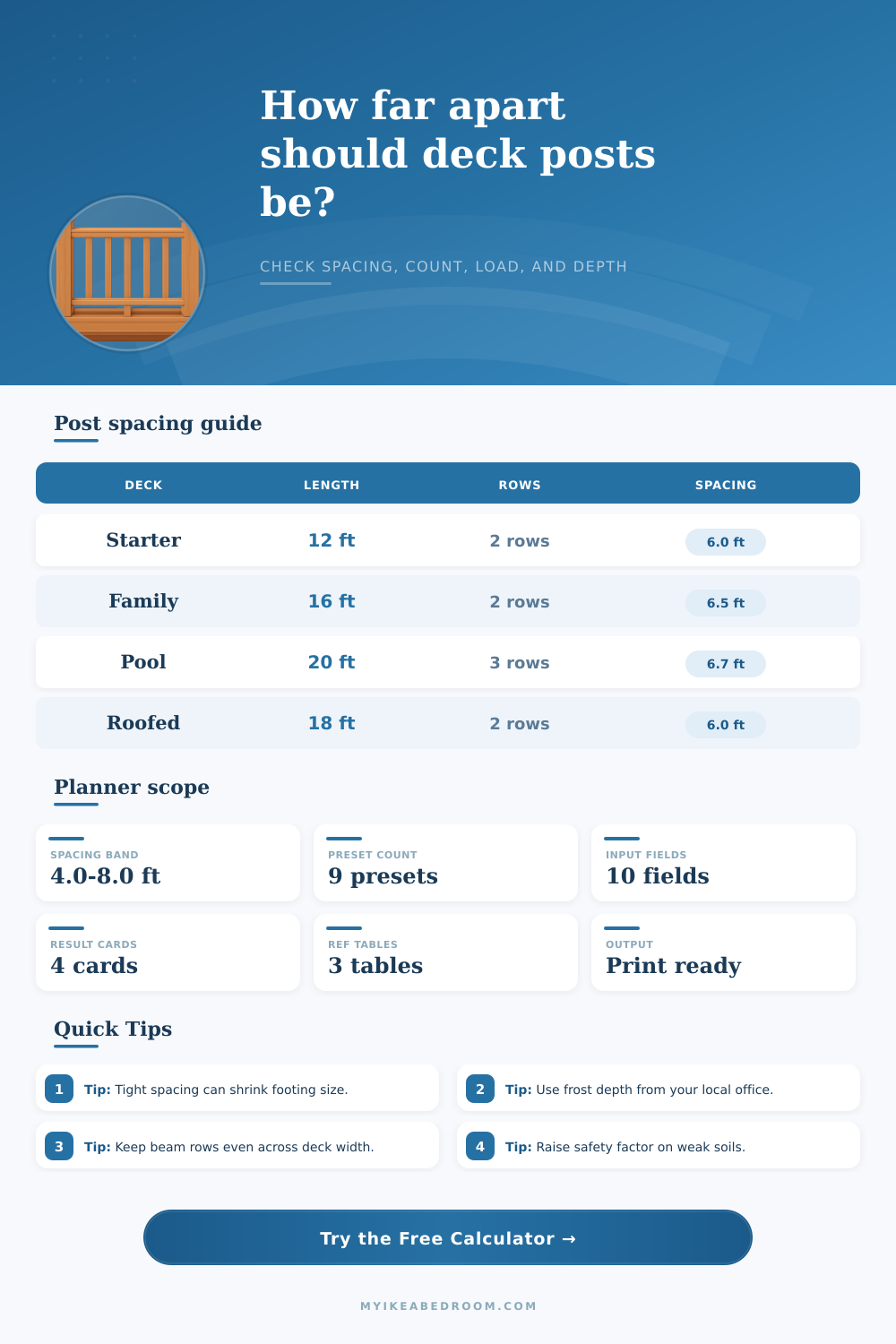
For instance, if the deck is 16 feet in length and 14 feet in width, and the deck includes two beam rows that are attached to the house, the area that is supported by each row is 7 feet in width (half the length of the deck). Additionally, if the distance between each row of posts is 6.5 feet, each row of posts will support an area of 91 square feet (6.5 feet * 6.5 feet). Furthermore, if the total load on the deck and the safety factor is multiplied, the resulting number is 3100 pounds of load that each post will have to support.
For these loads on normal soil, each post will require a footing that is 20 inch in diameter. The size of the posts that are used to build the deck will also play a role in the strength of the resulting structure. For instance, 6×6 treated posts are often used for building decks.
These types of posts are able to support spans of up to 14 feet in height. In locations where the load upon the deck is relatively light, 4×4 posts can be used for the decks. However, 4×4 posts has a relatively lower limit upon the total load for which they are design.
For instance, 4×4 posts may have a limit of 2500 pounds, whereas 8×8 posts may have a limit of 6200 pounds. In addition, 4×4 posts may need to be braced if they are used for spans in excess of 6 feet 9 inches in height. In addition to the factors discussed above, there are also environmental factors to consider when building a deck.
For instance, if the site upon which the deck is to be built is sloped, the calculations of the area that is tributary to each post may need to be adjusted. Additionally, wind uplift may act upon the posts that are supporting the deck; in these cases, rebar or sonotubes can be utilized in the footings to ensure that the posts does not shift from these forces. Furthermore, local inspectors will also have certain requirements for the decks that are built, especially in regard to frost depth and the requirements of the soil where the building is to be constructed.
When beginning to build the deck, batter boards should first be established in the ground to indicate the location of the posts that will be install. String lines can be established between the batter boards to ensure that the posts will be even with respect to each other. Additionally, the footings should be dug in such a way that they are slightly larger than the diameter of the posts, and the posts should be anchored to the footings to ensure they dont shift from the ground settling.
The posts should be plumb (vertically aligned) before the concrete sets into the footings. Finally, the beams must be constructed in a way that the beam pockets is notched in the appropriate manner, and carriage bolts should be used to secure the beams to the posts. These secure connections between the beams and the posts will ensure the stability of the resulting deck structure.