Deck Joist Spacing Calculator
Compare spacing, joist count, span reserve, and framing weight using prescriptive deck span references and board support rules.
Deck inputs
The calculator reads joist span from the selected size and species, then checks the chosen spacing against board support and cantilever reserve.
Calculation results
Lumber density grid
Span reference tables
| Southern Pine | 12 in O.C. | 16 in O.C. | 24 in O.C. |
|---|---|---|---|
| 2x6 | 9 ft 11 in | 9 ft 0 in | 7 ft 7 in |
| 2x8 | 13 ft 1 in | 11 ft 10 in | 9 ft 8 in |
| 2x10 | 16 ft 2 in | 14 ft 0 in | 11 ft 5 in |
| 2x12 | 18 ft 0 in | 16 ft 6 in | 13 ft 6 in |
Reference spans reflect prescriptive wet-service deck guidance for No. 2 lumber. Use the final code check and manufacturer notes before framing.
| DF-L / Hem-Fir / SPF | 12 in O.C. | 16 in O.C. | 24 in O.C. |
|---|---|---|---|
| 2x6 | 8 ft 10 in | 8 ft 0 in | 6 ft 10 in |
| 2x8 | 11 ft 8 in | 10 ft 7 in | 8 ft 8 in |
| 2x10 | 14 ft 11 in | 13 ft 0 in | 10 ft 7 in |
| 2x12 | 18 ft 0 in | 15 ft 9 in | 12 ft 10 in |
| Redwood / cedar group | 12 in O.C. | 16 in O.C. | 24 in O.C. |
|---|---|---|---|
| 2x6 | 8 ft 10 in | 8 ft 0 in | 6 ft 10 in |
| 2x8 | 11 ft 8 in | 10 ft 7 in | 8 ft 8 in |
| 2x10 | 14 ft 11 in | 13 ft 0 in | 10 ft 7 in |
| 2x12 | 17 ft 5 in | 15 ft 1 in | 12 ft 4 in |
| Board type | Guide spacing | Edge rule | Best use |
|---|---|---|---|
| 5/4 PT wood | 16 in O.C. | L/4 cantilever | General decks |
| Composite board | 12 in O.C. | L/4 cantilever | Stiffer feel |
| 1x cedar/redwood | 12 in O.C. | L/4 cantilever | Tighter boards |
| 2x deck plank | 24 in O.C. | L/4 cantilever | Thick planks |
| Diagonal layout | 12 in O.C. | L/4 cantilever | Reduced bounce |
Spacing comparison grid
12 in O.C.
Best for composite, diagonal boards, and firm walking feel.
More joists, more fasteners, and the stiffest deck surface.
Use it when you want the most board support.
16 in O.C.
The usual all-around spacing for 5/4 pressure-treated decking.
Balanced lumber count, span performance, and installation speed.
It is the default choice for many residential decks.
19.2 in O.C.
A middle step that can reduce framing count without jumping to 24 in.
Useful when the joist table and board system both allow a wider layout.
Check span reserve carefully before choosing it.
24 in O.C.
Fast framing and fewer members, but only suitable for thicker deck boards.
Most surfaces feel springier at this spacing unless the deck board is stiff.
Use the board guide and span table before committing.
Joist spacing is a critical measurement in building a deck; the joist spacing will determine the amount of weight that a deck can support. If the joist spacing is too wide for the size of the deck, the deck boards will bend under the weight of the individual walking on the deck. If the joist spacing is too narrow for the size of the deck, the builder will spend more money on lumber for the joists, and it will take more time to build the deck.
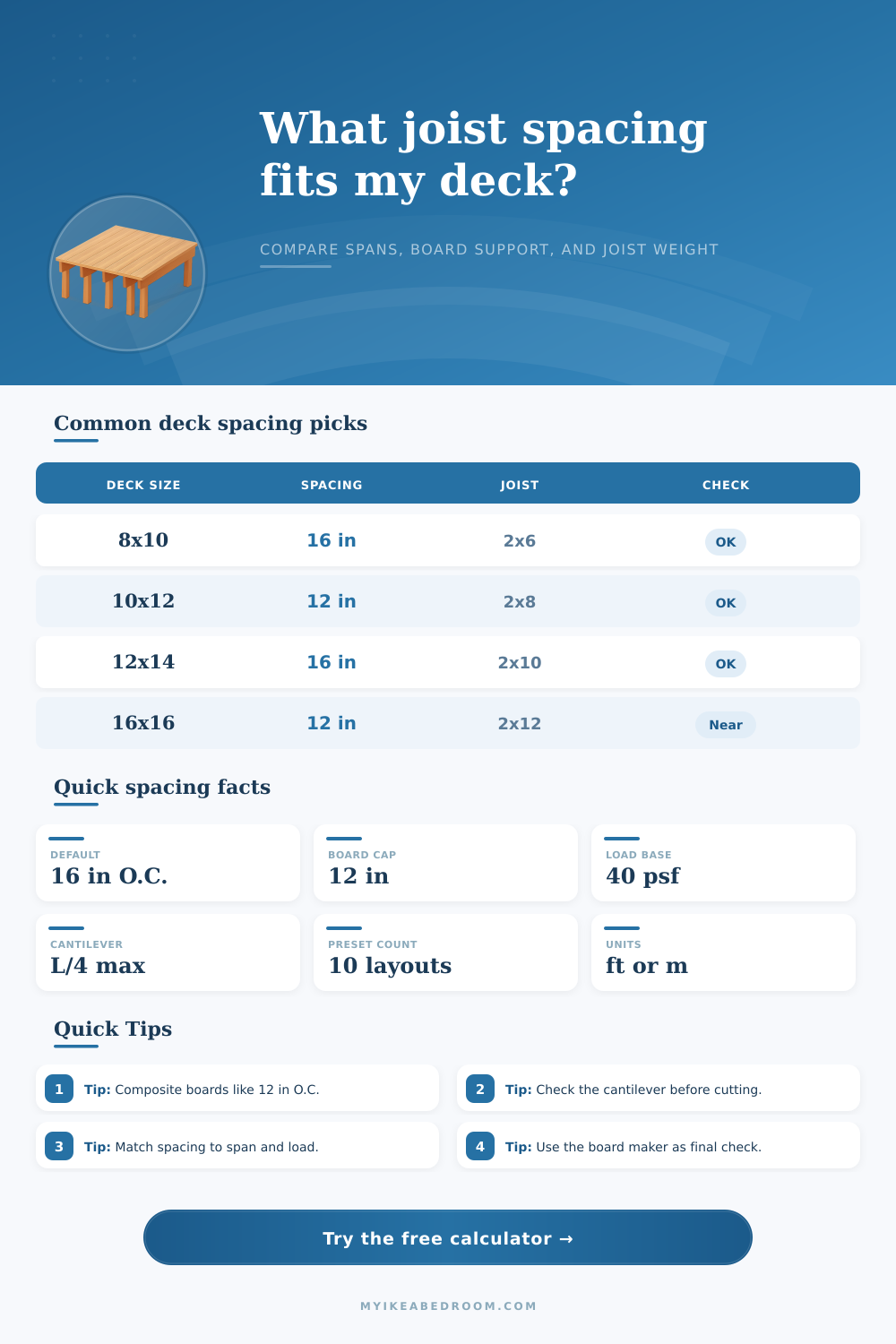
Because joist spacing can impact the strength of a deck, it is critical to plan out the joist spacing for a deck prior to begin to build it. Many residential decks uses joist spacing of sixteen inches on center. Sixteen inches on center is a preferred spacing for residential decks because it provides a balance between the strength of the deck boards and the cost of the lumber used for the deck boards.
How to Choose Joist Spacing for a Deck
A decks boards need to be supported underneath them to ensure that the deck boards will not bend when individuals walk on the deck. Using a joist spacing that is too wide will cause the deck boards to feel bounce to the individuals walking on the deck. Using a joist spacing that is too narrow will require the purchase of extra joists for the deck that may not be needed for the structure of the deck.
The type of wood used for the joists will impact the amount of weight the joists can support. For example, if southern pine is used for the joists, the joists can travel further distances from one joist to the next than if spruce-pine-fir wood is used for the joists. This is because southern pine is a dense wood that can support more weight over a longer span of distance than spruce-pine-fir wood can.
Another consideration for joist design is the span that the joists will cover. The joists will need to be able to cover the distance from one support to the next. If a cantilever is to be added to the deck, the span of the joists can be no longer than a quarter of the length of the entire back span of the deck.
Otherwise, the back edge of the deck may droop under the weight of the individuals stand on the deck. The type of decking material that will be used on a deck will also impact the joist spacing. If composite decking is chosen for a deck, the joists should be placed at twelve inches on center.
If the decking on a deck will be thick 2x planks, the joists can be placed twenty-four inches on center. A twenty-four inch on center spacing, however, may make the deck feel springily to the individuals walking on it unless the joists are very strong. If the decking boards are installed on the deck in a diagonal pattern, the joists will need to be placed closer together at regular intervals since the diagonal decking boards will require more support to avoid making the deck feel bouncy when individuals walk on it.
Another consideration for building a deck is the amount of load that will act on the deck. The live load is the weight of the individuals and the furniture that will be placed on the deck. The dead load is the weight of the materials that make up the deck such as the joists and decking boards.
For lounging purposes, the live load should be able to support forty pounds per square foot. For areas where decks are near pools or play areas, however, the live load may have to support sixty pounds per square foot. Both of these load should be calculated to ensure that the joists will not fail under such loads.
The other consideration with building a deck is the weight of the framing materials. For example, if the framing for a deck is constructed out of dense woods like southern pine, the weight of the framing will be more than if cedar wood is use for the framing. Additionally, the total weight of the framing should be calculated to determine the size of the footings that will best support the beams for the deck.
Many people make mistake when constructing a deck. One of the most common mistakes is attempting to use the maximum span for joists as listed in a construction table without first checking the spacing between the decking boards. Another of the most common mistake is creating a cantilever for the deck that extends more than the joists can span.
Additionally, many people may not consider the codes for their area for joist spacing. Depending on the region in which they are building the deck, the codes may be different for snow loads on the decking boards or the wind loads that may act on the structure of the deck. There are some tradeoffs to building a deck with specific joist spacing.
Using a joist spacing that is close together will make the deck feel stiff to the individuals walking on it. However, if the joist spacing is close together, there will be more lumber and hardware need to build the deck. If the joist spacing is created with wider spacing between the joists, though, there will be cost and time savings in building the deck.
However, there is a risk that the deck may bend under the weight of the individuals who use the deck. Additionally, span utilization can also be used to calculate the maximum number of joists that could potentially be used in a deck. If seventy-five percent of the potential span utilization is used for the joists in the deck, there will be extra capacity in the joists to account for imperfection in the wood being constructed for the deck.
Using these factors to plan the joist spacing for a deck will ensure that it is stable and can last for a long time after being construct.