Deck Joist Size Calculator
Find the smallest joist size that fits your span, spacing, load, and cantilever using a clear prescriptive screening workflow.
Deck inputs
Enter your deck dimensions and the calculator will screen the smallest joist size that fits the conditions.
Results
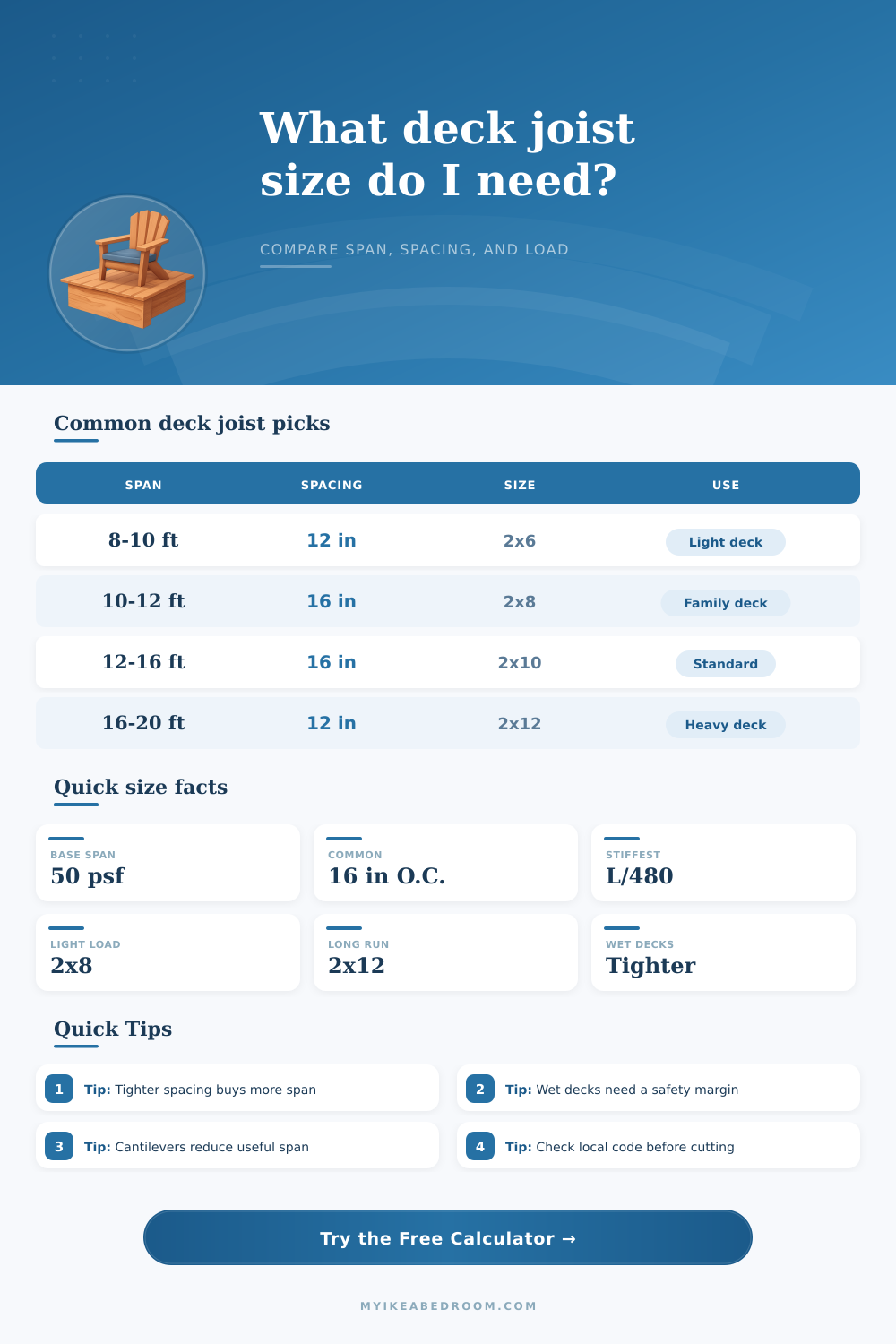
Joist size reference
The table below extends the screening data to 2x14, so longer runs still have a reference point.
Reference tables
| Nominal | 12 in O.C. | 16 in O.C. | 24 in O.C. | Notes |
|---|---|---|---|---|
| 2x6 | 10.2 ft | 9.5 ft | 8.3 ft | Light deck spans |
| 2x8 | 12.9 ft | 12.0 ft | 10.5 ft | Typical short runs |
| 2x10 | 16.1 ft | 15.0 ft | 13.1 ft | Common deck choice |
| 2x12 | 18.8 ft | 17.5 ft | 15.3 ft | Longer clear spans |
| 2x14 | 21.0 ft | 19.5 ft | 17.1 ft | Extended screening size |
| Decking type | Best spacing | Why | Notes |
|---|---|---|---|
| Composite | 12 in | Tighter support | Often needs stiffness |
| 5/4 wood | 16 in | Standard support | Most common layout |
| 1x wood | 16 in | Balanced span | Watch board stiffness |
| Diagonal lay | 12 in | Less bounce | Better edge control |
| Factor | Baseline | Tighter | Looser | Effect |
|---|---|---|---|---|
| Grade | #2 | #1 / SS | Utility | Stronger wood carries more |
| Service | Dry | Covered | Wet | Exposure lowers capacity |
| Load | 50 psf | 40 psf | 60 psf | More load shortens span |
| Deflection | L/360 | L/480 | L/240 | Stiffer target reduces span |
| Deck size | Area | Starter size | Starter spacing | Use case |
|---|---|---|---|---|
| 8 x 10 | 80 sq ft | 2x6 | 16 in | Entry deck |
| 10 x 12 | 120 sq ft | 2x8 | 16 in | Family deck |
| 12 x 16 | 192 sq ft | 2x10 | 16 in | Entertainment deck |
| 14 x 20 | 280 sq ft | 2x12 | 12 in | Large deck |
Comparison grid
Joist sizing refer to the process of ensuring that a deck has the correct sized joists in order to remain stable and safe. In order to make certain that a deck will remain stable and safe, an individual must consider several factor of the joists that will be used to build the deck. For instance, if an individual decide on using joists that are too small in size, or if the joists are spaced too far from one another, the resulting deck may sag or feel bouncy when standing on it.
However, if the joists that are use for the deck are of a large enough size, and if the spacing of those joists is correctly set up, the resulting deck will feel solid and stable when use. The span of a joist is the distance between the support of the joist. The spacing of a joist is the distance between the joists themselves.
How to Size Joists for a Safe Deck
An individual can increase the span of a joist by decreasing the distance between the joists; the longer distances that the joists must travel means that each joist will carry more of weight of the deck. However, if the joist spacing is increased, each joist will have to support more of the total weight of the deck, limiting the span of each joist. Thus, an individual must balance these two factor in order to create a stable deck.
The type of lumber that is use to create the joists will also play a major role in the span of those joists. For instance, if someone uses spruce pine fir lumber, the joists made from this type of lumber can span up to 15 feet with 2×10 joists. Additionally, if someone uses Douglas fir larch and southern pine lumber, those joists can span up to 16 or 17 feet.
Finally, cedar lumber is a lighter type of wood, and as such, its joists may only be able to span shorter distances. In each case, however, an individual must also consider the service conditions in which the joists will be used. For instance, if the deck will remain dry and covered, the joists can reach their full capacity.
However, if the deck will be exposed to the weather, the joists will have to be provided for an 8% reduction in the capacity of the lumber. The loads that a deck will experience will impact the sizing of the joists that are use to build that deck. For instance, live loads are the weight of the individuals that will walk on the deck, the furniture that will be placed upon it, etc. Live loads are typically calculate at 40 pounds per square foot.
However, if the deck will include a hot tub or dance area, live loads will have to be increased to 50 or 60 pounds per square foot, respectively. Dead loads are the weight of the deck itself, including the decking board and railings. Dead loads are calculated at 10 pounds per square foot.
Adding these two number together calculates the total load; the total load will impact an individual in constructing the deck as to whether or not large joists is needed. Deflection refers to the amount that the joists of a deck bend. In order to ensure that a deck feels stable and does not sag or feel bouncy under the weight of the individuals that use it, joists should bend to a certain target.
One common target for deflection is L/360, which mean that the joists will not droop more than one-third of an inch for every 12 feet of joist span. If a deck is to be constructed of composite lumber, however, an individual may have to adjust to L/480, as the composite lumber will bend more readily than wood lumber. Additionally, one should consider the length of the cantilevers of the joists (the portions of the joists that overhang the beam).
The length of the cantilevers should not exceed one-quarter of the length of the span of the joist back from the beam. When planning a deck, there are a few common mistake that an individual should avoid making. One common mistake is failing to account for the weight of the rim joists when determining the total load that will act upon the deck.
Additionally, many individual fail to account for the effect of wet environments on the joists; the capacity of the wood will decrease by 8% if the deck will become wet. Furthermore, individuals often do not order enough lumber for their plan; an individual should calculate the total number of joists that will be used based on the width of the deck. Finally, individuals should account for local building code; these codes may dictate different sized joists for decks different than those indicated in the engineering reports regarding the strength of different types of lumber.
Thus, by calculating the span of the joists, the spacing of those joists, the type of lumber that will be used in their construction, the total load that will act upon the deck, and the deflection of those joists, an individual can be certain that their plans for the deck will be safe and stable.