🪛 Deck Joist Size Calculator
Find the correct joist size, spacing & span for your deck project
⚡ Quick Presets
📏 Deck & Joist Details
✅ Deck Joist Results
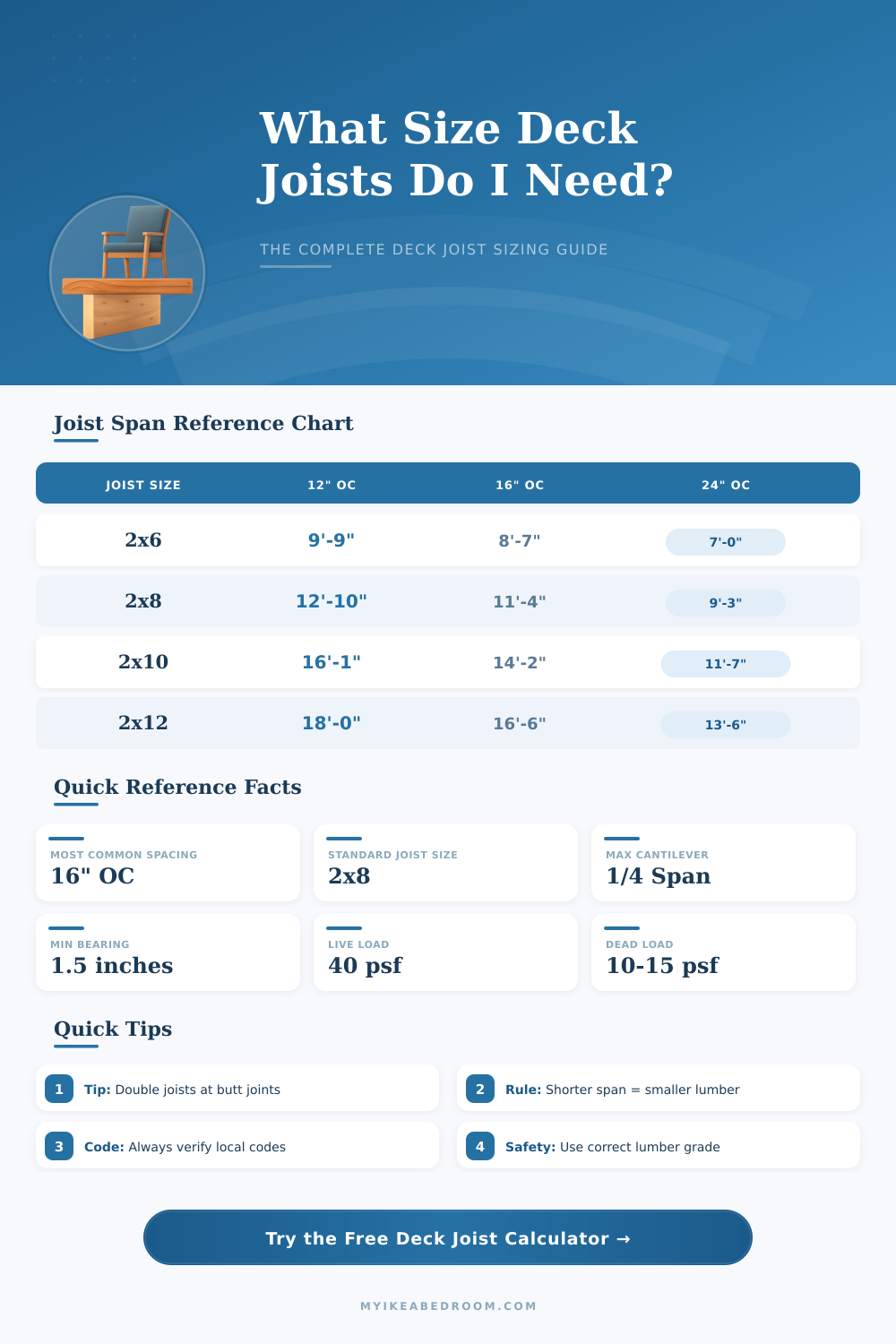
📊 Joist Span Reference Table — Douglas Fir-Larch #2 (40 psf Live Load)
| Joist Size | 12" OC | 16" OC | 24" OC |
|---|---|---|---|
| 2x6 | 9'-9" | 8'-7" | 7'-0" |
| 2x8 | 12'-10" | 11'-4" | 9'-3" |
| 2x10 | 16'-1" | 14'-2" | 11'-7" |
| 2x12 | 18'-0" | 16'-6" | 13'-6" |
📊 Joist Span Reference Table — Southern Yellow Pine #2 (40 psf Live Load)
| Joist Size | 12" OC | 16" OC | 24" OC |
|---|---|---|---|
| 2x6 | 10'-9" | 9'-9" | 8'-1" |
| 2x8 | 14'-2" | 12'-10" | 10'-6" |
| 2x10 | 18'-0" | 16'-1" | 13'-2" |
| 2x12 | 20'-0" | 18'-0" | 15'-7" |
📊 Lumber Species Structural Properties
📊 Joist Count & Coverage Table
| Deck Length | 12" OC Joists | 16" OC Joists | 24" OC Joists |
|---|---|---|---|
| 8 ft | 10 | 8 | 5 |
| 10 ft | 12 | 9 | 6 |
| 12 ft | 14 | 10 | 7 |
| 16 ft | 18 | 13 | 9 |
| 20 ft | 22 | 16 | 11 |
| 24 ft | 26 | 19 | 13 |
📊 Nominal vs Actual Lumber Dimensions
| Nominal Size | Actual Size (in) | Actual Size (mm) | Common Use |
|---|---|---|---|
| 2x6 | 1.5" x 5.5" | 38 x 140 mm | Short spans, light loads |
| 2x8 | 1.5" x 7.25" | 38 x 184 mm | Standard residential deck |
| 2x10 | 1.5" x 9.25" | 38 x 235 mm | Long spans, heavy loads |
| 2x12 | 1.5" x 11.25" | 38 x 286 mm | Max span, hot tubs |
Joists are the structural components that will support the floor of the deck. The joists will bear the weight of the people, furnitures, and the deck boards. In order to build a safe deck, a person must select the correct size for the joist based off the distance that the joists must span.
The span of the joist is the distance between the ledger board and the beam. The longer that the span of the joist, the deeper that the lumber for the joist must be. If the span of the joist is too long for the size of the joist, the joist will bend or bounce when the individuals walks upon the deck.
How to Choose and Install Deck Joists
For instance, a 2×6 joist may be sufficient for an eight-foot span, but a 2×6 joist may be insufficient for a fourteen-foot span, because such a fourteen-foot span will cause the 2×6 joist to flex. The second factor that will impact the strength of the deck is the spacing of the joists. The further that the joists are spaced from one another, the less weight each individual joist will have to support.
For instance, if the joists is spaced twelve inches apart, they will be able to support more weight then if the joists were placed twenty-four inches apart. However, placing the joists closer together means that each joist will have to support more of the total load of the deck, meaning that more joists will be required. Another factor that will impact the strength of the deck is the type of lumber that is used for the joists.
For instance, Douglas Fir-Larch is a strong type of lumber because it has high bending strength. Additionally, other strong types of lumber include Southern Yellow Pine, which is also a strong lumber type that is often treated to prevent it from rot. Spruce-Pine-Fir is another type of lumber that is often used for the joists because it is more affordable, especially for those building light construction projects.
Another factor that will impact the strength and stability of the deck is the grade of the lumber that is used in the joists. For instance, the grade of the lumber will determine how many defects are in the lumber. If the lumber has fewer defects, it is able to bear more weight than lumber with greater defect.
Therefore, if a person chooses a higher grade of lumber, it will have fewer knots in the boards, and fewer defects overall, thus allowing the joists to hold up better under the stress of the deck and it’s load. In addition to the factors mentioned above, another factor that a person must consider is the different types of loads that the deck must support. For instance, live loads are the type of loads that are caused by movable objects on the deck, such as the people that lives in the house and walk upon the deck.
Residential decks are typically designed to support a live load of forty pounds per square foot. Dead loads are the types of loads that are caused by the permanent objects to the deck, like the deck boards and the railings. Residential decks are typically designed to have a dead load of between ten and fifteen pounds per square foot.
For instance, if an individual planned on installing a hot tub in the deck, the live load would increase to sixty pounds per square foot. Therefore, a sixty-pound live load would require the joists to have shorter spans. In addition to considering the types of loads that the joists will bear, there are specific rules for installing the joists.
For instance, there are rules regarding cantilevers and bearing. Cantilevers are the overhangs of the joists that extend past the beam. The rules state that the length of the cantilever should not exceed one-quarter of the length of the backspan of the joists.
The backspan of the joist is the portion of the joist that is supported by the beam. The backspan should be at least twice as long as the cantilever. Furthermore, at least one-and-a-half inches of solid support must support each end of each joist on both the ledger board and the beam.
Finally, another factor that a person should be aware of when building a deck is the nominal sizes of the joist. For instance, a 2×8 joist does not have actual dimensions of two inches in thickness and eight inches in its width; rather, 2×8 joists are actually one-and-a-half inches in thickness and seven-and-a-quarter inches in width. Therefore, using smaller joists to save money will result in a deck that may wobble or flex when heavy loads are placed upon it.
Instead, using larger joists will increase the stability of the deck. Additionally, toe-nailing the joists to the ledger board is not recommended. Instead, people use joist hangers to attach the joists to the ledger board to provide more longevity to the joists.
Finally, blocking should be installed between the joists to prevent the joists from moving side-to-side on the deck.