Deck Board Spacing Calculator
Use this deck board spacing calculator to dial in the gap, board count, and order quantity for straight runs, diagonal layouts, and multi-zone decks.
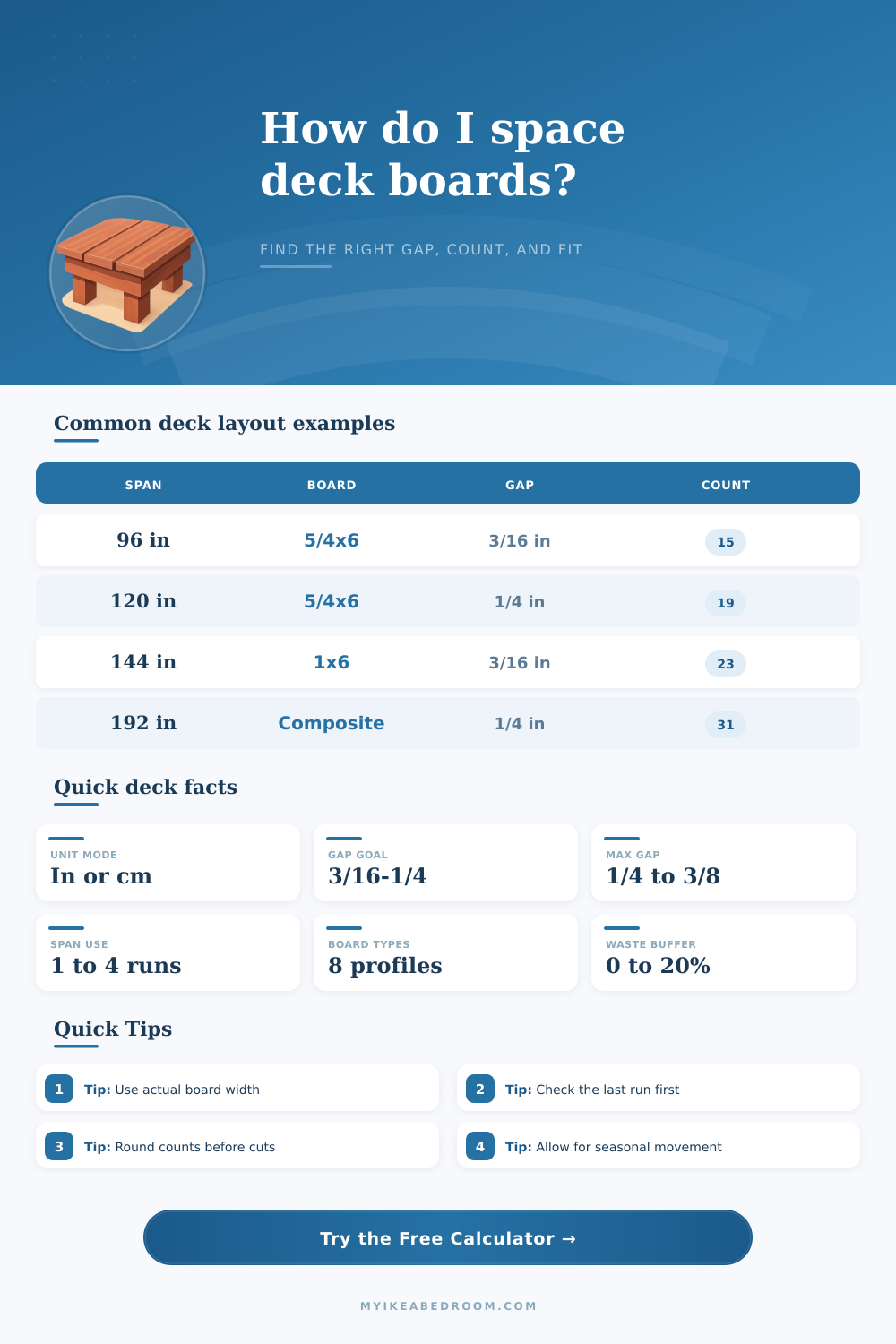
| Span example | Width | Gap | Count |
|---|---|---|---|
| 96 in deck | 5.5 in | 3/16 in | 15 |
| 120 in deck | 5.5 in | 1/4 in | 19 |
| 144 in deck | 5.36 in | 3/16 in | 23 |
| 192 in deck | 5.5 in | 1/4 in | 31 |
| Stock type | Wt/ft | Typical width | Best use |
|---|---|---|---|
| PT pine | 0.58 | 5.50 in | Family deck |
| Cedar | 0.49 | 5.50 in | Warm deck |
| Composite | 0.78 | 5.36 in | Low upkeep |
| Ipe | 1.28 | 5.50 in | Dense hardwood |
| Gap | Meaning | Visual feel | Use case |
|---|---|---|---|
| 3/16 in | Tight | Dense | Dry cedar |
| 1/4 in | Balanced | Even | Most decks |
| 5/16 in | Open | Airy | Wet stock |
| 3/8 in | Max gap | Loose | Check spec |
| Imperial | Metric | Imperial | Metric |
|---|---|---|---|
| 1 in | 25.4 mm | 4 in | 101.6 mm |
| 12 in | 304.8 mm | 36 in | 914.4 mm |
| 48 in | 1.22 m | 96 in | 2.44 m |
| 120 in | 3.05 m | 144 in | 3.66 m |
Gap-first layout
Uses the smallest count that keeps the gap under the limit. Best when the deck must stay strict and predictable.
Balanced fit
Targets the chosen gap first, then adjusts count to fit the span. Best for a clean, symmetrical visual rhythm.
Tight spacing
Pushes spacing tighter than the target gap. Best for a more closed look on short sections or decorative runs.
Open spacing
Leaves more breathing room while staying within the gap cap. Best for wide spans that need a lighter finish.
Measure the actual board face, not the nominal label, then run the layout from the inside faces of the posts.
Snap a test line first, then check the last gap before cutting the full batch or ordering extras.
Deck spacing is one of a critical aspects of constructing a deck. The purpose of adding gap between each of the decking boards is to allow for the boards to expand or contract with the changes in the moisture content of the wood. If the gaps between the boards is too small, the boards may either buckle or crack as a result of the expansion of the wood when it absorbs water.
If the gaps between the boards are too large, water may pool between each of the boards, making the deck feel unstable when walked upon. The type of wood that are used for building the deck will impact the size of the gaps between each of the boards. For instance, pressure treated pine will absorb significant amount of water and will experience significant expansion and contraction of the wood by as much as a quarter of an inch.
How to Space Deck Boards
Alternately, cedar wood is more stable than pressure-treated pine. Composite decking is more stable than natural wood but still requires the proper spacing between the boards to maintain a level walking surface for those who use the deck. Finally, exotic hardwoods like ipe have very little movement in the wood, so the gaps between the boards can be smaller for decks made of this type of wood compared to pressure-treated pine.
The width of each of the decking boards must be measured prior to installing the decking planks on the framework of the deck. The width of the boards may be labeled on the plank but may be of a different measurement when measured on the actual board. The actual width of the board must be used to calculate the number of planks needed to even out the deck.
To determine the number of planks n
Your layout will impact the amount of material that you have to purchase for your project. If your gaps are narrow, you will need to purchase more of the necessary materials to cover the same area as compared to using wider gaps. If your gaps are wider, you will need to purchase fewer of the materials for your project.
Finally, if you install your boards at a diagonal along the deck, you will need to make mathematical adjustment to your calculations for how many boards will be needed to cover the area. Avoid eyeballing the gaps that you create for your boards. Eyeballing the gaps will introduce inconsistency into the project.
As you add more boards to your deck, the inconsistencies will become more visible. Use a tool to ensure the gaps between the boards are all of the same size. Make certain to also calculate the gaps from the house rim to the outer joist.
The final board needs to be accounted for in your calculations. The environment in which your deck will be installed will play a major role in the project. Install your deck in a manner that accounts for the moisture that will be in your environment.
If the wood that you are using for your deck is still wet (green wood), you will need to create wider gaps in the plan for the deck. As the wood dries, it will shrink. In addition to drying the wood, you should also install the deck frame with a quarter-inch of slope per foot of deck.
This will allow water to drain off of the deck. Proper drainage will contribute to the life of your deck. Finally, check the local building codes for your area.
Most local codes will state that the maximum allowable gap for boards is 3/8 of an inch.