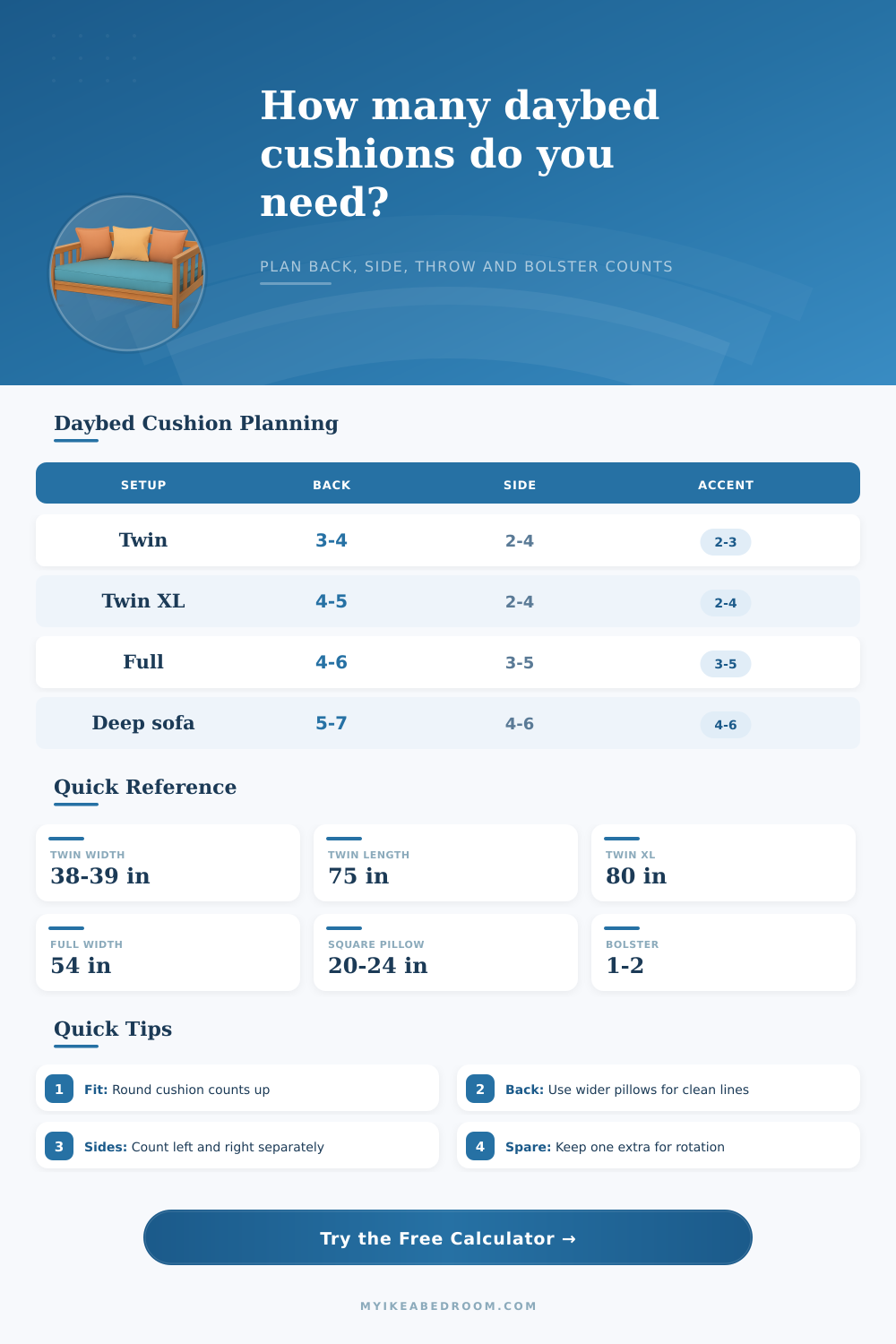
Cushion Quantity for Daybed Calculator
Estimate the number of back cushions, side supports, throw pillows, bolsters, and spare rotation cushions needed for a daybed layout.
| Daybed surface | Typical sleep size | Back run to cover | Side run to cover |
|---|---|---|---|
| Twin daybed | 38-39 x 75 in | 69-75 in | 28-39 in each side |
| Twin XL daybed | 38-39 x 80 in | 74-80 in | 28-39 in each side |
| Full daybed | 53-54 x 75 in | 69-75 in | 38-54 in each side |
| Window bench daybed | Custom bench pad | Measured wall run | Usually 0-24 in |
| Cushion face | Clean coverage | Relaxed overlap | Best use |
|---|---|---|---|
| 18 in square | 18 in per cushion | 16 in per cushion | Kids rooms, tight corners |
| 20 in square | 20 in per cushion | 18 in per cushion | Side rails, compact daybeds |
| 22 in square | 22 in per cushion | 20 in per cushion | Balanced mixed layouts |
| 24 in square | 24 in per cushion | 21 in per cushion | Main back cushion row |
| 26 in square | 26 in per cushion | 23 in per cushion | Deep lounge back row |
| Style choice | Coverage factor | Throw pillow rate | Typical result |
|---|---|---|---|
| Light spacing | 108% of face width | 1 per 54 in | Airier guest-ready bed |
| Clean edge-to-edge | 100% of face width | 1 per 42 in | Simple daybed back |
| Relaxed overlap | 90% of face width | 1 per 36 in | Soft casual lounge |
| Plush dense overlap | 80% of face width | 1 per 28 in | Sofa-like cushion wall |
| Daybed plan | Main cushions | Accent pieces | Planning note |
|---|---|---|---|
| Minimal twin guest bed | 3 back + 0 side | 1-2 throws | Keeps bedding easy to remove |
| Corner twin lounge | 3 back + 2 side | 2 throws + 1 bolster | Supports sitting from the corner |
| Studio sofa daybed | 4 back + 3 side | 3 throws + 2 bolsters | Reads more like a compact sofa |
| Full deep nap bed | 5 back + 4 side | 4 throws + 2 bolsters | Needs larger cushions to avoid clutter |
When you plan your daybed, you must also consider its cushions because the cushions transforms a mattress into a seating surface. The cushions must provide support for your back and comfort for your body. You must determine how many cushions is needed for your daybed and what types of cushions will best enhance the appearance of your daybed arrangement.
The arrangement of the cushions for your daybed will depend on the size of the space where the daybed will be and the frame of the daybed, and how often the daybed will be utilized for sleeping or lounging. A calculator can assist you in determining the correct number of cushions for your daybed by calculating the number of cushions based off the lengths of the rails of the daybed and the width of the cushions. Daybed cushions serve three main function in enhancing the comfort of the daybed.
How to Choose and Arrange Cushions for Your Daybed
The first of these functions is the cushions that provide support to your back, referred to as back cushions. The second of these functions is the cushions that fill the spaces on the left and right sides of the bed referred to as side cushions. The third of these functions are the accent pieces, such as throws or bolsters, that add an additional layer of comfort to the daybed but do not play a role in supporting your body on the daybed as do back cushions.
You can calculate the number of back cushions that are needed by taking the length of the back rail of the daybed; the longer the back rail, the more back cushions will be needed to provide comfort for sleeping or lounging on the daybed. The same can be said for the length of the side rails; the longer the side rail, the more side cushions will be needed to provide comfort to the sleeping or lounging individual on the daybed. In order to purchase the correct number of cushions for your daybed, it is essential to measure the usable space on your daybed.
The size of the mattress that will be used on the daybed may indicate the length of the daybed, but it may not provide an accurate measurement of the usable space for the cushions. For example, a twin mattress is 75 inches long but may not provide 75 inches of usable space for the cushions due to the presence of the mattress arms or headboards. The length of the usable space for the back cushions is the only measurement of the daybed that will determine the number of back cushions needed for your daybed.
Additionally, you may also measure the lengths of the usable space on each side of the daybed; however, if there is no usable space on one side of the bed, then side cushions are not needed for that side of the daybed. Measuring the usable space on the daybed will ensure that you do not purchase an excess number of daybed cushions and that they will physically fit onto the bed. The width of the cushions that you buy for your daybed will also impact the total number of cushions that you will need to purchase.
For example, if you choose to utilize 24-inch square cushions, you are purchasing cushions that will cover more of the daybeds rail lengths than if you purchased 20-inch cushions. However, the 24-inch cushions will also contribute to the total weight of the daybed. Additionally, if the daybed is to have narrow cushions, the sleeping or lounging individual may find it challenging to visually arrange the cushions along the daybed.
Too many narrow lines created by the cushions may leave gaps between the cushions. The choice of how the cushions will be arranged, such such as whether they will be arranged edge to edge or will have overhangs, can also impact the total number of cushions that will be required to fill the daybeds rail lengths. Another decision that you can make when purchasing daybed cushions is the choice of how many rows of back cushions you would like to include on your daybed.
For example, if you choose to have only one row of back cushions, only a low-profile will be provided to your sleeping or lounging individual on the daybed. Additionally, only one row of back cushions will provide the most efficient support for your sleeping or lounging individual when using the daybed as a bed most of the nights. Conversely, if you choose two rows of back cushions, your daybed will have more depth for your sleeping or lounging individual.
However, two rows of back cushions will make your daybed look more like a sofa than a daybed. Additionally, two rows of back cushions will take more time to move to and from the bed if it is to be used as a bed for sleeping. It is common for individuals to choose to utilize thinner lumbar pieces for the second row of back cushions to provide more ease in moving from the daybed to the bed.
Another choice for those who plan their daybeds is the decision of how many accent pieces, such as throws and bolsters, will be purchased for the daybed. Throws can enhance the sleeping or lounging experience by adding an element of extra softness to the bed. Additionally, throws can provide extra support for the sleeping or lounging individual’s back.
However, these throws are not structural cushions for the daybed. Bolsters may be used to define the ends of the daybed. Additionally, bolsters help to ensure that other pillows do not slide off the daybed.
The number of accent cushions that are purchased will have an impact on the amount of effort that is required to clean the daybed. The fewer accent pieces that are purchased, the easier it will be to clear the daybed of the sleeping or lounging individual. In addition to purchasing the number of cushions that are required for the daybed, it is also a good idea to purchase at least one spare cushion.
Over time, each cushion will flatten with the sleeping or lounging individual that utilizes the daybed. By rotating each cushion, each individual will receive even wear on each cushion. Additionally, having a spare cushion will allow for the possibility of purchasing a replacement cushion in the event that a spill occurs on the daybeds cushions.
One spare cushion may be sufficient for the sleeping or lounging individual who utilizes the daybed alone. However, two spare cushions are better bought if the daybed is to be used as a guest bed. Additionally, having spare cushions will also act as a buffer for any measurement errors in the measurement of the daybeds usable space.
Many people can make mistakes when purchasing cushions for their daybed. One of the most common mistakes is measuring the outer dimensions of the daybed rather than the usable length of the daybed for the cushions. Another mistake is the selection of the width of the cushions such that they will leave gaps along the bed rails when the daybed is completed.
Another common mistake is purchasing too many accent pieces for the daybed. If there are too many accent pieces to be moved from the daybed, it may be challenging to convert the daybed into a bed. Using a daybed cushion calculator will help to prevent these mistakes because it will provide the total number of cushions that are needed prior to purchasing the daybed cushions.
Some of the physical factors of the room in which the daybed will be placed may impact the choice of cushions that are to be purchased. For example, if one of the windows in the room has a low window sill, it may prevent the selection of tall back cushions for the daybed. Additionally, if the daybed has an arm of a considerable height, it may prevent the placement of side cushions in the corner of the bed.
Additionally, the fabric that will be used for the daybed may also impact the appearance of the daybed. For instance, if thick fabrics are to be used for the daybed cushions, the daybed may appear to have a heavier appearance when the sleeping or lounging individual is on the daybed. These physical factors for the room may have an impact on the comfort or the fitting of the cushions that are to be purchased for the daybed.
Finally, the ultimate goal of planning your daybed cushions is for the cushions to suit the sleeping and lounging individual and to allow the cushions to function as a part of the furniture piece. If the number of cushions that are determined for the daybed to match the length of the usable space for the daybeds rails, the cushions will function as a part of the furniture. Additionally, the arrangement of the cushions and their relationship to the body will allow the sleeping or lounging individual to feel comfortable on the daybed.