Curtain Tieback Quantity Calculator
Plan tiebacks, wall hooks, holdback height, wrap length, and spare pieces for bedrooms, bay windows, closets, nurseries, and layered curtain panels.
Curtain Tieback Breakdown
Fabric band
Best for matched curtains and soft bedroom panels; usually needs one hook for every band.
Rope cord
Good for medium drapes, tassels, and loose gathers; length increases with fullness.
Fixed arm
Best for heavy panels or daily use; count one mounted arm for each gathered side.
Magnetic wrap
Useful for rentals and light fabrics; no wall hook unless extra side control is needed.
| Curtain layout | Count tiebacks by | Hook count | Best use |
|---|---|---|---|
| Two panels on one rod | One per panel | Two hooks | Bedroom and guest room windows |
| Single side-swept panel | One per window | One hook | Closets, nooks, and doors |
| Sheer plus drape layers | Two per side | Four hooks | Privacy plus blackout curtains |
| Center cinch panel | One band per window | No side hook | Decorative closet or canopy panel |
| Bay window set | One per visible panel | One hook per gathered side | Angled windows with separate panels |
| Placement style | Height from floor | Visual effect | Use with |
|---|---|---|---|
| Lower sweep | 45% of panel height | Relaxed fabric arc | Sheers and casual linen |
| Balanced gather | 55% of panel height | Soft side drape | Most bedroom curtains |
| Classic holdback | 60% of panel height | Clean upper stack | Light to medium panels |
| High formal drape | 66% of panel height | Long lower fall | Velvet and lined drapes |
| Tall stackback | 72% of panel height | More glass exposed | Patio doors and walkway edges |
| Fabric weight | Wrap length guide | Mounting note | Safety note |
|---|---|---|---|
| Sheer voile | Short 10 to 14 in loop | Magnetic or small hook | Avoid long dangling cords |
| Light cotton | 12 to 18 in loop | Standard hook works well | Keep loop above reach in nurseries |
| Medium woven | 16 to 24 in loop | Anchor drywall hooks | Check that fabric clears walkways |
| Blackout lined | 20 to 30 in loop | Use fixed arms or strong hooks | Shorten loops near cribs or beds |
| Velvet or thermal | 24 to 36 in loop | Prefer stud or robust anchors | Support weight without pinching fabric |
| Room or opening | Typical panels | Tiebacks | Placement detail |
|---|---|---|---|
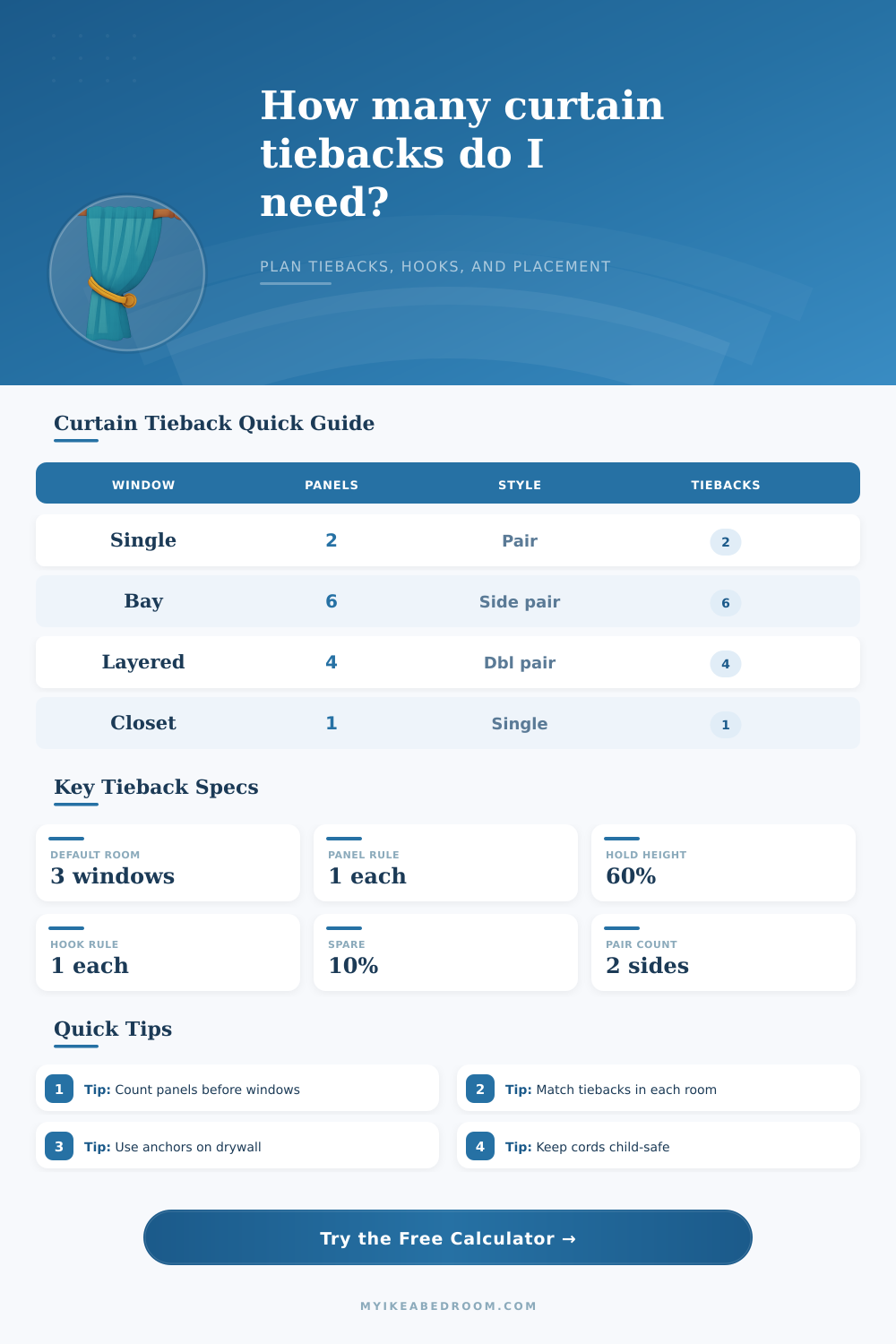
| Single bedroom window | 2 panels | 2 tiebacks | Classic 60% holdback height |
| Two-window guest room | 4 panels | 4 tiebacks | Match height on all hooks |
| Bay window with returns | 6 panels | 6 tiebacks | Use angled side placement |
| Patio door curtain | 2 panels | 1 to 2 tiebacks | Keep walkway side clear |
| Closet curtain | 1 panel | 1 tieback | Single side sweep or center cinch |
Use the calculator for the final count when a room has mixed panel widths, layered sheers, or no-drill mounting limits.
To determine an correct number of curtain tiebacks to purchase for your installation project, many people may assume that each window will require two curtain tieback. However, two curtain tiebacks isnt always sufficient for each window. For example, if the window has various layer of curtains or numerous panels of curtains, more than two curtain tiebacks will be required for each window.
The number of individual curtain panels to be gathered with the curtain tiebacks will determine the number of curtain tiebacks required for your installation project. The placement height for the curtain tiebacks will also impact the appearance and safety of your installation project. If the tiebacks is placed too low on the curtain panels, the curtains will sag into the walking path, creating a tripping hazard.
How Many Curtain Tiebacks Do You Need
However, if the tiebacks are placed too high on the curtains, the curtain will create an awkward stack of curtain fabric. Sixty percent of the height of the curtain panel from the floor is the suggested placement for the curtain tiebacks to allow the curtains to drape proper from the window and clear any furniture in the area. The weight of the curtain fabric will also play a critical role in determining the type of curtain tiebacks to purchase.
For example, if the curtain fabric is lightweight, such as sheers voile, the curtain tieback will require only a short loop to accommodate the lightweight fabric. In contrast, if the curtains are heavy, such as velvet fabric, the curtain tieback will require a longer loop to accommodate the body of the heavy fabric. Using a linen loop for a set of blackout panels may cause the loop to become crooked or exit the wall due to the weight of the curtains.
The weight of the curtain fabric will determine the type of loop for the curtain tieback. Another factor to consider before installing the curtain tiebacks is the type of wall surface. For example, if the wall has drywall, the curtain tiebacks will require anchors.
In contrast, if the wall features wood trim, the curtain tiebacks may use screws that directly attach to the trim. If the wall features tile, a specific bit and hook will be required for the curtain tiebacks to securely attach to the wall. The type of curtain tiebacks will depend on the type of wall surface.
Safety is another consideration for the placement of the curtain tiebacks. In a nursery, for example, you should install the tiebacks high enough to prevent young children from being able to reach the tiebacks. Near a patio door, the curtains should be pulled clear from the walking path to avoid creating a tripping hazard.
In a rental property that cant drill into the walls, magnetic curtain tieback wrap can be installed. If the curtains will be opened and closed daily, metal curtain tiebacks may be the bestest choice. It is also a helpful idea to purchase an extra amount of curtain tiebacks for a safety buffer.
A percentage of ten percent of the total amount of curtains may be purchased in excess to account for the possible variation in the manufacturing of the curtain tiebacks or for stains on the curtain tiebacks during the installation process. Purchasing an extra amount of curtain tiebacks is also important if the installation project will include more than one room. In this case, it will be difficult to purchase additional curtain tiebacks of the same dye lot as the others.
The calculator will provide the math necessary to complete your installation project. Enter the number of curtain panels, the style of the curtain tieback, the type of wall surface, and the percentage of buffer to be purchased. The calculator will show you the total number of curtain tiebacks to purchase for your installation project.
Once the calculator determines the total number of curtain tiebacks required for the project, you can complete your installation with the appropriate amount of hardware.