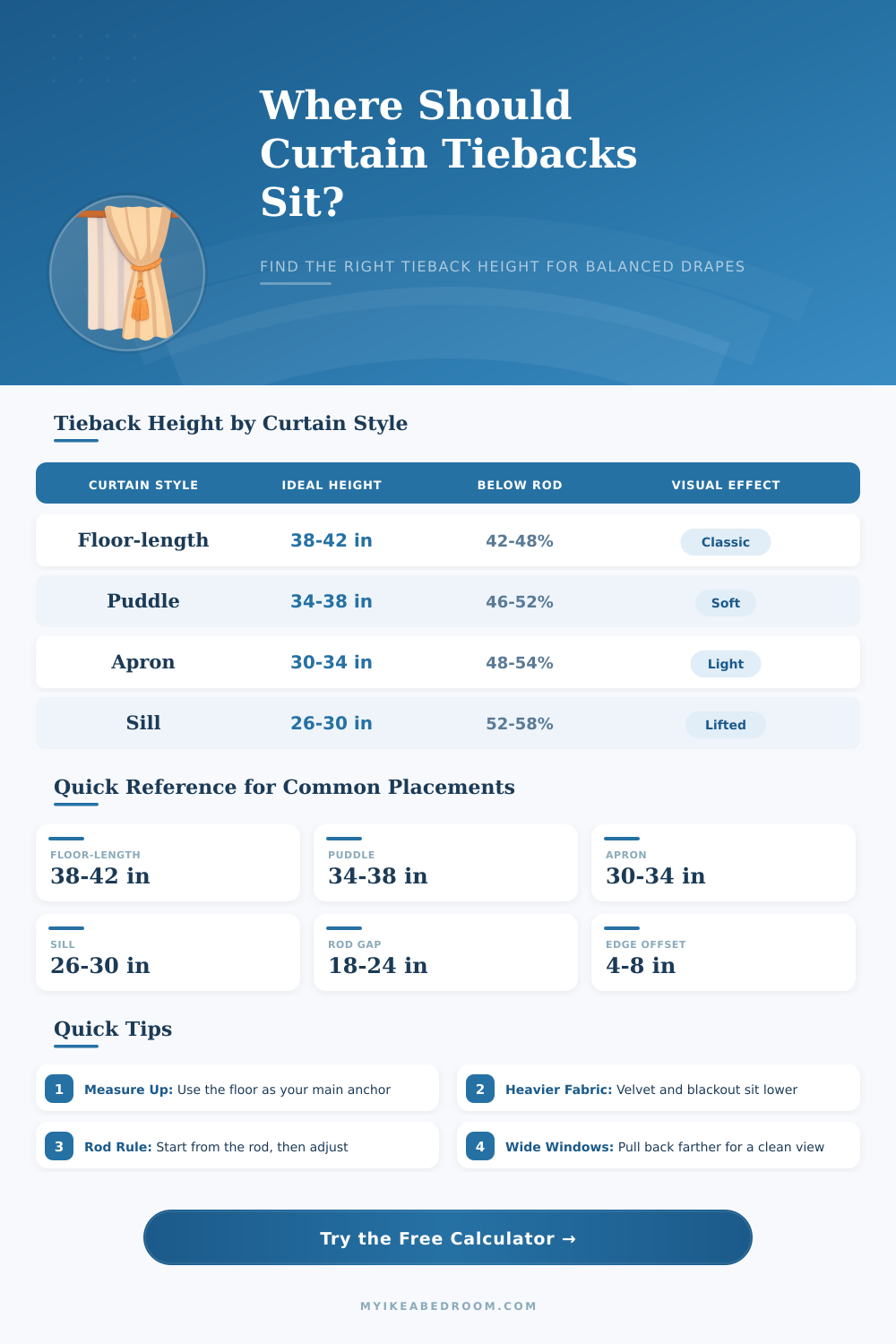
📏 Curtain Tieback Height Calculator
Find a balanced tieback point for drapes, holdbacks, and window styles without guesswork
Recommended Tieback Placement
| Style | Base ratio | Typical look | Best use |
|---|---|---|---|
| Floor-length | 0.42 | Balanced and grounded | Most bedrooms and living rooms |
| Puddle | 0.36 | Lower and softer | Formal or romantic rooms |
| Apron | 0.54 | Higher and lighter | Kitchen and cafe curtains |
| Sill-length | 0.58 | Lifted and tidy | Short windows or compact rooms |
| Room setup | Rod height | Recommended tieback | Notes |
|---|---|---|---|
| Bedroom window | 90-96 in | 38-42 in | Classic full-length drapes |
| Living room | 96-108 in | 40-46 in | Slightly higher for openness |
| Patio door | 84-96 in | 36-40 in | Keep the sweep clear of traffic |
| Cafe window | 54-72 in | 26-32 in | Small windows read best when lifted |
| Fabric | Offset | Visual weight | Placement effect |
|---|---|---|---|
| Sheer | +3% | Very light | Can sit a touch higher |
| Cotton | 0% | Medium | Neutral baseline |
| Linen | +1% | Soft medium | Often feels airy and loose |
| Velvet | -2% | Heavy | Usually looks best slightly lower |
Getting the right curtain tieback height really changes the look of the room. They are made of fabric bands or metal hooks that keep the drapes or curtains away from the window. If you loosen one end, the curtain can close easily.
The height depends on the window style the window size and shape, and the wanted use
How High to Hang Curtain Tiebacks
Measure the length and divide it by three, that gives a good starting spot. Curtains have different lengths, but the usual are 84, 95, 108 or 120 inches. Café curtains, that commonly decorate kitchens, measure normally 24 or 36 inches.
Most commonly you find 84 or 55 inches, although there are many unusual sises. For floor-length curtains the standard height is 84 inches.
The “rule of thirds” works well for tieback height. Set the hooks 3 to 4 inches outside the window frame, so that the cloth leans grace. Lower position does a dramatic drape, while higher give a relaxed style.
For instance, measure from the floor upward to one third of the curtain, so around 36 inches in a typical case.
That is not a strict rule, but around 85 to 90 cm (33 to 35 inches) from the floor works for many tiebacks. For a more personal look, you can adapt the height. Usually you install at 52 to 53 inches when cloths touch the ground.
The center or a bit above the middle point also works well. Ultimately it depends on your taste where that pinch finds its place.
Curtain holdbacks, or also called pullbacks, come in many variations. From fabric bands to metal hooks or knobs on the wall beside the window. Tiebacks work mostly for decorative curtains that stay closed, while knobs and hooks give more flexibility.
You can lead the curtains with tiebacks, so that they hang directly on the rod or slip with hooks and rings. Tiebacks strengthen the full fold of the fabric.
For thick curtains use two tiebacks one after the other. They commonly sell individually, so for a pair you need to buy two. Magnetic versions are another option.
If all tiebacks sit at the same height from the floor, that balances the visual weight in the room. Curtains that hang high give the illusion of ceiling height, and those with a header band or linear fabrics looklike bigger windows.