🪟 Curtain Stack Back Calculator
Calculate exact stack width, clear opening, and minimum rod length for any curtain style & fabric weight.
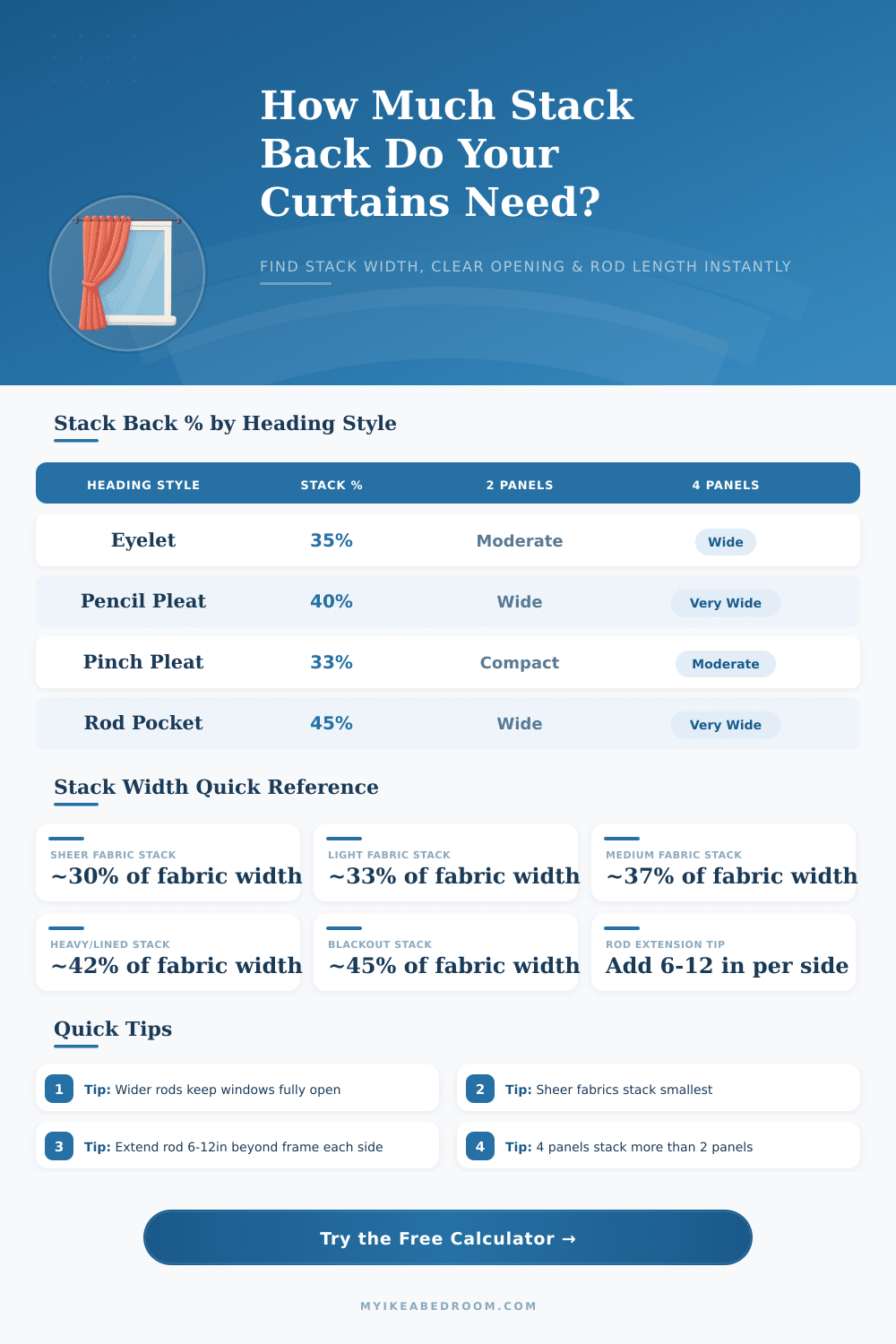
| Fabric Weight | Stack Multiplier | Total Stack (in) | Total Stack (cm) |
|---|---|---|---|
| Sheer | 0.30 | 30 in | 76 cm |
| Light (cotton/voile) | 0.33 | 33 in | 84 cm |
| Medium (linen/poly) | 0.37 | 37 in | 94 cm |
| Heavy / Lined | 0.42 | 42 in | 107 cm |
| Blackout / Thermal | 0.45 | 45 in | 114 cm |
| Rod Length (in) | Total Stack (in) | Clear Opening (in) | Good For Window |
|---|---|---|---|
| 72 in | 26.6 in | 45.4 in | ~36 in window |
| 84 in | 31.1 in | 52.9 in | ~48 in window |
| 96 in | 35.5 in | 60.5 in | ~60 in window |
| 108 in | 40.0 in | 68.0 in | ~72 in window |
| 120 in | 44.4 in | 75.6 in | ~84 in window |
| Heading Style | Stack % | Stack Depth | Best For |
|---|---|---|---|
| Eyelet / Grommet | 35% | Moderate | Modern, casual looks |
| Pencil Pleat | 40% | Wide | Traditional, full look |
| Pinch Pleat | 33% | Compact | Formal, tailored finish |
| Tab Top | 38% | Moderate-wide | Casual, decorative |
| Rod Pocket | 45% | Widest | Stationary / decorative panels |
Curtain stack back is the space that the curtains take on the sides of the window when they are fully open. Basically, it is the width of the fabric when it is “stacked back” to the furthest spot that the rod allows This is very important when you design or install window treatments because it affects the general look of the room.
You can improve the view and the light when the curtains are fully drawn to the sides. The secret lies in the stack back. If you want to entirely show the window and enjoy the view, the fabric must be well installed.
What Is Curtain Stack Back
To reach that airy and lightweight look, the glass must be entirely free. If you minimze the width of the stack back, the curtains will sit aside and barely touch the window or the sliding doors.
The stack back of curtains depends on the amount of space that they take when you draw them open. You can count that yourself or use helpful calculators on the net. For instance, if the window is 48 inches wide and you use 6 equal parts, that gives 8 inches for the rod on each side.
If the curtain is made up of only one panel that goes to one side, you divide the width by 3 to find the needed space.
Three main factors affect the measures: the face of the rod, the returns and the overlap when the curtains are closed. A fourth part happens when you try to clear a door. That is called stack-back allowance.
Do the curtains need to be practical or stationary? That determines how much space is required on each side for the total width of the rod.
The best solution is that the stack back sits mostly on the wall, so that only the edge covers the window. If you hang the curtains high and wide, you do not lose a lot of natural light. The fabric will cover maybe only two inches on every side; that suffices to hide the edge of the window, so that it looks bigger than it truly is.
Eyelet curtains take the least space when you push them open. Next are the double pinch pleat. Pleated curtains commonly splay out when they are stacked back, so you can use tie-backs.
A lot also depends on the fabric. The stack back changes based on the material, the lining, the interlining, the headings and even according to how different people pull the curtains. A general rule is to allow space that is a third more than the width of the window.
Some windows, for instance those with French return style rods installed side by side, have no place for stack back. That means a lot of the window stays covered even when the curtains are open. IKEA panel curtains can be stacked on their tracks for more flexibility, which is useful for sliding setups.