Curtain Rod Extension Beyond Window Calculator
Calculate how far your curtain rod should extend past the window frame, including stack-back, bracket inset, finial clearance, and wall limits.
Curtain Rod Extension Results
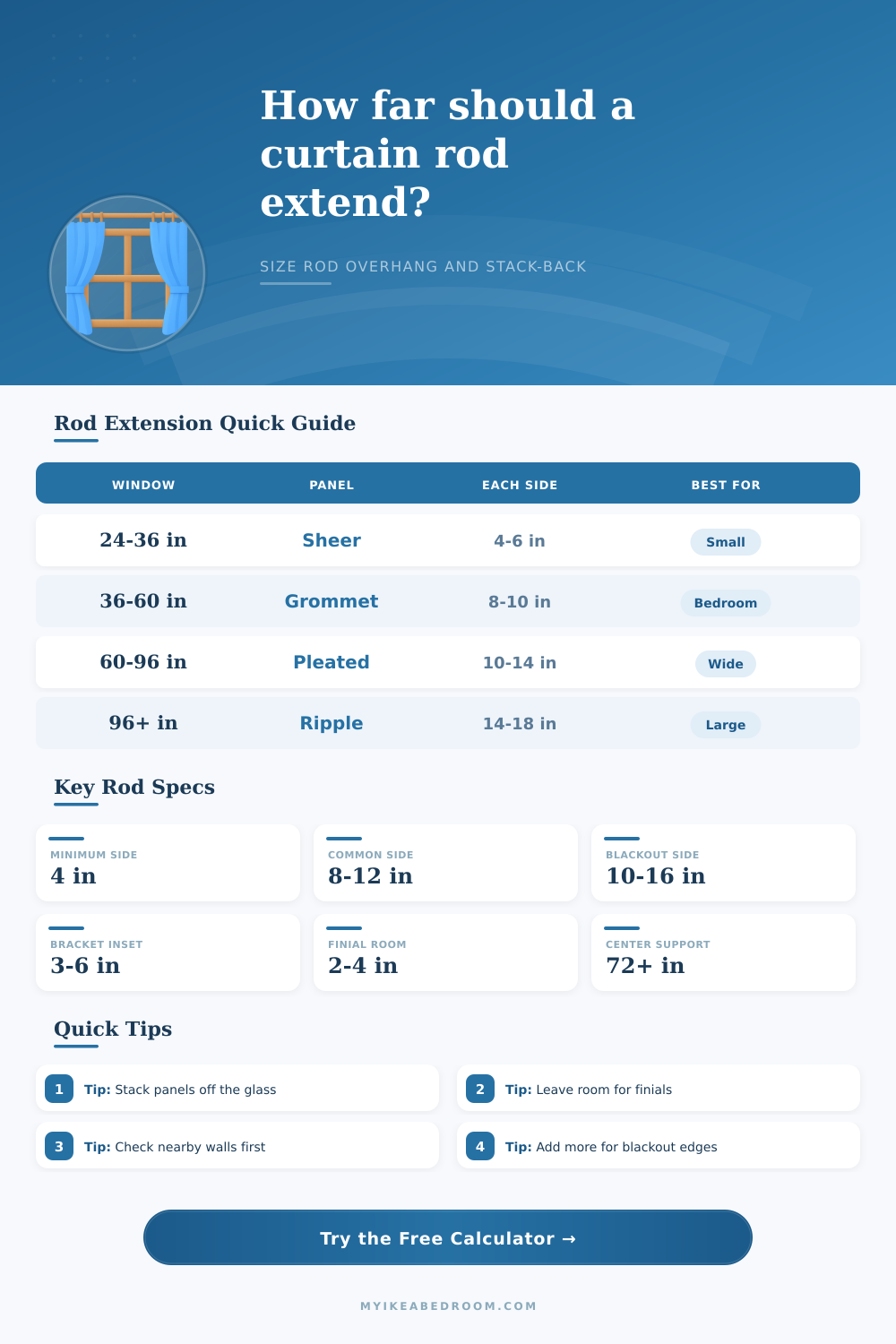
| Window Width | Light Panels | Standard Drapes | Blackout Drapes |
|---|---|---|---|
| 24 to 36 in | 4 to 6 in each side | 6 to 8 in each side | 8 to 10 in each side |
| 37 to 60 in | 6 to 8 in each side | 8 to 12 in each side | 10 to 14 in each side |
| 61 to 96 in | 8 to 12 in each side | 10 to 14 in each side | 12 to 18 in each side |
| 97 to 144 in | 12 to 16 in each side | 14 to 20 in each side | 18 to 24 in each side |
| Total Rod Span | End Bracket Inset | Center Support | Placement Note |
|---|---|---|---|
| Up to 48 in | 3 to 4 in from rod end | Usually none | Keep brackets outside trim |
| 49 to 72 in | 4 to 5 in from rod end | Optional for heavy fabric | Check rod stiffness |
| 73 to 120 in | 4 to 6 in from rod end | Recommended | Place support at center line |
| Over 120 in | 5 to 7 in from rod end | Required or split rod | Use two support points if needed |
| Heading Style | Stack Factor | Best Extension Goal | Common Use |
|---|---|---|---|
| Light sheer panels | 0.14 of panel width | 4 to 8 in | Soft daylight filtering |
| Grommet or eyelet | 0.18 of panel width | 8 to 12 in | Bedroom and living room |
| Back tab or rod pocket | 0.22 of panel width | 8 to 14 in | Full fabric face |
| Pinch pleat on rings | 0.24 of panel width | 10 to 16 in | Tailored drapery |
| Ripple fold track | 0.28 of panel width | 12 to 20 in | Wide modern spans |
| Scenario | Window Width | Suggested Extension | Rod Span |
|---|---|---|---|
| Small bedroom window | 36 in | 6 to 8 in each side | 48 to 52 in |
| Standard bedroom pair | 60 in | 9 to 12 in each side | 78 to 84 in |
| Nursery blackout window | 42 in | 10 to 14 in each side | 62 to 70 in |
| Patio or slider opening | 96 in | 14 to 18 in each side | 124 to 132 in |
The placement of an curtain rod is important because the placement of the rod will determine how the window display when the curtains are open or closed. If the rod are too short, the curtains will crowd the window when the curtains are open. If the rod is too long, the rod will take up too much wall space.
The goal of the rod is to allow the curtains to moving and to block the light from the window as needed. The extension is the amount of rod that stick out past the window frame. The extension is important to determine where the fabric will rest on the curtain rod.
How to Measure and Place a Curtain Rod
The extension is also where the bracket and finials will be placed on the rod. If the curtain feature a bulky heading, such as pinch pleats, the fabric will take up more space on the wall when opened. If the fabric has a light heading, such as grommets, it will compress more closely to the rod.
Therefore, a light heading will require a smaller extension than one with a bulky heading. One of the factors that must be considered is the amount of wall space available. The length of the rod is limited by the amount of available spaces on the wall.
For example, if there is a door frame or other piece of furniture in the space, there is a limit to how far out from the window the rod can extend. In this case, the user will have to shorten the length of the rod so that the finials will not extend into the door frame or furniture. The calculator consider the width of the window and the amount of available wall space to calculate the extension needed.
The calculator will also use the type of heading and fullness of the fabric to calculate the extension needed. The coverage goal that is selected will also impact the extension needed. If the desired goal is to view the daylight through the window, the extension will be more shorter.
If the goal is to block all light from the window, such as for sleeping area or media rooms, the extension will be longer. If a return is to be added to the rod, the extension will be lengthened to allow the fabric to return toward the window frame. The calculator will also indicate if a center support is need for the rod.
Long curtain rods may sag in the middle without support. The location of the brackets is linked to the extension of the rod. The brackets must be placed far enough from the end of the rod to account for the placement of the finials on the rod.
The brackets should be placed on a solid wall, not on the window trim. When the extension of the rod is correctly calculated, the brackets will sit outside of the window frame. If the calculations indicate that the brackets will come within the corner of the window frame, the extension will have to be shortened or the finials will have to be smaller in size.
The heading style can also impact the extension needed for the rod. If the heading features rod-pocket panels it will compress in a different way than if the heading were grommets. Each type of heading will require a certain extension to allow for the panels to open as the curtains are opened.
The heading styles can be changed in the calculator to reflect the impact that each heading will have on the extension needed for the rod. The fullness of the fabric is also a factor in the extension of the rod. High fullness means that there is alot of fabric relative to the length of the rod.
If there is more fabric on the rod, the thickness of the fabric will extend the extension of the rod further out from the window. If there is not enough space on the wall for such an extension, the fullness of the fabric will have to be reduced. Many times, people make mistake when determining the extension of the rod.
For example, many people measure the length of the windows and add a certain amount of inches to each side of the window. This is a mistake because it does not account for the available wall space or the type of heading that the curtains will have. Other mistakes include forgetting that the finials will add to the length of the rod.
If the finials do not account for the length of the rod, the rod will be too short to properly support the curtains. The type of room that is to be adorned with the curtains is another variable that can impact the extension of the rod. For instance, a nursery may require both a large extension and a return to block all of the light from the window.
Office spaces, in contrast, may require the curtains to be less than a return in length so that the office uses sheer curtains to allow the light into the office. Finally, a patio door will have a different extension based off the number of curtains and the coverage goal for that specific area. These factors can be accounted for in the curtain rod calculator.
If the extension is correctly calculated, the curtains will display in a way that is intentional and the installation of the curtains will be successful. The curtains will be able to clear the glass, the brackets will be on the wall, and there will be enough space for the finials. By testing the extension, the return depth and the heading style of the curtains prior to purchasing the hardware, time and money will be save.
Youll find that if you follow these steps, the result will be more better than if you rushed the process. It could of been a big mistake to ignore the rod’s length.