Curtain Ring Quantity Calculator
Estimate ring count, pack rounding, panel spacing, spare rings, and rod coverage for clip rings or eyelet-free drapery panels.
🏠Real Curtain Presets
📏Curtain Ring Inputs
🧷Ring Style Comparison
Clip Rings
Fast to attach and easy to adjust; use closer spacing on sheer or light fabric to avoid sagging between clips.
Sewn Rings
Best for consistent folds on lined panels; count stays close to clip-ring math but placement is less forgiving.
Pin Hooks
Useful with pleated headers; ring count usually follows pleat count plus end and return control points.
Bypass Rings
Helpful on rods with center supports; add a small spare allowance because special rings are not interchangeable.
📊Quick Ring Benchmarks
📐Spacing Reference Table
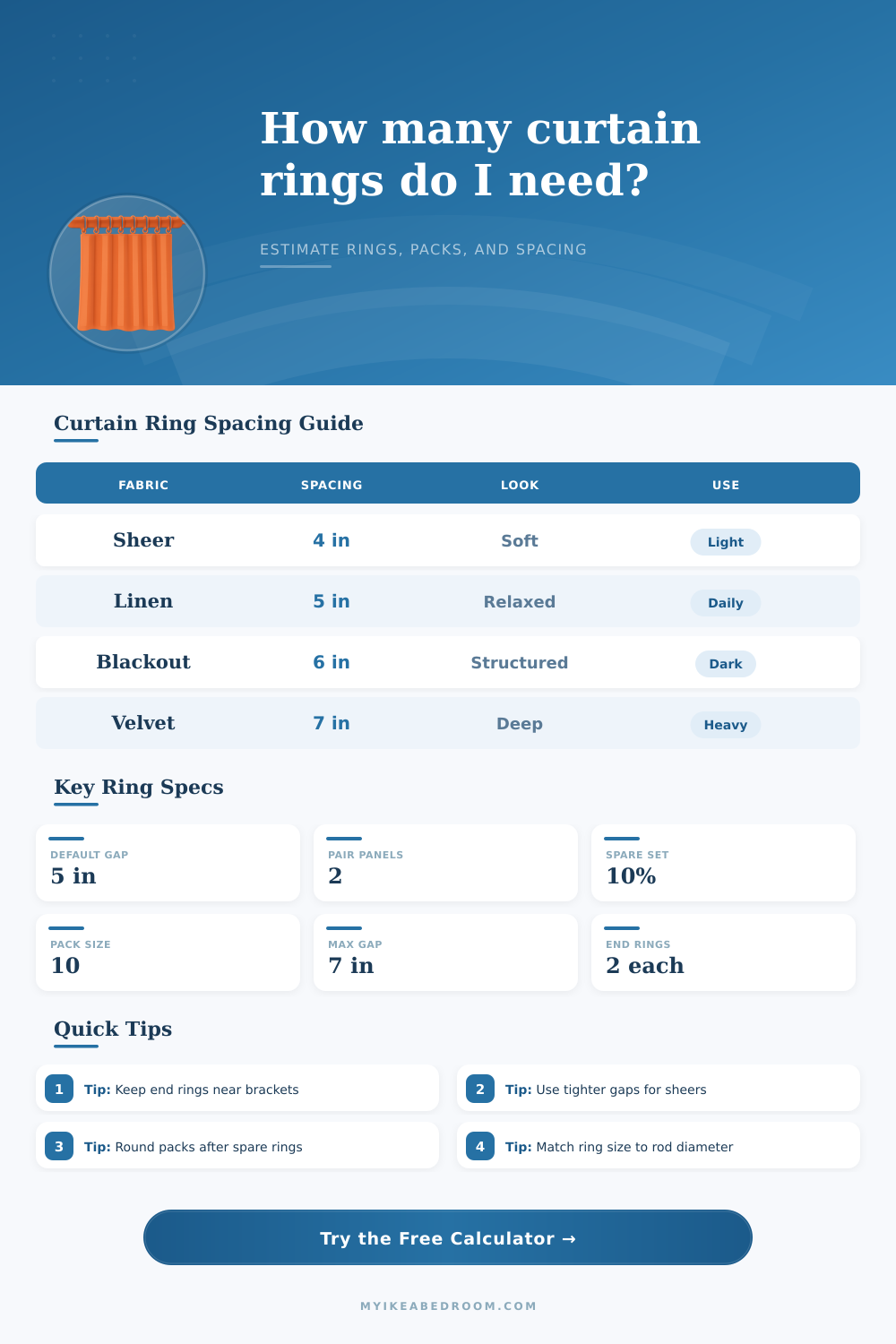
| Panel Type | Suggested Gap | Best Ring Style | Quantity Note |
|---|---|---|---|
| Sheer voile | 3.5 to 4.5 in | Small clip rings | More rings reduce soft sagging |
| Cotton blend | 4.5 to 5.5 in | Clip or sewn rings | Good everyday bedroom spacing |
| Linen-look panel | 5 to 6 in | Clip rings | Balances relaxed folds and movement |
| Blackout panel | 5.5 to 6.5 in | Sturdy clip or hook rings | Use enough rings to support lining weight |
| Velvet drape | 6 to 7 in | Large ring with hook | Wide folds need strong, smooth rings |
🖼Common Window Setups
| Setup | Rod Span | Panels | Typical Rings |
|---|---|---|---|
| Small bedroom window | 48 in | 2 x 42 in | 20 to 24 rings |
| Standard bedroom pair | 72 in | 2 x 50 in | 24 to 28 rings |
| Wide living room | 96 in | 4 x 50 in | 44 to 52 rings |
| Patio door | 100 in | 2 x 54 in | 26 to 32 rings |
| Room divider | 144 in | 4 x 57 in | 52 to 60 rings |
📦Pack Rounding Table
| Raw Ring Count | 8-Pack Result | 10-Pack Result | 12-Pack Result |
|---|---|---|---|
| 18 to 20 rings | 3 packs | 2 packs | 2 packs |
| 24 to 28 rings | 4 packs | 3 packs | 3 packs |
| 32 to 36 rings | 5 packs | 4 packs | 3 packs |
| 44 to 48 rings | 6 packs | 5 packs | 4 packs |
| 52 to 60 rings | 8 packs | 6 packs | 5 packs |
⚖Fullness And Ring Count Guide
| Fullness | Visual Result | Ring Impact | Best Room Use |
|---|---|---|---|
| 1.3x | Simple, flatter panel | Fewer visible folds | Closet covers and cafe curtains |
| 1.5x | Balanced soft folds | Reliable everyday count | Bedroom and home office windows |
| 1.8x | Fuller bedroom look | More rings across wider fabric | Blackout and privacy panels |
| 2.0x | Classic drapery fullness | Higher count with deep folds | Living rooms and patio doors |
| 2.5x | Dense decorative folds | Check rod load and ring glide | Formal drapes and room dividers |
💡Practical Ring Notes
Determining the correct number of curtain ring is a necessary step in the installation of window treatment curtains. The number of curtain rings that you use for a particular curtain will determine both the way in which the fabric hang from the rod, as well as the way in which the fabric is able to move from one side of the window treatment to the other. If there is too few curtain rings for the length of the rod, the fabric will sag between the rings and will create an unevens appearance for the curtains.
Too many curtain rings, however, will make the fabric too stiff to naturaly drape from the rod. Thus, each of the necessary factor for determining the number of curtain rings that should of be used for a curtain panel can be considered. The first of these factors is the length of the curtain rod that must be measured.
How to Find the Right Number of Curtain Rings
The length of the rod will indicate the distance that the curtain panel must cover when they are closed. The panels will gather at the center of the curtain rod, however, which will change the length of the header for the curtain panels. Thus, you will need to account for the length of the rod in the calculation of the number of curtain rings that will be need for the panel to hang properly from the rod.
The weight of the fabric will influence the spacing between the curtain ring. Lightweight sheer curtains will require more closely spaced curtain rings than heavy fabrics like velvet or blackout curtains. Thus, the weight of the curtain will impact the determination of the number of curtain rings.
The fullness of the curtain panels is another factor that will impact the number of curtain rings that is needed. Fullness is the ratio of the width of the curtain panels to the width of the rod. For instance, using a 1.5-times fullness ratio will create gather in the panels that are appropriate for a bedroom curtain, but using a 2-times fullness ratio will create deeper gathers that are appropriate for a living room curtain.
Thus, fullness will impact the number of curtain rings needed, as increasing the fullness of the curtains will also increase the width of the header for the panels, which will lead to an increased number of curtain rings. In addition to consider each of the factors discussed above, it is also necessary to include end rings for the curtains and allowances for the panels to overlap. The installer will install end rings closest to the brackets on the rod, and they are used to anchor the edge of the curtain panels.
Allowances for the panels to overlap at the center of the curtain rod also increase the length of the header for the panels. Thus, allowances for the panels to overlap will increase the number of curtain rings that is needed for those panels. It is also common and practical to include a ten percent allowance for the curtain rings that are to be purchase.
An allowance of ten-percent of the total number of curtain rings will provide extra curtain rings in the case that one of the rings is lost or damage during installation. Additionally, an extra ten percent will provide for the circumstance in which any of the curtain panels may need to be replace at a later date. Such an allowance is included in the calculation for the number of curtain rings, which is also rounded to the nearest package of curtain rings that are generally sold.
Different heading style will change the way in which the curtain rings are to be used. Clip rings allow for adjustment in the spacing between the rings after the installation of the curtains. Rings that are sewn to the curtains, however, will prevent any change to the spacing between the rings.
Pin hooks are used with pleated headers, while bypass rings are used when there is a support for the curtains on the rod. Thus, while the type of heading change the way in which the curtains are installed, the calculations for the number of curtain rings that will be needed is independent of the heading style. Once the curtain panels are hung on the rod, the distance between the curtain rings may not be exact as calculated.
The panels will gather at the center of the rod. If the gap between the curtain rings is too tight once the panels are hung on the rod, it is possible to remove one of the ring. Should the fabric begin to sag between the rings, however, it is possible to add another ring to the rod.
Thus, while the curtain ring calculation provide the number of curtain rings that are needed, it is also possible that more adjustments will be made to the number of rings once the curtain panels are install on the rod.