Curtain Return Depth Calculator
Estimate how far curtains should return to the wall from bracket projection, fabric bulk, heading style, trim projection, and light-control goals.
🏠Return depth presets
📏Hardware and fabric inputs
Curtain return depth result
🧵Return depth spec grid
🔍Hardware comparison grid
📊Return depth reference tables
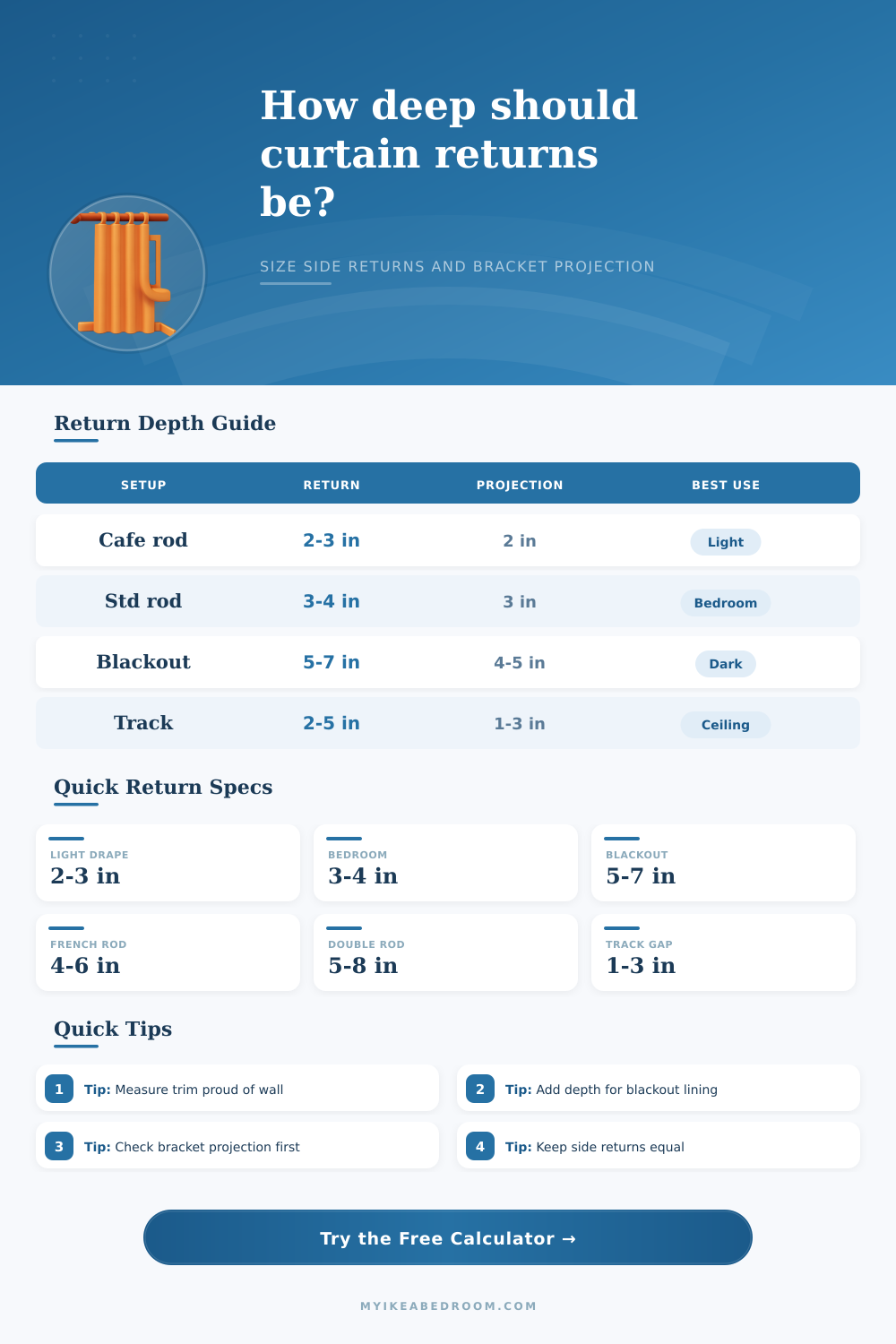
| Light-control goal | Typical return | Target side gap | Planning note |
|---|---|---|---|
| Decorative side cover | 2 to 3 in | 1.5 to 2 in | Enough for visual wrap without a darkening target |
| Bedroom privacy | 3 to 4 in | 0.75 to 1 in | Works for lined panels on common brackets |
| Room darkening | 4 to 5.5 in | 0.5 to 0.75 in | Use deeper brackets or side hooks |
| Blackout side wrap | 5 to 7 in | 0.25 to 0.5 in | Best with return rods, tracks, or side pins |
| Nursery sleep darkening | 6 to 8 in | 0 to 0.5 in | Allow extra fabric bulk at the wall |
| Heading style | Return behavior | Depth add-on | Best return method |
|---|---|---|---|
| Rod pocket | Fabric sits close to rod | 0.25 in | Fabric wrap or cafe rod |
| Grommet or eyelet | Large waves need side room | 0.75 in | Standard bracket return |
| Back tab | Soft folds compress moderately | 0.50 in | Rod bracket or side hook |
| Ring clip or hook | Rings project in front of fabric | 0.85 in | Deeper wall bracket |
| Pinch pleat | Tailored stack at leading edge | 1.00 in | French rod or return hook |
| Ripple fold or wave | Carrier spacing sets wave depth | 1.15 in | Track return carrier |
| Fabric weight | Compressed thickness | Bulk factor | Return cue |
|---|---|---|---|
| Sheer or voile | 0.10 to 0.20 in | Low | Small returns can still close neatly |
| Light cotton or linen-look | 0.15 to 0.30 in | Low-medium | Use a modest side allowance |
| Medium lined drape | 0.25 to 0.50 in | Medium | Standard bedroom depth usually works |
| Blackout or thermal lining | 0.40 to 0.70 in | High | Plan a deeper wall return |
| Heavy velvet or dense weave | 0.55 to 0.90 in | Very high | Check stack and return together |
| Drape plus sheer layer | 0.50 to 0.85 in | Layered | Double rods need more projection |
| Window scenario | Common hardware | Return depth | Side treatment |
|---|---|---|---|
| Small bedroom window | Standard rod | 3.5 to 4.5 in | Equal side brackets |
| Wide blackout window | French return rod | 5.5 to 7 in | Fabric returns to wall |
| Sliding balcony door | Ceiling track | 3 to 5 in | Return carrier at side |
| Layered sheer and drape | Double rod | 5.5 to 8 in | Front panel covers rear gap |
| Bay window side leg | Angled track or rod | 2.5 to 5 in | Match return to shallowest side |
| Inside recess window | Recess track | 1.5 to 3 in | Confirm handle clearance |
💡Return depth tips
Return depth is measured from the wall toward the curtain line. The calculator estimates finished side return depth and fabric allowance; verify unusual brackets, angled bays, or recessed hardware with the exact hardware drawing.
Return depths is the distance between the window wall and the edge of the curtain panels. Return depth is vital in determine whether the panel will block the light from the window or allow it to enter through the gap created at the side of the window by the curtain panel. Many peoples assume that the fabric of the curtain is responsible for the light gaps at the side of the window.
However, the insufficient return depth create the gap between the side of the window and the curtain panel. By calculating the return depth correct, people can ensure that the curtain panel will reach the wall. The calculation of the return depth begin with the measurement of the hardware that is attached to the wall.
How to Measure Curtain Return Depth
The wall bracket is the hardware that hold the curtain rod. The distance between the wall and the wall bracket is the first measurement that should be taken. Additionally, the thickness of the trim or the handle of the window may act as an obstruction for the curtain panel.
The curtain panel should be allowed enough spaces to clear the trim of the window handle. If people dont account for the thickness of the trim when calculating the return depth, the curtain panel may not reach the side of the wall and may lead to a light gap. The thickness of the curtain panel’s fabric is another factor to consider when calculating the return depth.
As a curtain panel consist of the fabric, lining, and heading, a heavier curtain will have more volume than a thin curtain panel. Therefore, the return depth must account for the thickness of the fabric. If the return depth is insufficient for the thickness of the curtain panels fabric, it may push the curtain panel away from the wall.
The third factor that people must consider when calculating the return depth is the type of light control they want the curtain to exhibit. For instance, people use sheer curtains to filter the light entering a room while blackout curtains are used to keep the room dark during sleep hours. The return depth for blackout curtains must be deeper than sheer curtains because it must block all the light from entering the side of the window.
Therefore, if the people want darkness in the room, the return depth must be deep enough to allow the curtain panel to meet the wall completely. Another factor that may affect the return depth of the curtains is the heading style of the curtain. Curtain heading styles include rod-pocket and pinch-pleat headings.
As the name suggests, a rod-pocket heading allows the fabric of the curtain to directly slide onto the rod while the pinch-pleat heading gathers the fabric into fold. The volume that a pinch-pleat heading adds to the curtain panel requires a deeper return depth. In changing the heading style of the curtain, people will have to change the return depth calculation to ensure the curtain does not prevent the curtain panel from reach the wall.
The condition of the wall may impact the return depth of the curtain panel. As curtains are meant to meet the wall, people can have a flat wall that the curtain can reach. However, a corner or a radiator in the wall can act as an obstruction for the curtain panel.
In such cases, the return depth must be deeper to allow the curtain panel to clear the obstruction on the wall. People must take time to measure the wall to ensure that the return depth calculation account for the conditions of the wall. The calculator provide three specific pieces of information when calculating the return depth of the curtain panel.
The first is the finished return depth required for the side of the curtain. The projection check will tell the person if the current wall bracket is sufficient or if a deeper bracket is required. Additionally, the fabric allowance tells the person how much fabric they need for the side hem of the curtain so that it can reach the wall.
These three pieces of information ensures that the curtain will function as intended. People often make a mistake when calculating the return depth of the curtain by choosing a wall bracket before calculating the return depth. By choosing the wall bracket first, people may find that their current wall bracket is too shallow for the return depth requirement of the curtain.
By using the calculator and entering in all the measurement at once, people can avoid this mistake. Additionally, the variables in the curtain return depth calculator can be adjusted to see the impact on return depth of altering the thickness of the curtain or the heading style. Another factor to consider is the symmetry of the curtains in the room.
People may want the return depth to be even on both the left and right side of the window. If one side of the window has a corner while the other side of the window does not have a corner, the return depths may not be equal on both sides. The calculator allows people to choose between equal returns and custom returns to allow them to account for the actual condition of the window.
Before calculating the return depth of the curtain, people must look at the actual window in the room. Curtains’ return depth calculator cannot view the feature of the window such as the window sills, air vents, or the layers of trim on the window. With the accurate measurements of the window, the return depth calculator can provide people with the correct return depth measurement.
By calculating the return depth of the curtain, people want to ensure that the curtain panel will close the gap on the side of the window to prevent light from entering the room. By ensuring that the return depth measurement is equal to the hardware and the fabric of the curtain panel, the curtain will reach the wall and the light gap will be eliminated.