Curtain Return Clearance Calculator
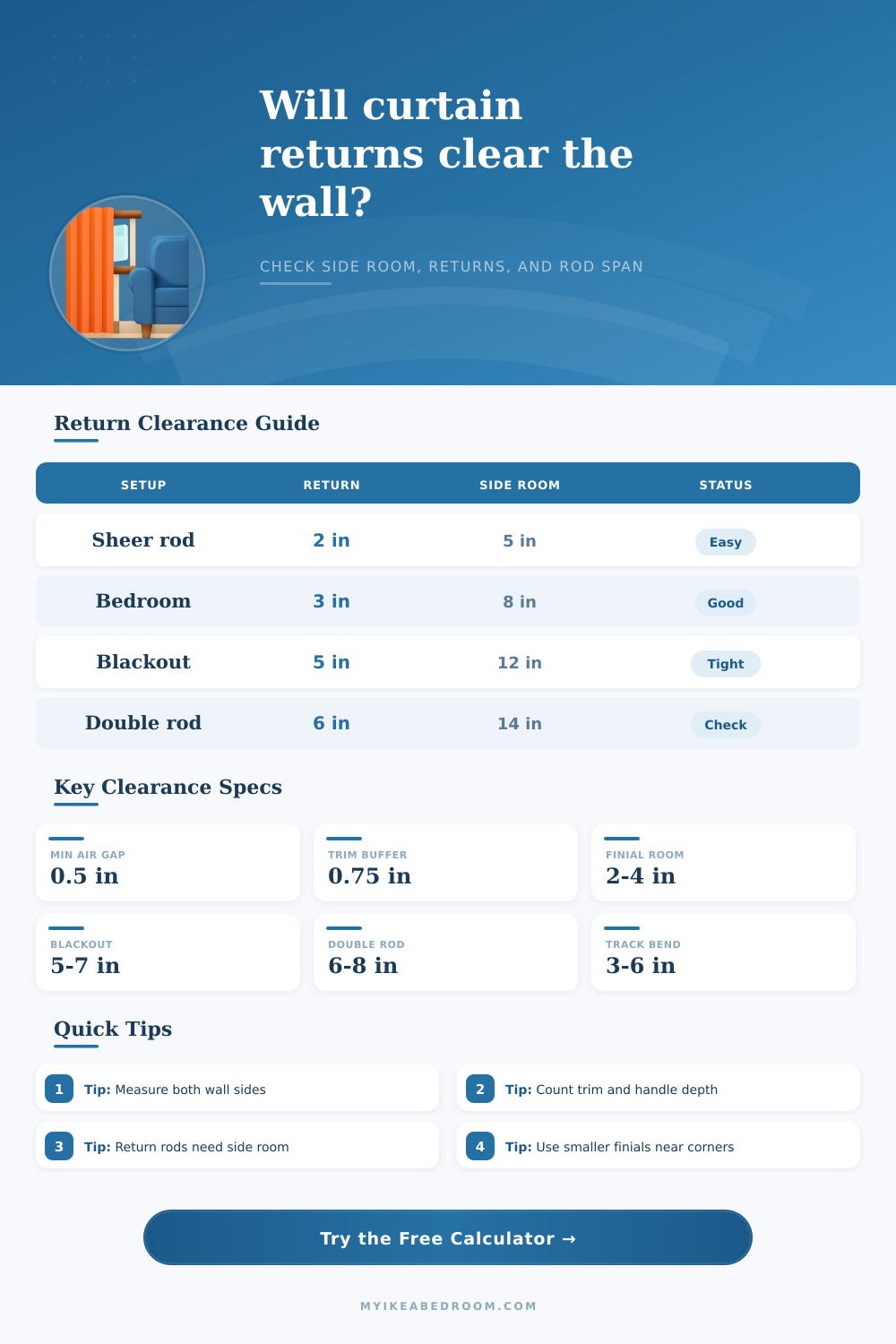
Check whether your rod, track, finials, brackets, fabric stack, and side returns fit beside the window before you mark the wall.
Return clearance results
| Curtain style | Typical return | Best clearance use | Watch point |
|---|---|---|---|
| Sheer, voile, or cafe curtain | 1.5-3 in | Soft privacy with light filtering | Small returns are fine when no blackout edge control is needed. |
| Unlined cotton or linen panel | 2.5-4 in | Bedroom or living room decorative side cover | Let rings or clips swing without touching trim. |
| Standard lined drape | 3.5-5 in | Better side coverage with moderate fabric weight | Projection often matters more than fabric thickness. |
| Blackout lined panel | 5-7 in | Reducing side light leaks beside the window | Deep returns need more usable side wall. |
| Thermal or interlined drape | 6-8 in | Heavy fabric with deeper folds and more stack bulk | Check bracket strength and the wall anchor layout. |
| Ripplefold or wave track | 3-6 in | Track bends or wall returns with smooth fold spacing | Track bend radius can control the minimum return. |
| Hardware style | Projection range | Side clearance effect | Best fit note |
|---|---|---|---|
| Standard decorative rod with finials | 3-5 in | Add stack room plus finial room at the ends | Works best when both sides have generous wall space. |
| French return rod | 3.5-6 in | Uses return depth but often no finial allowance | Strong choice for tight corners and blackout returns. |
| Ceiling track with bend | 1-3 in below ceiling line | Needs bend radius rather than a projecting finial | Good for closets, alcoves, and full-wall treatments. |
| Double rod | 5-7 in | Outer rod projection adds return and wall-depth demand | Check that the inner sheer can move independently. |
| Inside mount or tension rod | Inside opening | Side return is limited by jamb depth | Best when trim side room is nearly zero. |
| Corner or bay connector | Varies by connector | Clearance is controlled by the shortest leg | Measure each leg separately before matching returns. |
| Obstacle near return | Typical depth | Add to return check | Why it matters |
|---|---|---|---|
| Flat painted trim | 0.25-0.5 in | 0.5 in | Fabric can brush the trim if the bracket is shallow. |
| Thick casing or rosette block | 0.75-1.25 in | 1-1.5 in | Return fabric needs to clear the proud edge. |
| Roller shade or blind headrail | 1.5-3 in | 2-3.5 in | Layered treatments need enough front projection. |
| Window crank or handle | 1-2.5 in | 1.5-3 in | Handles can catch lining when panels are closed. |
| Wall sconce or shelf nearby | Project-specific | Use measured depth | Side stack may collide before the return reaches the wall. |
Tight side wall
Use end caps, a French return rod, or a ceiling track when one side has less than the stack plus return requirement.
Blackout priority
Favor deeper returns and matched side clearances so both curtain edges wrap evenly toward the wall.
Layered curtains
Double rods need outer projection clearance, inner movement clearance, and enough side room for two fabric stacks.
| Window setup | Opening width | Return target | Side room to plan |
|---|---|---|---|
| Small nursery window with light-filtering panels | 36 in | 2.5-3.5 in | 5-7 in each side |
| Standard bedroom with lined curtains | 48-60 in | 3.5-5 in | 8-12 in each side |
| Blackout bedroom with decorative rod | 60-72 in | 5-7 in | 12-16 in each side |
| Patio door with wide stack-back | 72-96 in | 4-6 in | 14-22 in each side |
| Ceiling track across full wall | 96-144 in | 3-6 in bend | Depends on track curve |
First they drill their holes, then they do the math. That’s why most curtain rods appears to be hugging the window trim and forcing the fabric into an odd wad against the wall. It happens in living rooms, in bedrooms, and in sunrooms where the goal is to feel light and airy, not trapped.
It isn’t usually the type of rod or curtain that creates problem. It’s typically because someone failed to consider depth of the space between the closest obstacle and the hardware.
Why Curtains Need More Space Than You Think
You simply input the dimensions of your windows (width and side wall) and the Return Clearance Calculator does all of the calculations for you. No more guessing about how far out the decorative finials extend and whether they collide with casing. It makes you think through everything that takes up horizontal space. Enter the depth of the fabric stack, the projection of the brackets, the obstruction of any trim, and even amount of side space. And then it reports back, telling you if there is sufficient room for the curtain to swing freely without colliding with another roller shade headrail or scraping along the paint.
Here’s how it works: Homeowners assume the window dimension they’re looking at is the width, which is true. However, they don’t realize that curtains are not flat objects. When gathered, they require a lot of depth. Blackout drapes with interlined linings can be twice as wide than sheer panels when gathered. To account for this, the calculator includes a stack factor depending on your type of curtain. For example, a typical lined drape may require three to four inches of return depth, whereas thermal insulation panels requires six or more. Without accounting for such depth, the curtain will lean out away from the glass instead of wrapping around the side. Additionally, the rod will be installed too close to the wall.
Another frequent issue with window treatments are bracket projection. Ever purchase that perfect brass rod, only to find the arms protrude five inches from the wall? If you have a window crank handle (or even a deep wooden casing), that five inches makes all the difference, since there’s nowhere for the fabric to stack up. To compensate, the tool compares the depth of your brackets’ reach to the depth of whatever is blocking them, whether it’s a wooden casing or a plastic handle. Then it figures how much air space must exist so the hooks and rings can slide freely without scraping the plastic or wood. Half an inch may not seem like much but it’s often enough to make the curtains glide smoothly versus snag and grind loudly each time you pull them across.
But what if you have some tight spots in corners, with not much room on either side? One option is French return rods. Instead of having that fabric hanging out loose they turn it around and tuck it back into the wall. You get that nice clean finish against the wall, shutting out any light leak, but don’t have to take up huge amounts of horizontal space. The tool will pick up on this style of hardware and update its demands for you. For example, it may be able to tolerate less finical clearance at the end but require tighter tolerances for depth so that whatever bend radius your return rod has can fit snugly behind your trim.
But then double rods add a whole new set of complications. Using two fabric treatments on top of each other means you need clearance for the outer rod and movement clearance for the inner sheer. You also need side room for two separate stacks instead of just one. Those layers overlap at the end, it’s very easy to not realize how much width gets eaten up! So the tool lets you visualize whether or not your side wall will accommodate both of them without one being squished up against the other.
You should of checked those measurements twice! It can be actualy difficult to calculate all this based off just looking at it. Making sure everything is moddern and fits correctly is a luxurius feeling.